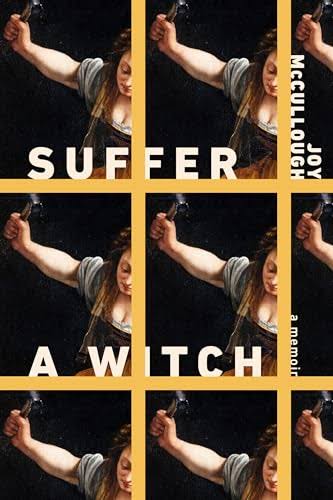
Book: Suffer A Witch
Author: Joy McCullough
Publisher: Dutton Books
Year: 2026
Rating: 4.5 out of 5 stars
Synopsis : “Joy McCullough’s earliest memories are of time spent in church, moments when she climbed the steps to recite from the pulpit, just like her preacher father. But when she was a teenager in San Diego in the 1990s, her connection to her family and church were forever altered when a youth pastor groomed and sexually assaulted Joy.
In her debut memoir, McCullough recalls both her abuse and its ongoing aftermath as she seeks healing and justice in a country that rewards men for sexual abuse and still insists “girls these days will say anything.”
Review : I would be remiss if I didn’t make it clear from the start that Suffer A Witch discusses sexual assault and on-going abuse of a minor, discussions of an eating disorder, abuse of power, religious domination, and police proceedings involving pressed charges as well as broad disbelief of women’s testimony and abuse within the church, past and present.
Suffer A Witch has come to me in the most unlikely of circumstances as I have no memory of requesting this advanced copy. Just two days before cracking the spine, I sat listening to Switchfoot’s new release, Darkness, for the first time, feeling waves of grief crashing through my body as I heard the words :
“In a prearranged marriage
The youth pastor from my parish
Pledged to marry the 10th grade girl from down the street
Strange way to start a song
Even stranger to belong
To that same youth group when I was just fifteen“
McCullough, a pastor’s kid, or PK, in the 1990s at a Presbyterian church in San Diego, was sure she would grow up to become a pastor herself one day. Through verse narration and alternating essays on women witches through history and across the globe, she paints a picture of what so many women who grew up in the church know deeply in their marrow: That we are not, and will never be, safe among men in power. Suffer A Witch hit me like a punch right in the gut, as I also grew up in a Presbyterian church in the 1990s in the clutches of purity culture and male figures hell bent on keeping those who do the most harm safe from any form of justice. I read, enraptured by the truth telling McCullough was able to stomach, and felt the sick churning in my stomach knowing that had things gone even slightly differently, her experience could have been mine, too. Knowing, further, that her experience mirrors that of an incalculable number of other women and children in the church for what has now been thousands of years. The gross reality is that what has been shared in this work is not unique, that the words McCullough has cut from her own flesh is only an echo of what so many have struggled with from time immemorial.
McCullough, as though reading my own life story, has chosen a painting by the Italian Baroque painter Artemisia Gentileschi for the cover of her memoir; a painter whose image emblazoned a shirt I once owned that said “Artemisia AF”, purchased sometime in the last ten years in response to a particular president’s sexually graphic depictions of women and a particular supreme court justice’s rape allegations that went without any moral repercussions. If you haven’t been introduced to the feminist icon Artemisia, I highly recommend seeking her story out, though you will certainly be introduced to her through McCullough’s evocative description of the story – a woman raped and abused, whose father only pressed charges against the offender out of offense that his property, Artemisia, had been damaged. McCullough threads the needle of her story with short essays dedicated to shedding a light and sharing the importance of a number of accused witches throughout history, and pulls tightly to bind us together in a shared space of injustice and raging iniquity. If you weren’t mad before, you most certainly will be after reading this incendiary work. You should be feeling the flames of rage licking at your feet.
While not everything flows perfectly, McCullough has brought her unwavering perspective to the narrative and done what so many women know is the nearly impossible task of clearly stating her abuse, delving the emotional depth that comes with reliving her most harrowing traumas, and presenting the long-term, historical, and outrageous neglect of women and children at the hands of the church . Suffer A Witch made me so full of fury it’s almost hard to put into words. It is my story in so many ways, my own abuse while not at the hands of the church, wielded by a man who came from the church, who snuck into communities that refused to protect the most vulnerable, and who continues to exist in those spaces to this day with no repercussion. The church I grew up in was so deeply entrenched within the purity culture of the 90s that it felt almost unrecognizable compared to McCullough’s experience, and yet my teenage years were marked by dress codes meant to keep the men of the church from straying because the temptation was too strong, while children were offered no further protection beyond the incessant quest to cover our shoulders, legs, and midriffs. “What was she wearing?” may as well be the anthem of my youth group experience.
McCullough’s experiences are a funhouse mirror of my own, the experiences she had as a teenager while attempting to navigate the current of abuse and danger she experienced at the hands of every adult in her orbit, so relatable and understood by my own; the incredulity, the feelings of being unworthy, the shame, and the fear are all so palpable in my own life that I felt like I was having a conversation I could barely manage to have. Much of what McCullough details of her inner world are indeed exactly what I’ve worked so long to navigate in therapy as an adult. Suffer A Witch feels like a kindred spirit in the most soul-crushing and gut-twisting sense. I don’t wish McCullough’s experience on anyone, but I do wish this book into the lives of the women who grew up in the church, who weren’t protected, whose stories haven’t been believed, those who have deconstructed, who watched their former youth leaders date their former students while being gainfully employed by the church that sees no harm in the abuse of power, and those who have had their own stories to tell who have felt incapable of doing so on their own. This book is for us.
McCullough tells her story and no more, the fine line tightrope we survivors of abuse know intimately, as the laws are changing and our own stories are often not even safe for the sharing anymore (see Marilyn Manson, see Johnny Depp, see Donald Trump). She does make mention of her father, the pastor of her church who was ousted for his own infidelity and abuse – of power, of women – and while she doesn’t mention him by name, she does offer enough information for me to track down his own memoir and see that it sells for nearly $200. Endorsed by Desmund Tutu and with 4.2 stars on Amazon. Remarkable, indeed that a man’s story of redemption despite being an abuser can garner such words of praise from so many. I hope for us all that a woman’s story of truth and abuse at the hands of men in power can do the same. But I, too, know better than that. In my bones. In my marrow.
I hope you give this a read in spite of the difficulty of the content. These are the wounds we do best not to look away from. This is how we heal. By screaming the truth and keening and grieving and never letting it happen to another person again.
Advice : If you are okay with the content warnings, I cannot recommend this book highly enough. This is for those of us who have deconstructed, who have found Mary Magdalene and Artemisia and Sue Monk Kidd and Chanel Miller, who have spent hours in therapy dissecting feelings of worth, and who have ripped the old skin from our bodies in order to become something new. This is for the PKs, the Bible College dropouts, the silenced, and the loudmouths. It’s a quick read, not an easy read, but a good read. If you don’t want to find yourself galvanized, angry, or overwhelmed, this may not be for you. But if you’re ready, if you feel the rage licking at your feet, if you want to hear a voice giving words to that which you have felt unable to speak, this is very much, emphatically for you.

