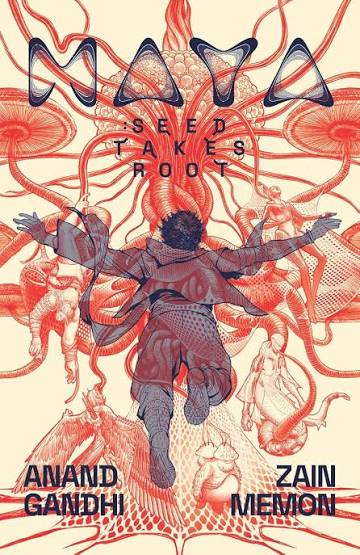
Book: Maya: Seed Takes Root
Author: Anand Gandhi & Zain Memon
Publisher: Author’s Equity
Year: 2026
Rating: 5 out of 5 stars
Synopsis : “The Divya Trials have been announced. Billions will compete. One will ascend to godhood. In every future predicted by the Maya network, the outcome is certain: the son of a god will win. Kshar disagrees. He has rehearsed the scion’s assassination a hundred times in Maya’s simulations. In seventeen minutes, a single fruit will begin a cascade that ends in a riot. The plan is perfect. Every move predicted. Every breath choreographed. Except one. Yachay. Nineteen years old. Maker of riddles. His grandfather has staked their lives on his winning the Trials. But Yacht seeks what he has been kept away from. Maya. He doesn’t know: When you gaze into Maya, Maya gazes back.”
Review : Maya: Seed Takes Root is the first in a projected trilogy whose universe has already published a table-top game. From the creators of VR, movies, shows, and board games, it is hardly surprising to find a fully formed universe complete enough to encapsulate not just books but games as well. Maya is an epic tale of adventure and exploration on a grand scale and a deep dive into the intricacies and minutiae of the delicate web of life on a tiny, microscopic scale. And while Maya is undeniably sci-fi, it offers the reader a chance to examine life on Earth through a microscope.
We’re told in the introduction that while some of the words may be familiar to us, we should allow the similarities to fade away and become something new, but it’s nearly impossible to separate the idea of Maya in the book from the Indian concept of Maya, or illusion. Within the world of the book, Maya is, in physical form, a network of sacred trees that nearly every creature within the world of Neh can tether to. Once tethered into Maya, they interact with the world but from a theoretical level, rather than a literal interaction in the so-called real world. Hundreds of years and thousands of probabilities may be lived out and tested within Maya in the span of a single evening. In this way, they may advance civilization at a rate much higher than would have previously been imaginable – or so they are led to believe. In this way, Maya of the book is truly Maya of our own current reality; nothing more than a precious illusion. How much of an illusion Maya may be, however, remains to be seen, at least by a select few who live their entire lives without tethering to Maya, an illegal habit that those in power cannot abide by.
In the world of Neh, a select few citizens over the centuries have been given rise to godhood through something known as the Divya Trials. Upon achievement of such status, they are not only granted the ability to perceive the future through Maya, they are also privy to a life-extending elixir known as panchamrit. It is through this godhood status that the first gleams of our own reality begin to take shape; a society controlled by the few wealthy elite, making choices for those they deem less intelligent, less fortunate than themselves, doling out tiny morsels with one hand while robbing the proletariat blind with the other.
In a world where a K-shaped economy looms large, seemingly never-ending global crises persist, the media is owned by a handful of billionaires with their own preferred politicians in pocket, and social media algorithms latch onto whatever rage-fueled nonsense might be trending (perhaps due in part to the aforementioned billionaires), it’s hard to read Maya and not see the immediate connections. And while Maya is a depth exploration of our own poisoned norm, it is also an exploration into ecology and connection and the ways in which our choices, lives, and fellow non-human citizens of Earth tread this existence together.
Maya is a delicious, complex, and infuriating dive into human entanglement as told through the lens of a nineteen year old boy named Yachay. While the narrative jumps back and forth between species and characters, the through line remains with Yachay, highlighting the importance of a boy who may have never experienced tethering to Maya, who just may be primed to see through the illusions entire lifetimes of Neh have been unable to wrap their minds around while subtly being maneuvered by Maya and the Divyas who nudge Neh through their tethering to it. Maya introduces an idea familiar to many of us, that when seemingly infinitesimal choices are made, they cause ripple effects that radiate out into society; that even the slightest wingbeat might change the course of history. That something as slight as remaining above the fray of illusion might create the invention necessary for real change to occur for those beyond the elite few who would rather cling to their own immortality than truly improve upon life as we know it.
Maya is thoroughly science fiction and as such it introduces the reader to an entirely new world with new languages, new species, and new ways of experiencing life. It is at times a tricky read, with so many unique species to keep track of, so many words to store in the mind. And while there is a glossary in the back (that I found myself referring to repeatedly), it can still be a bit of a challenge to keep up with at times. I didn’t even realize there was a glossary in the back until about a quart of the way through the book, so it’s worth going into it knowing that you do have assistance, even if you have to go looking for it. I would have been pretty frustrated if I’d gotten to the end of the book to discover the tools I wished existed had been there all along. Nonetheless, it’s a beautiful feeling to have your brain stretched a bit and Maya most certainly does just that. Every intricacy introduced has a purpose and every purpose has a greater connection within the web of Neh. This is not a light or easy read but it is excellent.
Advice : A few content warnings first; theoretical murder, riots, speciesism / racism, the death of a loved one, political instability, poverty, and oppression all make their way throughout Maya. If you enjoy science fiction, political commentary, or seeing a possible way forward for our future, I think you’re going to love this book! If you enjoy Indian mythology, have a background in Ayurveda or yoga or have any familiarity with Sanskrit words and phrases, I think you’ll find connections here that are hard to look away from. If you love an epic tale, an exciting journey, and a world that unveils itself slowly over time; if you don’t mind being a bit confused at times as the details are slowly revealed you, I cannot recommend this book highly enough.
I do want to let you know that this does not wrap up neatly and it is very much the first book of several. The second appears to be underway.