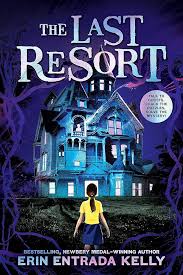
Book: The Last Resort Author: Erin Entrada Kelly Publisher: Scholastic Press Year: 2025 Rating: 4 out of 5 stars
Synopsis : “Just before her Grandpa Clem’s funeral, twelve-year-old Lila makes a shocking discovery. He didn’t die of natural causes – he was murdered. Possibly by someone who wanted to control his inn…and its secret portal to the afterlife. Now, a girl who’s vowed to become “less dramatic” must uncover her grandpa’s killer AND stop the ghosts desperate to make it back to our world.”
Review :The Last Resort is a super fun and enjoyable mid-grade read (grades 3-7) about the power of friendship, family, and finding places where you can be yourself. Lila, a twelve year old whose so-called best friends have described as “too much” and “overly dramatic” and, worst of all, “immature”, is ready for summer vacation so she can work on being as calm as a rock, as cool as ice, and as mature as her two besties think they are as they all head toward seventh grade next year. Her friends have stopped hanging out with her and have begun to hang out without her, she doesn’t have much time to regain their friendships. So when a relative she’s never met, Grandpa Clem, passes away unexpectedly and her family decides to travel out of state for his funeral, Lila is distraught. With the backdrop of frenemies / bullies who find Lila to be too much, we delve into Grandpa Clem’s world of ghosts, crystals, and portals to the world beyond the veil – a less than perfect scenario for a pre-teen who’s trying to be a lot less.
I thoroughly enjoyed this book, it was cute and fun and had some twists and turns that, while I saw coming, didn’t fully take shape until they’d arrived. It doesn’t talk down to the reader or assume the reader’s too young to understand new concepts and it presents unknowns and uncertainties in a way that makes it a true learning experience. I’m always pleased to find a middle grade read that doesn’t feel incredibly dumbed down for a kid to read and The Last Resort really held up. It did include some scary imagery, so I think this might be a proceed with caution book if you or your reader are a bit antsy when it comes to large spiders, the idea of death, or ghostly apparitions – but all in all I found it to be a safe and spooky walk on the paranormal side, perfect for fall! In the finished copy of the book, there will be ghostly illustrations who will come to life on the page via a QR code, which is such a fun addition to an already ghostly book, I think it’ll help bring the book to life in a way that’ll keep the reader thinking about it for a while.
While at Grandpa Clem’s inn, Lila meets a neighbor who’s her age, a boy named Teddy. It’s through Teddy’s friendship that Lila finds her place with someone who doesn’t view her as too much, who lets her be exactly who she is, and who doesn’t dismiss her as being an overly dramatic person. It’s an important lesson without being preachy, that bullies have no place in our lives, and that shrinking ourselves down to fit into the box of other people’s expectations makes us a shell of ourselves. In a world where even adults struggle with this concept, and even the concept of not being bullies to other adults, I found this messaging to be a refreshing change of pace from what we see day-to-day. Ultimately, Lila’s friendships are the cornerstone for this book, not the ghosts!
Finally, I gave this book 4 stars rather than 5 because I felt the ending was too abrupt and lacked the closure I wanted from it. It didn’t need to be drawn out or even significantly longer than it already is, but it would have benefitted from a little more than it received. I think the door was left open for further books down the road, and I’m not ashamed to tell you that this adult will absolutely be reading whatever Kelly comes up with next if she decides to continue this book into a series!
Advice : If you have enjoyed any iterations of Disney’s Haunted Mansion (including the ride), I think you’d enjoy The Last Resort! As advised above, if you or your reader have any squeamishness around spiders, near death experiences, dogs, crows, the threat of death, or ghosts, this might be one you approach cautiously. I think it’s the perfect amount of spooky and calm – a great way to dip the toes into a paranormal subject without diving in head first and scaring the bajeesus out of yourself.
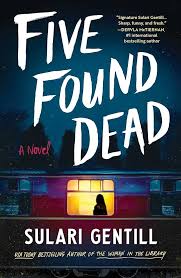
Book: Five Found Dead Author: Sulari Gentill Publisher: Sourcebooks Year: 2025 Rating: 3.5 out of 5 stars
Synopsis : “Crime fiction author Joe Penvale has won the most brutal battle of his life. Now that he has finished his intense medical treatment, he and his twin sister, Meredith, are boarding the glorious Orient Express in Paris, hoping for some much-needed rest and rejuvenation. Meredith also hopes that the literary ghosts on the train will nudge Joe’s muse awake and he’ll be inspired to write again. And he is; after their first eventing spent getting to know some of their fellow travelers, Joe pulls out his laptop and opens a new document. Seems like this trip is just what the doctor ordered… And then some. The next morning, Joe and Meredith are shocked to witness that the cabin net door has become a crime scene, bathed in blood but with no body in sight. The pari soon find themselves caught up in an Agathy Cirstie-esque murder investigation. Without any help from the authorities and with the victim still not found, Joe and Meredith are asked to join a group of fellow passengers with law enforcement backgrounds to look into the mysterious disappearance of the man in Cabin 16G. But when the steward guarding the crime scene is murdered, it marks the beginning of a killing spree that leaves five found dead – and one still missing. Now Joe and Meredith must fight once again to preserve their newfound future and to catch a cunning killer before they reach the end of the line.”
Review : It takes a certain level of gumption to write a new take on a famously done murder mystery, possibly none as more culturally known as Murder on the Orient Express, and while I enjoyed much of Five Found Dead, it simply did not live up to Agatha Christie’s famous work. Gentill, to her credit, does much work to lay a foundation wherein her novel would not simply be a retelling, but a fairly meta mystery involving an author, a couple podcasters, and a whole host of law enforcement attempting to sold a crime all while existing within a world in which Murder on the Orient Express might cloud ones perspective of such an incident. It is from this perspective that the entirety of the book ultimately begins to unravel – there are far too many characters, at least a few of whom we rarely interact with; far too much extraneous story-telling happening, some of which does seem to be an attempt at red herring; and far too many details to make this a succinct murder mystery, or really anything that might ever stand up to Christie’s work. And while I think it might be a bit unfair to compare Five Found Dead with Murder on the Orient Express, it’s also exactly what one asks to be done when writing a book about a murder (nay, murders) upon the very Orient Express Christie herself wrote about.
Joe Penvale, a famous murder mystery writer, has undergone an intense period of cancer treatment and upon finding himself in remission, has taken himself and his sister on the trip of a lifetime : a train ride on the famous Orient Express. Gentill managed to set a perfectly cozy scene aboard the train, and after reading her acknowledgments I can clearly understand why, for she herself endured medical treatments and a ride upon the Orient Express. Her understanding of what sets a cozy scene does feel perfectly in line with what I’d like in a murder mystery, even what I’d like within a locked door mystery, but beyond this scene setting, I found the gross majority of the book to be a conundrum. To begin, while Joe and Meredith are twin siblings with a shared family trauma, I found their relationship to be odd and uncomfortable at times. I’m not sure if they were mirrored after a family relationship Gentill has or if they were simply conjured out of thin air, but I did not find believability within their world in the least. If we can look past the strangeness of their written relationship, we find ourselves enmeshed within a world where Covid still has a grip – I was unable to determine during what time frame this story was set and we are given no clues beyond the fact that Covid is still creating new variants. Is there a new variant ravaging the world? Perhaps this was set a few years ago? Or even 2020? It’s unclear and the answer is never given. ***Any further reading will reveal SPOILERS AHEAD*** There is an entire subplot in which we find several passengers have tested positive for a new and deadly variant, a small detour I believe Christie would have used in her own writing, but nonetheless, without more details I found it to be added confusion in a story that is already more confusing than I necessarily agree with.
Upon awakening after their first night aboard the train, Joe and Meredith find that the man in the cabin next to theirs has been murdered or has at least gone missing. What follows is a strange and chaotic 24-48 hours whereby multiple passengers test positive for Covid, five people are murdered, and at we discover that at least seven of the passengers aboard are members of varying international police forces. We encounter so many needless characters that it quickly begins to feel superfluous and needlessly confusing – I suspect in part at least to mimic Christie’s work, but it simply doesn’t play out in a way that lends any ease to the reader. There are so many side trails and intentional red herrings that by the time we do finally unmask our criminal(s) it feels strange, tangled, and frustrating (which, to my mind, is the exact opposite of what you want from a murder mystery reveal). I will say, I was able to determine fairly easily who the man in the cabin next to the Penvale’s actually was, though this does not mean I was able to determine who the killer was. I warned you, here be spoilers. While I won’t reveal the exact nature of the crimes and perpetrators, I will tell you that in the end, it was anticlimactic and disappointing to find the truth. Not to mention, the final chapter reveals an entire podcast episode whereby Gentill undoes much of the convoluted work she’d laid out for us, creating further confusion and disappointment in the ending. I did not find myself pleased with the end result.
Gentill has managed to create a cozy atmosphere aboard the Orient Express, allowing the reader to feel, truly, as if they were on board themselves. Beyond that, however, I found the work to be needlessly convoluted and had to return to past pages to reread sections that didn’t make much sense. It wasn’t exactly what I was hoping for. The ending left much to be desired, the second ending even more so, and with a cast of characters limited to those aboard a train, I suspect many readers will be able to sniff out at least one of our criminal elements prior to the “big reveal”. To her credit, Gentill, unlike Christie, has given the reader enough breadcrumbs to figure things out on their own (for the most part) and, even if I didn’t agree with how it all turned out, I do enjoy that aspect of things. All in all, it was fine, I felt cozy, but it wasn’t deeply satisfying or even tremendously challenging. Take that how you will.
Advice : You may find this to be a worthwhile and perhaps even enjoyable read if you love the genre and consume anything you can within it. However, I suspect you will be comparing it to Christie’s works along the way and in that respect, you may not enjoy it at all. It’s 50/50 – maybe check it out from the library before committing to buying. Happy sleuthing!
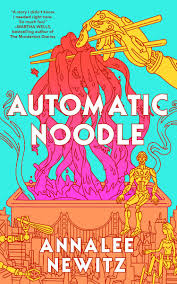
Book: Automatic Noodle Author: Annalee Newitz Publisher: Tor Publishing Group Year: 2025 Rating: 4 out of 5 stars
Synopsis : “You don’t have to eat food to know the way to a city’s heart is through its stomach. So when a group of deactivated robots comes back online in an abandoned ghost kitchen, they decide to make their own way doing what they know : making food – the tastiest hand-pulled noodles around – for the humans of San Francisco, who are recovering from a devastating war. But when their robot-run business starts causing a stir, a targeted wave of one-star reviews threatens to boil over into a crisis. To keep their doors open, they’ll have to call on their customers, their community, and each other – and find a way to survive and thrive in a world that wasn’t built for them.”
Review :Automatic Noodle is a sweet, quick, low-stakes read that I managed to get through in under a day. Weighing in at just 160 pages (in ARC form), when I tell you this is a quick read, I mean it; while Automatic Noodle tells one small story quickly, it isn’t without substance or a deeper meaning. Newitz has done what I have found happening with regularity these days, they’ve disguised within their robot novel a story with a greater meaning, taking a group of othered people and mirroring them to our current world, perhaps not in a perfectly seemless manner, but with dedication that pays off.
In a world where robots have been granted some, albeit small, level of rights (particularly if they’re of a sentient class of robot) following a brutal war between California and the rest of the United States, we enter this novel to find that the sentient robots don’t have much in the way of rights after all. Living either slaved or indentured to corporations or woken to find they’ve been created by a debt that’s strapped not to who created them but to the robot themselves, most sentient robots have little to no choice about the life they must live. They may also find themselves the subjects of hate speech, disgust, cancel culture, and worse due to the nature of their capitalistic society that created a thing to do a job that a human would otherwise have been hired to do. I’ll admit, it was hard for me to wrap my mind around the first layer of this novel, which is, at face value, robotphobia, given the horrific misuse and abuse of generative AI in our current world; destroying the planet, replacing jobs, and demolishing our creative abilities all in one fell trendy swoop. It feels as though Automatic Noodle might be a look through time at ourselves if we don’t get behind human beings pretty immediately. And that’s where our second layer comes in.
Automatic Noodle is a clever mask for a narrative driven by the gross inequities people of all creeds and backgrounds face even in 2025, particularly our queer, trans, neuro-spicy, and non-white friends. Empathy is the thread Newitz binds this story together with, putting the reader into the shoes of sentient robots who just want to live and thrive in a world where others are so able to live and thrive within. In a world where they are outcast and othered simply for being exactly who they are, they find a way to engage with each other, with their community, and to find their own personhood in the midst of everything. Without needing to ask their community for assistance, it’s freely given to them because in Newitz’ world, empathy exists in the majority of people and for those who seem incapable of seeing a person as a person, they appear to be the minority, enraged and bated by targeted online attacks from those with outdated ideas of what might make a country great. Uncanny, huh?
If you want to know how a society is functioning, simply look to the sci-fi and fantasy world to tell you. It’s no coincidence that the last two books I’ve read in this realm have emphasized the concept of empathy. In a world where we forget that people are people and our humanity makes us inherently more alike than different, it’s no surprise to find stories that allude to the hate and vitriol that’s being spewed with more and more vehemence and frequency. Automatic Noodle does an excellent job of relating a futuristic scenario to our present-day troubles, all while cultivating a narrative of joy, peace, friendship, and community despite and because of our differences. Love is a greater force than fear and hate and we see it time and time again in sweet novels such as this. And while I didn’t find the flow of robotic narration my favorite to follow (in fact, I enjoyed Newitz’ writing the best in their letter to the reader), Automatic Noodle is a book I’ll be recommending to friends in the future. It’s a joyous journey into the world of savory noodles, found family, and community support despite raging phobias and hate over a group of people who are simply trying to live their lives in peace. We are all deserving of a peaceful, joy-filled life. Full stop.
Advice : If you’re looking for a quick, cozy read in the vein of A Psalm for the Wild Built, I think you’ll really love Automatic Noodle. If you enjoy a reclamation story, found family, or how food gets made, this is definitely for you!
Book: The Salt Grows Heavy Author: Cassandra Khaw Publisher: Nightfire – Tor Publishing Group Year: 2023 Rating: 4 out of 5 stars
Synopsis: “Certain stories are recounted so many times that they becomes parched of meaning. Others, however, are kept from wine-warmed conversations, catalogued but rarely recited. Complicated stories with no easy ending, stories that remind us karmic debt is a contrivance of despair, that there is nothing fear or sweet about this world. This is one of those stories.”
Review: I almost didn’t write this review. I read the book, I was enthralled, I was mesmerized, I was horrified, and then I was disappointed. I put The Salt Grows Heavy down, fully intending to walk away from it without reviewing it, but something about it kept pulling me back. I had to review it. I had to give it the space to be seen. Be forewarned, this one is odd; perhaps in the best possible ways, perhaps in the worst.
Khaw, in her letter to the reader, explains that TSGH was birthed from the question “what would happen if Ariel laid eggs?” and that’s possibly all you need to know before diving into this one. It’s short, a quick read, but it delves into themes of body horror, bodily autonomy, and existential dread. This novella is graphic, pointed, and poetic. I stopped short of giving it five full stars because of the disappointment I felt over the ending, but we’ll get into that. It is masterfully written with Khaw driving the plot forward, never mincing words, never adding detail that didn’t serve a purpose, all the while turning a disney fairytale into a twisted brothers Grimm tale.
The Salt Grows Heavy begins with a mermaid-eque creature leaving the kingdom she calls home, though it is notably not her home, after her clutch of daughters hatch from their eggs, eat the king, and subsequently eat the entire kingdom (sparing a precious few). Unable to speak because of an injury incurred by the Prince, as many Grimm and folktales go, we find the protagonist-mermaid leaving the kingdom with the Prince’s plague doctor, one of the only remaining survivors of the hatchling’s apocalypse, uncertain of where she’s headed. As they leave together, they burn the entire kingdom to ash, the plague doctor remarking “What’s the point of revenge if you can’t enjoy it?”.
Spoilers Ahead
As the unlikely pair leaves together, they get no further than a strange, cobbled together village of wildlings, children who systematically and routinely kill each other for sport, only to be rebuilt and recreated by their saints – a trio of physicians who have mastered the art of bringing creatures back from the dead…seemingly. The mermaid and the plague doctor are both horrified, though we come to learn that this horror stems from two distinct places. From the mermaid, she seeks to prove the physicians wrong; having had her own tongue cut out of her mouth by the Prince, her teeth removed, and her sisters slain, she feels a sense of purpose amongst these “saints” and the children they seek to rebuild over and over again. However, the plague doctor, who until this point has never removed his mask, experiences horror for other reasons entirely. As they and the mermaid grow closer, we are offered a glimpse behind the mask only to find that the entirety of the plague doctor’s body has been stitched back together, unable to die, unable to discern any form of gender, a blending of hundreds of parts. In fact, they were the saint’s first project.
The Plague doctor begs the mermaid to allow them to stay behind, to bring wrath upon the saints, and to free the children from their menacing grasp. As this is not a long book, these events happen quickly and before long the mermaid and the plague doctor are discovered by the saints, tracked and attempted to be killed. We come to realize that the mermaid is much heartier than the mermaids of Walt Disney’s imagination and can regenerate nearly at will. The plague doctor, because of their many differing parts, is almost unable to be killed, but they are, after all, still human. As the plague doctor reaches the end of their life, they once more beg the mermaid to allow them to die – to attain the one thing the saints have kept from them for a completely unknown number of years, iterations, and science projects that have kept them alive and uncertain of who they are.
The mermaid allows the plague doctor to die, she kills the saints, and then in epilogue, she resurrects the plague doctor because she’s in love with them. And this. THIS is where I take issue. In a book that is entirely about bodily autonomy, how these creatures have had zero say over their bodies and minds for lifetimes, Khaw chooses to posit that love is more important. She distorts the message of the book, completely does away with the autonomy of the plague doctor, a character who has been (pun not intended) plagued by rebirths and regenerations for so many lifetimes that they cease to understand who they are at all, for the sake of love. I think Khaw misses the mark when it comes to the execution of this book. In her letter to the reader she says, “It’s my love letter to the people who can’t and won’t give up. Who love the end of days. Who love like it is the end of days, and there’s nothing left to lose. It’s my nod to love that comes when you’ve given up, when you’ve concluded that’s it, there’s nothing left.” Personally, I don’t find this book to meet that thesis at all. I think Khaw has written a masterful book full of hard hitting and timely messages, and she throws it all away at the end for the sake of selfish love that cannot allow someone the autonomy to choose to die.
Advice: If you’re looking for a body horror book, this is it. If you like something to move at a quick pace, not take too many pages, and still hit hard, this is it! If, however, you cannot help but analyze a book, see where it went wrong, and find frustration over it, I suspect you’ll find, like I did, that this is not it. If you don’t enjoy gore or graphic violence, this will probably be one you’ll want to skip.
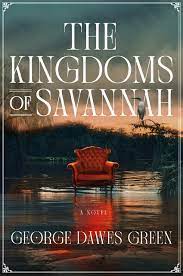
Book: The Kingdoms of Savannah Author: George Dawes Green Publisher: Celadon Books Year: 2022 Rating: 3.5 out of 5 stars
Synopsis: “Savannah may appear to be ‘some town out of a fable,’ with its vine flowers, turreted mansions, and ghost tours that romanticize the city’s history. But look deeper and you’ll uncover secrets, past and present, that tell a more sinister tale. It’s the story at the heart of George Dawes Green’s chilling new novel, The Kingdoms of Savannah. It begins quietly on a balmy southern night as some locals gather at Bo Peep’s, one of the town’s favorite watering holes. Within an hour, however, a man will be murdered and his companion will be “disappeared.” An unlikely detective, Morgana Musgrove, doyenne of Savannah society, is called upon to unravel the mystery of these crimes. Morgana is an imperious, demanding, and conniving woman, whose four grown children are weary of her schemes. But one by one she inveigles them into helping with her investigation, and soon the family uncovers some terrifying truths – truths that will rock Savannah’s power structure to its core. Moving from the homeless encampments that rings the city to the stately homes of Savannah’s elite, Green’s novel brilliantly depicts the underbelly of a city with a dark history and the strangely mesmerizing dysfunction of a complex family.”
Review: When I received this ARC, I was pleasantly surprised to find a little blurb by one of my favorite authors, Neil Gaiman, that called this book “The apotheosis of Southern Gothic Noir.” Of course this made me want to read it all the more, and what perfect timing it was, arriving just as I finished In the Shadow of Lightning, so I cracked it open right away. I found myself confused and disappointed, though, by the way Kingdoms played out and I feel fairly well baffled trying to explain the complexities that went wrong in this book. I think the only place to start is with the disparities between the synopsis and the actual book, so let’s begin there.
The back cover refers to Morgana Musgrove as an unlikely detective, leading one to believe this will unfold as a murder mystery should: with a detective, with clues unraveling, and with a clear and defined story arc. What actually happens is far from what I’ve described. While Morgana plays a central role in the first third of the book, she falls into the background as other members of her family take center stage. Told from several differing points of view, we’re lead to believe based on the foundation of the book that while we’d jump between a few different family members, we would ultimately come back to Morgana, the backbone of the story. What actually happens is we get a base that the book is built upon and rather than return to Morgana, we find ourselves spending the majority of the book with her granddaughter Jaq. And that would be okay, given that Jaq is and interesting character with a great point of view, but Jaq is conducting her own investigation into aspects of the events that aren’t really the same as what Morgana is looking into.
The second issue I have with the book is the way in which Morgana speaks. Granted, she’s married into old Savannah money but she actually comes from a small town in Georgia; however, she behaves and speaks in a manner that gives away none of her upbringing. We’re given a small glimpse into what her thought process was when she moved to Savannah and began to infiltrate upper society, but her background remains largely unknown other than a small section that mentions she never retained her country twang, assimilating smoothly into a more Savannah way of speaking. On page 16 (the first chapter still!) we get a flashback from her son, Ransom, into just what kind of absurd creature Morgana truly is and I can’t think of a better way to describe the outlandishness than by simply letting you see for yourself: “Then at the front steps he has one more memory. Thirteen years old. Standing out here awaiting the carpool to school and daydreaming, when his mother appeared on the balcony. Although it was a bright sunny morning, she was drunk. Clearly she’d been out partying the night before and hadn’t been to bed yet. She began to disparage him in the third person, one of her favorite pastimes. She said, “While the kid dawdles there like an idiot, gathering wool, concocting his little fantasies about how the world should be, the real world keeps marching on, doesn’t it? Clomp clomp clomp, crushing his little dreams. Does he even notice? No, he’s too stupid. Is he going to be a hobo? Well, yes, that’s certain, unless he gets some ambition and starts kiting checks. Ha ha ha.” I don’t know about you, but that does not a drunk monologue make.
My third problem with the book are the little tidbits thrown into the plot that seem to surely have somewhere to go but fizzle out without so much as another mention. Some spoiler alerts here, so be warned! As the story progresses, we find that one of the central characters is being held hostage in one of several underground tunnels that were used during prohibition era, tunnels that bootleggers would use to store and transport contraband. The character has been spirited away into the tunnels by a cylindrical tube out in the middle of the woods, but we’re told at a few different places in the story that Morgana’s late husband had relatives who made their money as bootleggers back in the day. This is such an important tidbit of information that Dawes Green spends no less than three different instances describing the ominous door in the basement of the Musgrove home that supposedly leads into these very tunnels – in fact there are other homes with similar doors, though the other home’s doors are rumored to be closed up and filled in. I kept waiting for someone to open the door in the Musgrove basement and find their way down into the tunnels, but after it’s mentioned several times it simply…goes away. We don’t hear of it again and it’s never turned into a distinctive plot point. There are several instances of tidbits of interest dissolving into nothing, leaving me feeling confused as to their purpose and frustrated that they were dangled in front of me for nothing.
The last issue I’m going to mention is the fact that Jaq is Black. There are so few descriptors in this book that when I realized Jaq was a member of the Musgrove family, I found myself flipping back and forth trying to determine if I’d entirely misread every aspect of the Musgroves. Were they actually Black too? Was I misunderstanding that they were a white old money family? It took another one, maybe two, chapters before Jaq’s connection and background were unveiled, which was far too long to go without an understanding of who and what I’m reading. I don’t always need extremely detailed descriptions of characters to feel fulfilled and confident reading a character, but the basics are important especially if you’re going to hinge the entire story on Black history in Savannah – another spoiler, perhaps. I left the book having essentially no idea what any of the characters look like, other than knowing that about halfway through the book it’s mentioned that Ransom, Morgana’s son, has a beard. At that point I was so baffled about what he may or may not look like that the beard fully threw me off and I gave up trying to discern anything about it. Turns out I didn’t need to, as he went the way of Morgana, a central figure in the beginning of the novel who fizzled out about halfway through the book.
There are a lot of twists and turns in Kingdoms, twists and turns we aren’t privy to as readers. When Morgana solves the mystery in the end, it’s a confounding aha moment that ends up being quite the let down. We haven’t seen much of Morgana by the time she reveals how she’s solved the mystery and we’re never really given any specifics as to how she was able to unravel the details. As readers, we’re able to see a lot of what’s going on and make our own deductions, but it’s never made clear how in the world Morgana might have come to the conclusions she makes, and that leaves me disappointed; it takes all the punch out of the ending, to be completely honest. On top of which, we spend the entire book reading whispers of a treasure, a hidden treasure somewhere in Savannah, a treasure so important that people are willing to kill for it. It’s built up and built up and built up in such a way that when it’s revealed and we find it’s not exactly what we’d been expecting or hoping to find, the treasure ends up being quite the let down as well. The fact of the matter is that the treasure reveal should have been the most amazing part of the entire story, the treasure (spoiler alert!!!) is not monetary at all, it’s an archeological finding of an entire free Black colony pre-civil war, living on an island in Savannah. What I love about this treasure story is that it’s actually historically accurate though no one has yet been able to find the archeological remains as the particular island they lived on was a secret and has such been lost to time. It’s likely that with time and money and some high tech ground penetrating radar, the remains could be found, and that’s exactly what happens in Kingdoms. The treasure that everyone is willing to die for is simply the rights to develop crappy condos and apartment buildings on a swampy island in the middle of nowhere. It’s…lacking.
At the end of the book, Dawes Green spends 6 total pages explaining some of the historical facts and significance of some of what he’s written about. Those 6 pages were more interesting to me and, in my opinion, more well written than the entire rest of the book, and I think that’s really something. I love all the details provided in Kingdoms, but at the end of the day in order to tell the story he wanted to tell, I think Kingdoms could have been written completely differently and it would have made a much greater impact. I didn’t leave this book continuing to chew over the details or stew about what did or didn’t go down, I finished it and I put it down, and that’s the mark of a book poorly designed. I have to think, surely there’s no way that Neil Gaiman read this book.
Advice: If you like Southern Gothic Noir fiction, I really don’t think this fits the brief other than it’s set in the old south and includes a murder or two. If you like murder mysteries, this might be something you’d be interested in, but realistically it didn’t satisfy this mystery lover. I think it’s worth the read if it’s given to you for free or if you find it on sale somewhere. Otherwise, pick it up in the bookstore, flip to the back and read the 6 pages that mention the historical accuracies included in it – that should lead you down a rabbit hole of books and topics that would be well worth your time.

 Paige Reviews Books