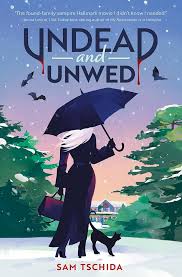
Undead and Unwed Review

Book: Undead and Unwed
Author: Sam Tschida
Publisher: Quirk Books
Year: 2025
Rating: 1.5 out of 5 stars

Synopsis : “Tiffenie may be three hundred years old, but she’s still a hot mess. The vampire is tragically single, works a dead-end job at a blood bank, and spends her nights marathoning Hallmark Channel moves with her cat.
When Tiffenie inherits a fixer-upper home in Valentine, Vermont, thanks to a case of mistaken (okay, stolen!) identity, she seizes the chance to get her life back on track. With her newly undead neighbor (it was an accident!) in tow, Tiffenie is determined to live out her holiday rom-com dreams in this picture-perfect town.
But between the mystery of her stolen identity, small-town drama, and the arrival of her insufferable vampire ex-boyfriend Vlad, getting her happily ever after with a smoking-hot Christmas tree farmer won’t be easy. Tiffenie must embark on a journey of self-acceptance – with the help of a few therapy sessions – for the first time in her immortal life.”

Review : Over the last few years of writing ARC reviews, I believe I’ve only given two other books a star rating lower than 2. I give a truly low review only when it feels absolutely necessary – sparingly, you might even say. While my reviews are always honest and truthful and they may be, at times, scathing, I’m always hesitant to give someone a low rating for something they’ve crafted. It feels deeply embarrassing to me that Undead and Unwed has garnered as high a review as 3.5 stars on GoodReads, which is really all I need to say when I tell you that I do not use or read GoodReads reviews. Having read over 100 advanced reader copies (sorry, only 90 of those have made it here), I can honestly tell you that I have never received an advanced copy as unfinished and unpolished as this book was. It’s not a surprise to find small errors in an advanced copy, some grammatical mistakes, misspellings, an unfinished sentence here or there – it is a surprise to find a book with so many glaring mistakes as Undead and Unwed, and to be completely frank, that’s not even what scored this book 1.5 stars for me. It’s just part of the chaos and nonsense of the entire experience.

This is the first time I’ve wanted to say this : I read Undead and Unwed so you don’t have to. Please. Take my word for it. You don’t have to put yourself through this. The most frustrating aspect of this entire journey through such an incredibly poorly written book and nearly unreadable premise is that I actually liked the initial idea behind the plot. It could have been so much better, it could have been something readable. Execution, however, has failed. We find Tiffenie, a 300 year old vampire, living and working in L.A. at a blood bank – okay, expected, at least to some degree. She’s depressed, doesn’t know how to stand up for herself, and has little will to live beyond caring for her cat, Cat. We learn fairly early on that for a vampire to continue to exist in the world in any kind of feasible manner, they need to take on someone else’s identity in order to rent an apartment or buy a car or work a job – you know, they need a social security number and a real life name. Tiffenie is currently living under the stolen / bought name Tiffany Amanda Blair, an identity she purchased via the “black market” (I’m using quotes here as there’s no real explanation for this and it’s glossed over, so one can really only assume). When she receives a letter in the mail informing her of an inheritance in her namesake’s hometown of Valentine, Vermont, she hops in a hearse (yes, really) and heads out of town. Of course, I’m glossing over a lot of the minutiae here, but this is how things unfold : girl assumes identity, girl receives inheritance meant for the person whose identity she assumed, girl moves to claim the inheritance. Meanwhile, Tiffenie has accidentally drained her neighbor within an inch of her life and is forced to turn her into a vampire and take her on the road to Vermont because…well, just because. There are so many instances where things happen in the book without a good reason, the reader is forced to go along with what’s happening just for funzies because Tschida said so and it makes for poor storytelling.

Evidently, it’s been just ten years since the real Tiffany has moved away from her hometown of Valentine, yet even though Valentine is a tiny, rural town and Tiffany lived there for her entire life as a child and adult, ten years is somehow enough for Tiffenie to show up as a totally different person under the assumed identity of Tiffany and pass for this other person with an entire backstory and history in the town. And no-one blinks an eye. This was the first (of many) glaring issues I took with Undead and Unwed, as an assumed identity does not mean you also look like the person whose identity you stole! We only get a small explanation by way of Tiffenie dying her hair blonde because Tiffany was also a blonde. Yes, you read that correctly. In all other accounts, everyone Tiffenie runs into, be they old flames, friends from high school, or people who knew her family, all really, truly believe that Tiffenie is actually Tiffany. It is as asinine as it sounds. Next, we encounter the trouble with Tiffenie’s bank account – namely, she was dirt poor in L.A., working a job for peanuts, somehow living alone, and yet when she moves to Vermont without a job, she has enough money to start paying thousand dollar fines for living in a condemned building. There’s no explanation for this change in circumstances beyond the inheritance of a condemned property. There hasn’t been some grand windfall, no change in her lifestyle, only that she’s gone from L.A. to Vermont.

If this isn’t enough, Tiffenie is written just as the synopsis describes, as a hot mess. She’s flaky, irresponsible, somehow and for some unknown and never fleshed-out reason, she’s obsessed with not drinking blood, and she has a shopping problem. I don’t love this characterization, but I can get on board with it if it’s how she’s written, unfortunately, Tschida goes back and forth between our modern-day Tiffenie and the Tiffenie of the past who had children, knew how to bake for her family, and lived a real life with big ideas and plans. It’s a stark contrast and the jumping back and forth between these two versions of the self is stilted, as though Tschida threw them in at random without any planning or thought. Further, the conversations are so choppy and robotic, they’re nearly impossible to read. When it comes to story writing, Tschida has landed so far from the mark it’s almost laughable. There are so many instances where someone’s speaking and the only response will be “Yes.” that it became impossible to read with any semblance of seriousness. At one point I actively questioned whether this book was even written or whether it was dictated based on the glaring errors staring back at me from the page. There were multiple instances throughout where the paragraph was re-written but the original was never taken out, so I was presented with multiple directions in which this ARC might go, unsure of which would eventually be chosen for the final copy, and one instance where an entire paragraph was broke up with bullet points. These kinds of errors are not commonplace in an advanced copy, they’re sloppy and lazy and do the author a tremendous disservice – in this instance, Tschida needed all the help she could get and her publishing house did her dirty.

Undead and Unwed is an unreadable mess. I can only hope that by the time it’s actually ready for print it will look dramatically different than it does in it’s advanced copy form, but from my experience this is rarely the case. I suspect this book will be slightly more readable, but I don’t believe it will have improved by much at that point. The concept of a Hallmark Channel-ish story where a vampire moves to Vermont and restores a property, finds a chosen family, and eventually love is actually such a cute idea and I’m actively upset that this book ended up being as poorly written as it was. It needs a significant amount of work, perhaps it would even be worth scrapping the whole thing and starting over, or maybe it would be better to never have started in the first place.

Advice : Don’t. Just, don’t. Don’t fall for the 3.5 GoodReads score. Don’t spend your money. If you really feel drawn to this book, request it at your local library and save your money for something else.
Speedy Reviews

To be honest, I fully intended to give each of these books their own individual reviews, but time got away from me and here we are! Let’s dive in :

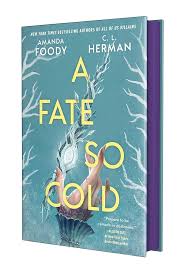
Book: A Fate So Cold
Author: Amanda Foody & C. L. Herman
Publisher: Tor Teen
Year: 2025
Rating: 4 out of 5 stars

Synopsis : “For most of the year, Summer reigns peacefully over Alderland. Then, for six brutal weeks, Winter rages, obliterating towns and wreaking casualties. Magicians bond with powerful wands of Summer to defend the nation, a duty that costs many their lives.
Domenic Barrow never wanted such responsibility – but destiny hasn’t granted him a choice. The greatest Summer wand has awakened for the first time in a century, warning that any icy cataclysm looms on the horizon. And despite his reputation as the last suited of his classmates, the and chooses Domenic to wield it.
Ellery Caldwell spent years striving to be a perfect Summer magician – and burying her fears of her own power. But her worst suspicions are proven true when she accidentally creates the first ever Winter wand.
Now, as the unprecedented Chosen Two, Domenic and Ellery must thwart the oncoming cataclysm together. And in trying to fulfill their destinies, they wonder if they were brought together for a second fate : to fall in love.
Until they discover the unthinkable truth. The Chosen Two aren’t fated allies, but eternal rivals, and the only way to save their home is for one of them to slay the other.”

Review : A Fate So Cold is a quick and enjoyable page-turning ‘chosen one’ fantasy that left me wishing book two would come out already! Told between bouncing perspectives, it guides the reader through the winding world of Summer and Winter – and teases the idea that a peaceful world where Summer reigns for 90% of the year might not actually be the ideal. When our protagonist and budding antagonist are chosen by their wands, we fall headfirst into a sweet and idealistic closed-door romance that feels like just enough personal story in the midst of heart racing suspense. This is certainly no cozy fantasy story, so if a sweaty palm fantasy isn’t for you, you might want to skip this one. I found the story to be unique and enjoyable, though I did find small reminders and little hints toward outside inspiration like the Magicians trilogy, the obvious “Winter is coming” of it all as we might have read (or watched) in Game of Thrones, and the wand ceremony from Harry Potter. And while there were small reminders and hints to outside works, none of them felt like direct replicas or served to remove me from the story. All told, this was a fast paced and fun fantasy read with just enough suspense and just enough of a cliffhanger at the end to leave me ready for the next book.

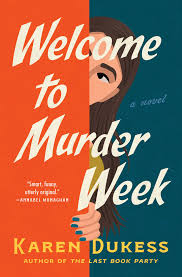
Book: Welcome to Murder Week
Author: Karne Dukess
Publisher: Scout Press
Year: 2025
Rating: 4.5 out of 5 stars

Synopsis : “When thirty-four-year-old Cath loses her mostly absentee mother, she is ambivalent. With days of quiet, unassuming routine in Buffalo, New York, Cath consciously avoids the impulsive, thrill-seeking lifestyle that her mother once led. But when she’s forced to go through her mother’s things one afternoon, Cath is perplexed to find tickets for an upcoming “murder week” in England’s Peak District: a whole town has come together to stage a fake murder mystery to attract tourism to their quaint hamlet. Baffled but helplessly intrigued by her mother’s secret purchase, Cath decides to go on the trip herself—and begins a journey she never could have anticipated.
Teaming up with her two cottage-mates, both ardent mystery lovers—Wyatt Green, forty, who works unhappily in his husband’s birding store, and Amity Clark, fifty, a divorced romance writer struggling with her novels—Cath sets about solving the “crime” and begins to unravel shocking truths about her mother along the way. Amidst a fling—or something more—with the handsome local maker of artisanal gin, Cath and her irresistibly charming fellow sleuths will find this week of fake murder may help them face up to a very real crossroads in their own lives.
Witty, wise, and deliciously escapist, Welcome to Murder Week is a fresh, inventive twist on the murder mystery and a touching portrayal of one daughter’s reckoning with her grief, her past—and her own budding sense of adventure.”

Review : I absolutely adored Welcome to Murder Week! I had no idea a book about a fictional murder mystery game would be exactly what I needed in my life, but it turns out it was. I did refrain from a 5 star review, though, due to the slow start. I found myself moving at a snail’s pace as the book began, but once things got rolling, boy did they. Sweet, wholesome, and a wonderful good time, Welcome to Murder Week is perfect for anyone who grew up watching Poirot movies, reading Agatha Christie, enjoying Murder She Wrote, or lives for a cozy mystery in book, tv, or movie form. As three strangers work together to solve a fictional murder mystery in a quaint English town, they find themselves growing together as close friends. What began as a quirky tourist trip, though, quickly becomes a deeper and more meaningful adventure for our protagonist, Cath, that we could even have expected. In moments of tenderness, we find Cath retracing steps that seem strangely familiar, despite having never visited the English countryside; we witness the healing of generational trauma, and we experience the joy of watching her story completely turn on its head and unfold in the most beautiful way. This book will make you laugh out loud while simultaneously making you cry. It’s everything I didn’t know I needed and more. Absolutely well done.

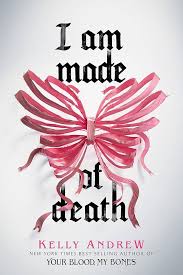
I Am Made of Death Review

Book: I Am Made of Death
Author: Kelly Andrew
Publisher: Scholastic Press
Year: 2025
Rating: 4 out of 5 stars

Synopsis : “Following the death of his father, Thomas Walsh had to grow up quickly, taking on odd jobs to help pay his gravely ill mother’s medical bills. When he’s offered a highly paid position as an interpreter for an heiress who exclusively signs, Thomas – the hearing child of a Deaf adult – jumps at the opportunity.
But the job is not without its challenges.
A selective-mute, Vivienne Farrow hasn’t said a word in years – not since going missing in Red Rock Canyon when she was four years old. No one knows quite what happened to her out in the dark. They only know that the sound of her voice is now as deadly as a poison. Anyone who hears her speak suffers a horrible death.
Vivienne is desperate for a way to regain control of bother her voice and her body. Because the face staring out of the mirror isn’t hers. It’s something with teeth.
Thankfully, she’s finally found someone who claims to be able to perform a surgical exorcism. She just needs to find a way to get rid of Thomas first. But Thomas can’t afford to walk away, nor is he willing to abandon the mysterious girl he’s falling for, no matter what dark powers threaten to swallow them both whole.”

Review : I Am Made of Death was the perfect antidote for both the book hole I found myself in after finishing The Devils and the disgust I felt over my last unfortunate one star review copy, Anji Kills a King. I needed something to grip me, and I Am Made of Death (IAMOD) did just that. I started and finished IAMOD in just under 48 hours, and had I just a tiny bit more free time available, I would have cut that time way down. Andrew created an absolute page turning, unputdownable read and I am eternally grateful for that.

As a child, Andrew lost her hearing at just 4 years old and it becomes evident throughout this book that Andrew has woven her own story into this dark fantasy, frankly, the personal connection, both to her own hearing loss and to her marriage with a Hearing individual, makes for a super compelling read. Told from the alternating perspectives of both Thomas, 18 year old interpreter for Vivienne Farrow, paid in unspeakably large sums of money by her step-father, Philip, and Vivienne, Thomas’ peer and wealthy heiress to Philip’s fortune who has remained largely unspeaking for most of her adult life. Following a tragic accident in the desert while a toddler, Vivienne has had the uncanny ability to kill with just the sound of her voice, no words necessary. Because of this unfortunate ability, Vivienne has mostly locked herself away, ashamed, afraid of her own voice, and more than anything, afraid of the monster she sees in the mirror. Both metaphor and reality, Vivienne is not merely the body from which a killer voice emerges, but the host to a parasitic demon; a demon who saved her life as a toddler, who continues to save her life as an adult, but for whom the price of existence is murder.

We enter IAMOD to find Vivienne mid-way into the process of entrapping a medical student into performing a highly risky procedure in which he will attempt to surgically remove the supernatural parasite from her body. Unfortunately, Thomas’ ever present self, and how little he knows or understands about the situation, stands between Vivienne and release from the creature who plagues her body and soul. *Spoilers Ahead!* Through the course of the book, told in three parts, we see an ever-diminishing gap between Vivienne’s hatred of Thomas and Thomas’ confusion over Vivienne’s situation. Andrew has written such a perfect foray into the sweetness of first love, it felt both intense and silly all at the same time, I found their quasi-friendship turned love so palpable and enjoyable. Beyond the slow growing love between Thomas and Vivienne, we also find a whole world of occult and magic intermingled with the world of high-stakes finance, law, and even medicine – it makes the somewhat dizzying world Andrew has created feel like maybe, just maybe, it could be part of our world.

Where things took a stumble, however, is in the telling. I can’t get a grasp on whether IAMOD is going to be the first in a series or whether it’s a planned stand-alone novel and that determines how I feel things were wrapped up and explained. If, as I hope, IAMOD is the first in a series, I think Andrew left plenty of room for questions to eventually be resolved and cleared up in a second, or even third, book. There were messy threads left incomplete by the time it was all said and done and as I closed the book I found I had more questions than answers. If this is to be a stand-alone novel, Andrew could have done a much neater job of tying up loose ends and that’s where I struggle with the final rating – there are too many things that went unsaid and too much that needed to be addressed for this to be the end. It’s possible this will be a one-off, but I think that would do a disservice to the characters Andrew has begun to built and a disservice to the broader aspects of the story that were never fully resolved. While IAMOD doesn’t end on a cliffhanger, it almost might as well with how many loose threads Andrew left behind and that’s why I feel this must be the introduction to a bigger world yet to be revealed through a sequel. I guess it’s yet to be seen! Either way, the loose ends as they were, this book was still so compelling, so well written, and so enjoyable that I had no choice but to give it 4 out of 5 stars. I think you’ll understand why when you read it.

Advice : If you enjoy a nail biter, enemies to lovers, dark fantasy, or a sweet first love story, this will definitely be for you!

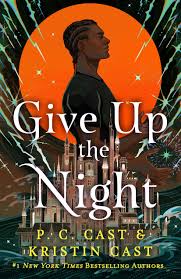
Give Up the Night Review

Book: Give Up the Night
Author: P.C. Cast and Kristin Cast
Publisher: Wednesday Books
Year: 2025
Rating: 3 out of 5 stars

Synopsis : “Since becoming Moonstruck on her eighteenth birthday, Wren Nightingale has found herself thrust into a world filled with deception, danger, and murder. Uncovering that their magic was fractured and limited when the original Moonstruck ritual was broken by Selene, Wren is determined to find a way to restore it. But the Elementals are split into two factions – some want the ritual completed and their freedom – and others are so terrified of change that they’re willing to end Wren before she can reach the center of the island where the ritual Selene ruined can be completed.
Between his overbearing father’s arrival, Rottingham delegated him more and more responsibility, and Celeste taking a special interest in him, Lee Young has been struggling to find his own path. As much as Lee wants to take his place in the Moonstruck hierarchy, he knows something’s not right at the Academia de la Luna. He thinks if he can talk some sense into Wren and get her to return to the Academia, that everything will turn out alright.
As Wren and Lee both battle for what they believe is right, they’ll have to uncover who their true allies are…and if they’re even on the same side of this magical fight.”

Review : Dear reader, to be completely honest with you, I’m not sure how I ended up with this early copy. Not only is Give Up the Night a sequel, to a book I didn’t read, mind you, but it’s been co-authored by two people I’m familiar with; if you’ve been here for a little while, you may remember that I reviewed the first and second books in a different trilogy written by P.C. Cast and Kristin Cast, and if not, you can find them here and here – as an aside, I didn’t realize the earlier of the two reviews was written all the way back in 2021 and now I must sit in shock that I’ve been receiving review copies for four years before I can continue on.

I make a point not to request sequels, and after my last two not-so-kind reviews of the Cast’s work, I’m a little more than surprised to find this book sitting in front of me. I must have made a mistake. Nonetheless, much like last year, my plans for this year include reading and reviewing every advanced copy that comes my way, so I did read Give Up the Night even though I didn’t read Draw Down the Moon, the inaugural book in the Moonstruck trilogy. To their credit, the Casts made it easy for someone to jump in without needing a total refresher of the first book – enough details were organically rehashed by the characters within the first chapter that I didn’t struggle to understand what was happening, despite jumping in at a pivotal moment. However, I do find it difficult to review a sequel without having read the first book, so this review will likely be quite short.

I find the Casts to be adequate writers, and by that I mean they do just fine if you’re not bored with a tired trope, ready for fresh material, or want a truly new, enticing, or compelling story. It’s just fine. Nothing more. I realize this is an advanced copy, but this book was riddled with errors, something I don’t tend to see in the more well put together books I receive – so that’s worth noting. Reading this book had me wondering how much might change between an advanced copy and a first edition; for example, if you have a nonbinary character, it might be worth your time as an author to ensure that you get your own character’s pronouns correct. It might even be worth your time to figure out the pronouns of the magical beings you’ve written into your novel, wouldn’t you think? Rather than jumping around confoundingly between he and she with no real clear reasoning as to why it’s jumping around – no, this is no gender fluid creature, it’s simply poor writing. The storyline matched every damn fantasy storyline you might be familiar with and that felt like an insult to the reader : young woman in a magical world finds herself bestowed with incredible! unbelievable! magical powers after spending time thinking something is wrong with her because her peers are developing their powers as normal while she lags behind; magical creature becomes magically attached to said young woman; young woman becomes marked as special, must go on magical quest to set things right / free everyone / do something spectacular that no one else has ever been able to do before. The “quirky” and “special” angle feels wildly overplayed – I can think of four books without even trying that fit the same mold. It’s overdone.

Lastly, I did find the majority of Give Up the Night to be fairly compelling, inasmuch that I continued to turn pages for a while before I got bored. I’ve said it before and I’ll say it again, a book doesn’t have to be well written to be compelling. Poorly written books with compelling storylines still turn pages. As we neared the ending of this book, however, things took a turn. The clear-cut narrative turned muddled, the geography became redundant, and the quest the characters found themselves on turned on it’s head in a way that made no clear sense. It felt like writing for the sake of wrapping up a book with a wild and crazy twist, not like something necessary to the storytelling at all. It was all a ploy to introduce book 3, which is fine, but not for me. Anyway, like I said…this book was fine. No more.

Advice : If you’re familiar with the Casts’ work already and enjoy it, I’m sure you’ll enjoy Give Up the Night. If you’re not or you’re looking for something that doesn’t read like a watered down Fourth Wing…try again. This one won’t be for you.

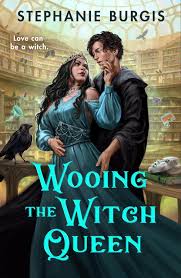
Wooing the Witch Queen Review

Book: Wooing the Witch Queen
Author: Stephanie Burgis
Publisher: Bramble
Year: 2024
Rating: 3.5 out of 5 stars

Synopsis : “Queen Saskia is the wicked sorceress everyone fears. After successfully wrestling the throne from her evil uncle, she only wants one thing : to keep her people safe from the empire next door. For that, she needs to spend more time in her laboratory experimenting with her spells. She definitely doesn’t have time to bring order to her chaotic library of magic.
When a mysterious dark wizard arrives at her castle, Saskia hires him as her new librarian on the spot. “Fabian” is sweet and a little nerdy, and his requests seem a bit strange – what in the name of Divine Elva is a fountain pen? – but he’s getting the job done. And if he writes her flirtatious poetry and his innocent touch makes her skin burn, well…
Little does Saskia know that the “wizard” she’s falling for is actually an Imperial archduke in disguise, with no magical training whatsoever. On the run, with perilous secrets on his trail and a fast-growing yearning for the wicked sorceress, he’s in danger from her enemies and her newfound allies, too. When his identity is finally revealed, will their love save or doom each other?”

Review : Wooing the Witch Queen was a cute, quick romantasy-ish book about two people who are ultimately misunderstood by those around them. I call it romatasy-ish because while it is a fantasy and it’s being published under Bramble, a romance novel imprint of Tor Books, the actual romance aspect of this book was…light. I think if this were a movie it might be rated PG-13 for implied nudity; the romance aspect of the book was mild, took the entire book to develop, and was about as closed-door as it gets without actually being a closed-door romance, take that how you will!

Outside the actual romance of the novel, which the synopsis seems to more than imply is the majority of the book, the actual plot of Wooing the Witch Queen centers around Saskia’s immediate threat to the throne she stole from her uncle – largely from her neighbors, seemingly under the order of the Archduke Felix.

** Warning, spoilers ahead! **

Being as quick as this read was, there’s very little I could say here that wouldn’t be a fairly immediate spoiler, so let’s just dive into it. What Saskia, or the rest of the surrounding kingdoms for that matter, doesn’t know is that Felix is simply a figure-head, someone who has been held prisoner, who has no formal diplomatic training, and who has no say in what his kingdom does or doesn’t do. On the night his traitorous family is poised to murder him and turn him into a martyr, Felix makes an escape to the only Imperial who has been able to hold off his in-laws : Saskia. Wearing what he doesn’t realize is the cloak of a dark wizard, Felix escapes while donning a swooping hooded cape. When he arrives at Saskia’s court, she assumes he’s a dark wizard answering her call for a temporary laborer to arrange her magical library. Without allowing Felix to get a word in edgewise, Saskia hires him and permits him to wear a mask – something that is, apparently, typical for dark wizards.

The remainder of the book follows this path : Felix bumbles his way through his task, only capable of organizing a magical library because he’s only ever been allowed to participate in the arts, Saskia falls for his gentle personality, and no one seems to be any wiser until he finally reveals himself to her at the end of the book. Ultimately, I found this story to be mildly cute but of no great importance or need to be told, the romance was more actually romantic than what you might expect out of a romance novel, and Felix’s character is written like the reversal of every female protagonist written by a man – deeply hard to believe, full of strange character traits that sound more like a woman who didn’t have any diversity in her beta readers, and not all that interesting when it’s all said and done.

Finally, I found the plot to be thin and weak, Felix’s background was never fleshed out, and I found myself with questions I didn’t ultimately find answers to. I think the trouble with writing a fantasy novel is you have to create a story that’s compelling enough that the reader finds themselves willingly reading about the politics of a world that is wholly made up – if you create a world the reader isn’t invested in, there’s then no incentive for them to involve themselves with the minutiae. Sadly, Burgis did not succeed in compelling me to care about the politics of the world she crafted and so during moments of political discourse (which comprised a good deal of the book), I found myself bored and uninterested. I was never given the chance to become invested in the world when the book moved so quickly and never fully explained the main characters backgrounds in a way that felt satisfactory. Overall, this book was fine.

Advice : If you pick up any romantasy you can get your hands on, maybe this will be for you! If you prefer more romance, more fantasy, more everything…well, maybe this isn’t going to be the one. It might be worth checking out from your local library.

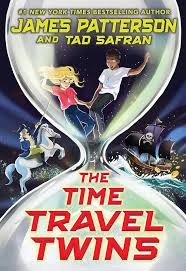
The Time Travel Twins Review

Book: The Time Travel Twins
Author: James Patterson and Tad Safran
Publisher: Little, Brown Young Readers
Year: 2024
Rating: 4 out of 5 stars

Synopsis : “Twins Pew and Basket Church dream of escaping the miserable misfortune of their isolated orphanage. Or, even better, the return of their unknown parents. But even in their wildest dreams, they never imagined the truth : The twins can travel through time.
Armed only with perplexing clues to their past and a time travel talisman that is key to their future, Pew and Basket embark on an epic quest It takes them into George Washington’s war tent and on a hunt for the Liberty Bell, from the battlefields of the American Revolution to a pirate republic in the Caribbean and beyond, all in a race to uncover the secrets of their family – and outsmart time’s greatest villain.
History, mystery, humor, and adventure collide in this delightfully clever romp that heralds the arrival of James Patterson’s newest blockbuster series.”

Review : If you’ve been here for a while, you might know that while I don’t often read and review young adult books, when I do, I tend to find myself disappointed. In general, the young adult advanced copies I’ve read over the years have left me wondering if I’m simply holding young readers to a high standard they may not be able to truly live up to. I wonder often if I’m so far removed from being a young reader that I simply cannot remember what it was like to read books as a pre-teen; my expectations have been dashed so many times. The Time Travel Twins, however, has fully restored my hope and faith in a high quality, enjoyable young adult read. As someone who works fairly hard to avoid a James Patterson adult read, I wasn’t entirely sure what to expect from this advanced copy, but it was genuinely such a fun and enjoyable read, I’m excited for the kids who pick this book up and find themselves sucked into a world full of time travel, mystery, and witty adventures.

Prior to heading to the front of the book for a bit more information about the authors, I’d already decided The Time Travel Twins reminded me a great deal of A Series of Unfortunate Events. The authors have created 12-year-old characters who talk and think like adults, not in a necessarily unbelievable way, but in a funny, charming, disarming sort of way – Basket and Pew, named for the literal church where they were found as abandoned babies, have grown up in an orphanage that’s educated them not as children might be, but as PHD candidates might be. They have amassed a wealth of information from higher education learning in a grueling atmosphere where they’re fed rock hard bread and worms, taught mathematical principals most adults wouldn’t understand, trade wind patterns, ancient ship types, and all manner of seemingly nonsensical information no child would ever need to know. Wink. The authors don’t speak down to the readers, taking several instances throughout the book to break the fourth wall and address the reader with little tidbits to explain complicated or new phrases in a way that feels like the reader is part of the adventure, rather than someone who hasn’t been educated to the tremendously high degree that Basket and Pew have been. It reads like Lemony Snicket wrote the book, and when I read a bit more about the authors, I discovered Tad Safran had, in fact, served as a writer for the Series of Unfortunate Events TV series.

This book is truly what would happen if Lemony Snicket got a little too engrossed in history and began writing historical time travel fiction for kids. It’s great. Where the books deviate from this particular style of storytelling, though, is in the detail and commitment to teaching the reader. Rather than an all out rampage of fun and whimsy and adventure, TTTT is smartly wrapped up in a sneaky campaign to teach the reader the ins and outs of the revolutionary war and, based on the ending, I’m guessing will continue to teach future readers about additional historical events as the series unfolds. It reminds me of the computer games you might, if you were my age, have grown up playing that were thrilling adventures serving as a sneaky vehicle to learn math and English particulars. Every so often the authors break off and give us an illustration of a scene, complete with a small blurb to further explain details either of a specific battle or the details of 1700’s attire that might not be familiar to the reader. It works so, so well. Everything about this book was amusing and charming and informative, giving the reader something to grasp onto and chew on while they found themselves whisked away to the pirate’s republic, or sucked into a time vortex to narrowly avoid escaping certain death.

It should be noted that this book is about as far from low stakes as a younger reader’s book could be. There’s action, adventure, and like I previously mentioned, the threat of certain death. There’s suspense building and nail biting, and to my displeasure, a lot of “but we just had that thing and didn’t know we needed it and now we need to backtrack to get it!” which, ultimately, earned this book one less than a perfect score. It did feel as though we spent far too much time zig-zagging between having the thing we needed and throwing it away, and going back for the thing only to be thwarted in the process. I’m not a side quest kind of person, if you can’t tell! All in all, the book felt like it was about 50 pages too long, all thanks to the back tracking and side questing – I think it could have easily wrapped up so much sooner and without any to-do, I doubt you’d have missed out if we didn’t have just one fewer instance of the above scenario.

It’s also worth mentioning that while Basket and Pew are twins, Pew is a Black boy and Basket is a white girl. And they come find themselves in the midst of the revolutionary war. Perhaps you can draw some conclusions on your own here? There’s some talk about racism, slavery, and what it might mean to find yourself in an era where the color of your skin alone could mean your demise. There’s also discussion about what it might mean to change time, to tell general Washington to abolish slavery before the war was concluded, what that might mean for the future of the United States, and why the North had the resources available to win in a battle against the south (the future civil war). The issues are addressed frankly and don’t gloss over them terribly, but are also pretty clearly written from the perspective of two white authors, so there’s certainly something the be desired here when it comes to navigating a character’s existence in a body that’s viewed as less than or other in the midst of war. I know, too, that this is a children’s book and doesn’t need to go into the horrific specificities of what that reality might look like, but there was something about making witty banter over why one simply cannot change time that rubbed me the wrong way and I think that’s worth being said.

Ultimately, this book was an enjoyable read that didn’t sacrifice education or writing quality for fun. It ended on a cliff hanger, leaving the door wide open to future books, and it makes you want to continue reading (for most of the book, anyway. Like I said, it does feel about 50 pages too long). I’m pleasantly surprised at how much I enjoyed this one and suspect many kids will feel similarly.

Advice : This is the kind of book you give to your advanced reader without feeling like it isn’t going to push them to learn something. It’s going to teach not only history but ethics, confirmation bias, and the importance of kindness to those around you, regardless of who they might be (like a pirate). I highly recommend it!

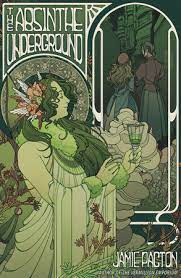
The Absinthe Underground Review

Book: The Absinthe Underground
Author: Jamie Pacton
Publisher: Peachtree Teen
Year: 2024
Rating: 3.5 out of 5 stars

Synopsis : “For Sybil Clarion, the Belle Epoque city of Severon is a wild, romantic dream, filled with cares, cabarets, and glittering nightclubs. Eager to embrace the city’s freedom after running away from home, she’s traded high-society soirees for empty pockets and barren cabinets. At least she has Esme, the girl who offered Sybil a home, and maybe – if either of them dared – something more.
Ever since Esme Rimbaud brought Sybil back to her flat, the girls have been everything to each other – best friends, found family, and secret crushes. While Esme would rather spend the night tinkering with her clocks and snuggling her cats, Sybil craves excitement and needs money. She plans to get both by stealing the rare posters the crop up around town and selling them to collectors. With rent due, Esme agrees to accompany – and more importantly protect – Sybil.
When they’re caught selling a power by none other that its subject, Maeve, the glamorous girl doesn’t press charges. Rather, she invites Sybil and Esme to the Absinthe Underground, the exclusive club she co-owns, and reveals herself to be a green fairy, trapped in this world. She wants to hire thieves for a daring heist in Fae that would set her free, and is willing to pay enough that Sybil and Esme never have to worry about rent again. It’s too good of an offer to pass up, even if Maeve’s tragic story doesn’t quite add up, and even if Sybil’s personal ties to Fae could jeopardize everything she and Esme have so carefully built.”

Review : The Absinthe Underground is a sweet and fun adventure, that, while not low stakes, somehow ended up feeling just low stakes enough that it didn’t trigger any anxiety while reading it. Pacton crafted a beautiful scene by introducing us to the world of Fae, showing us rather than telling us what an intoxicating other-world might look like to two girls from this world. However, where she did a fantasy world justice, I felt she let the reader down with her depictions of the city of Severon. With a name like Severon and very little explanation to the time frame of the book, I was at first convinced this story was not only fantasy but science fiction. It wasn’t until I read the author’s note (at the end, after finishing the book in it’s entirety) that I realized Severon was meant to be an 1890’s Parisian equivalent. Something got lost in translation, figuratively speaking.

Likewise, Pacton included real world names like Toulouse and Mucha when discussing poster artists whose work is often stolen for it’s one of a kind collector status, which lent a bit of confusion and complication that felt unnecessary to the story. Sybil and Esme live in the top of a clock tower in a made up city that contains real world artists, something that I have a hard time wrapping my mind around when it comes to necessity. Not enough of the pre-Fae exploration of TAU connected me to Paris in the late 1800s for the real world examples to make sense, Pacton could have made a more significant impact on the story by placing greater emphasis on the time frame and reality of the world Sybil and Esme live in, then trying to tie it to our world. She lost me there. 

Spoilers Below

That aside, the Absinthe Underground itself was beautifully described and the subsequent adventure Sybil and Esme embark upon is quite endearing. I did feel, though, that there were several loose ends Pacton left untied; it’s unclear whether they were left untied for a reason or because they were simply overlooked in the editing process. However, one seemingly purposeful loose end does find Sybil and Esme’s adventure into Fae and back into the real world marred by a broken promise to free a human they encountered in Fae and help her find her way back through the door – I find the prospect of another book exciting, I can’t wait to see what Pacton does next! She left several threads throughout the story, dropped like leaves, and I wonder if she’ll pick the all back up in the upcoming book or if we’re simply left to speculate why a forest hag might be frightened of a kitten, whether Sybil’s father was a magician, and why he tried so hard to marry her off and turn her into a “proper” young woman before she ran away. There were small explanations planted throughout the book, but not enough to satisfy the weight each of the aforementioned interactions had on the plot. 

TAU was a cute, low-ish stakes middle grade adventure book that has great potential for future iterations, I think there’s room for improvement, but that improvement could surely come in additional books. Overall, I found it easy to read and enjoyable, if not a little slow and sleepy at times.

Advice : If a low-stakes adventure through a fairy realm sounds up your alley, you’ll want to give this one a read when it debuts in February. If you like a bit of a nail biter or a faster paced adventure, this might not be your jam.

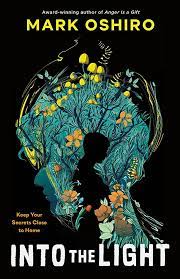
Into the Light Review

Book: Into the Light
Author: Mark Oshiro
Publisher: Tor Teen
Year: 2023
Rating: 4.5 out of 5 stars

Synopsis: “It’s been one year since Manny was cast out of his family and driven into the wilderness of the American Southwest. Since then, Manny lives by self-taught rules that keep him moving – and keep him alive. Now, he’s taking a chance on a traveling situation with the Varela family, whose attractive but surly son, Carlos, seems to promise a new future.

Eli abides by the rules of his family, living in a secluded community that raised him to believe his obedience will be rewarded. But an unsettling question slowly eats away at Eli’s once unwavering faith in Reconciliation: why can’t he remember his past?

But the reported discovery of an unidentified body found in the hills of Idylwild, California, will draw both of these young men into facing their biggest fears and confronting their own identity – and who ethyl are allowed to be.

For fans of Courtney Summers and Tiffany D. Jackson, Into the Light is a ripped-from-the-headlines story with Oshiro’s signature mix of raw emotions and visceral prose…but with a startling twist you’ll have to read to believe.”

Review: In both the ARC pamphlet I received with this book and the author’s note at the end of the book, Oshiro alludes to a childhood trauma that inspired and birthed this book, what I suspect, based on little tidbits throughout Into the Light, was conversion camp. The air of conversion, of being forced to undergo something dangerous, something heartless, and cruel at the hands of the people who should be the most loving and protective forces in your life, runs throughout this book. While it isn’t at all about that type of conversion, it is about the damage that the church causes at the hands of people who have no business holding positions of power.

Into the Light follows Manny, a young adult who grew up with his sister Elena, bouncing from foster home to foster home, seeing the worst of the worst, and finding that as he gets older the likelihood of seeing a real adoption happen grows smaller and smaller. Manny and Elena, however, find themselves being adopted blindly into a family with direct ties to a cult-ish christian community called Christ’s Dominion. The family quickly decides that Manny needs to participate in something called Reconciliation and sends both he and his sister to a three-day “retreat” in the Californian mountains. What Manny experiences at Reconciliation is not quite conversion camp, but it is detrimental, traumatic, and extremely dangerous. He arrives to find that all the families in attendance are white with adoptive children who are not, across the board, most have come directly from other countries, several from within the foster system, and all with something deemed wrong with them – whether that be their gender identity, their sexual preferences, or the color of their skin.

Into the Light is told from Manny’s perspective, jumping from the present, as he lives his life with the newly found Varela family traveling the country trying to find his sister Elena, to the past as he experiences Reconciliation, and yet from a third time period as he (known as Eli, having succeeded in Reconciliation in some ambiguous, nebulous way) lives his life at the compound in the mountains, sharing his success story with newcomers and their “wrong” children. I found this style to be confusing, as the chapters had no headings to tell you what point of view you would be reading – the perspective shift was shown by a slight change in font that got more confusing as the story ramped up and all three perspectives were being shared closer together than they had previously in order to get to the climax of Manny’s journey with Christ’s Dominion. I think some headers would have been a huge help particularly as the book wrapped up, jumping quickly from one perspective to another in order to round out the entirety of the narrative.

My biggest issue with this book is the plot twist at the end, I think it detracted from the weight of the story, took away from the very real issues being discussed in the book, and didn’t serve a function. We read through 90% of the novel as a realistic fiction book, yes quite troubling and pointed, but not a horror novel in that sense. With about 10% of the book remaining, the “truth” is revealed and the book becomes sci-fi or horror in an unrealistic kind of way, which I tend to enjoy but not when it shifts the entirety of the book into a new genre with no time to spare. I felt like there were some many important aspects of this book, so many important things being discussed in a first-person narrative that need to be spoken, that need to have a light shed on them, that when Oshiro changed the book with a strange plot twist that took Manny’s separation from Eli from being explainable as trauma, which he absolutely endured, to being explainable as a sci-fi impossibility it lessoned the weight of what Oshiro was trying to get across. Suddenly we have nothing more than a science fiction book with a weird ending that’s so disjointed from the majority of the book that I don’t know how to reconcile the two, and frankly I think that does a huge disservice to what Oshiro could have achieved.

With a rise in anti-LGBTQIA+ legislation, a rise in christian nationalism, and a rise in spoken hatred, books like Into the Light that share what children are really experiencing at the hands of people who should be doing their best to protect them are incredibly important. I found it disappointing that this book shifted in the way it did, that the twist wasn’t more seamlessly included throughout the rest of the book, and I left it thinking more about how disjointed it was than I did thinking about how realistic the rest of it was for thousands of teens and young adults across the country. Manny’s story, and by proxy, Oshiro’s personal story, deserve to be told and heard and believed with compassion and care and love. I fear that the twist has only served to detract from something so important.

Advice: This book contains depictions of the foster care system, of sexual harassment of a minor, of religious trauma, of conversion, of racism, of parental abandonment, of physical assault, and of very real trauma and ptsd experiences following. It is, however, a great read that moves swiftly and keeps you reading to see what’s going to happen. I think if you like a singular viewpoint told from multiple timeframes, you’ll probably read through this and really enjoy it. If you find that style to be confusing, this might not be the best or easiest book to read. If you have experienced religious trauma or conversion, this may be a pretty intense and difficult read for you as well.

The Carrefour Curse Review

Book: The Carrefour Curse
Author: Dianne K. Salerni
Publisher: Holiday House
Year: 2023
Rating: 3 out of 5 stars

Synopsis: “Twelve-year-old Garnet doesn’t know her family. Her mother has done her best to keep it that way, living far from the rest of the magical Carrefour clan and their legendary mansion known as Crossroad House.
But when Garnet finally gets summoned to the estate, it isn’t quite what she hoped for. Her relatives are strange and quarrelsome, each room in Crossroad House is more dilapidated than the last, and she can’t keep straight which dusty hallways and cobwebbed corners are forbidden.
And then she learns a terrifying secret/l the dying Carrefour patriarch fights to retain his life by stealing powers from the others. Every household accident that isn’t an accident, every unexpected illness and unexplained disappearance grants him a little more time.
While the Carrefours squabble over who will in heritage his role when (if) he dies, Garnet encounters evidence of an even deeper curse. Was she brought to Crossroad House as part of the curse…or is she meant to break it?”

Review: I don’t often read middle grade novels, but this looked too cute to pass up! I clearly didn’t retain the synopsis because when I found out our protagonist, Garnet, was 12 (about 3/4 through the book) I was shocked. While The Carrefour Curse reads like a mid-grade novel, Garnet reads as much older than 12. But, this could be how little I read books in this realm!

As the novel begins, we find Garnet in a very wizard-with-a-lightning-bolt-scar predicament: she’s spitting up frogs and has no idea how to reverse the effects of whatever has gone wrong. We find her riding in the car with her mother, Emerald, getting closer and closer to the old family home, Crossroads House. Convinced that this is a summoning spell gone wrong, Emerald brings her daughter to the family home she’s never before allowed her to visit, in the hopes that this will satisfy a magical spell she believes her siblings and cousins have placed on her daughter. As it turns out, the family has been experiencing their own fair share of mystical conundrums and once Emerald and Garnet arrive at Crossroads House, they find they cannot leave without experiencing some kind of physiological distress.

As the story progresses, we begin to get glimpses into a murky past that only Garnet is privy to. While each member of the Carrefour family has their own magical powers, Garnet’s are beginning to awaken now that she’s in the vicinity of the home. She’s always had a special connection to the element Earth, but the more time she spends at Crossroads House, the more she comes to realize that she can also see and walk in the past; a time traveler. It is this special gift that allows Garnet to begin to unravel the mystery of the old house, the original location of Crossroads House, believed to be built directly on top of magical lay lines. The current house sits off from the old ruins, as anyone who goes near the old house mysteriously vanishes. It soon seems as though Garnet is the only person who will be able to release the curse, and with it the missing people.

Salerni does a good job of creating a magical world in Carrefour Curse, she lays out the family tree in a way that’s easy to follow in spite of the fact that it spans multiple generations and several of the family members share the same name. I think it’s no small feat to not only make a confusing and convoluted family tree seem manageable, but to also take a mansion and make it’s layout feel understood. It’s helpful, of course, that she included both a house layout and a family tree in diagram form in the book, but I think, especially for a younger audience, this could have gotten confusing quick. It’s easy to step into this book and find yourself comfortably in the world Salerni’s created and I think that’s a huge positive!

The book itself feels like it misses a lot of opportunities for connections to be made, which on a positive note makes it harder to predict, but on a negative note makes it feel a bit frustrating at times. Salerni brings things up that you think will play out in a certain way based on context clues, but we find them unused pieces of information that don’t necessarily go anywhere. I think there’s some work that could have been done here to make the book even better, more rounded, and solid – for me. But all in all, it’s a fun and enjoyable mid-grade read with an ending I thought made sense, and that’s sometimes all you can hope for.

Advice: If you’re looking for a book that has a clearly built magical system in place, that feels light and fluffy to read, and that won’t make you frustrated, this is it! It’s a great read for a snow day in, it’s nice a quick, and it’s a good breather from other, more intense fantasy books. All around enjoyable and cute.

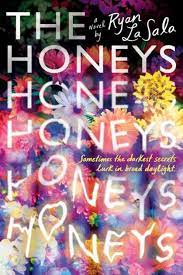
The Honeys Review

Book: The Honeys
Author: Ryan La Sala
Publisher: Push
Year: 2022
Rating: 5 out of 5 stars

Synopsis: “Mars has always been the lesser twin, the shadow to his sister Caroline’s radiance. But when Caroline dies under horrific circumstances, Mars is propelled to learn all he can about his once-inseparable sister, who’d grown tragically distant.
Mars’ gender fluidity means he’s often excluded from the traditions – and expectations – of his politically connected family, including attendance at the prestigious Aspen Conservancy Summer Academy, where his sister poured so much of her time. But with his grief still fresh, he insists on attending in her place.
What Mars finds is a bucolic fairytale. Folksy charm and rigid gender roles combine with toxic preparatory rigor into a pristine, sun-drenched package. Mars seeks out his sister’s old friends: a group of girls dubbed the Honeys, named for the beehives they maintain behind their cabin. They are beautiful and terrifying – and Mars is certain they’re connected to Caroline’s death.
But the longer he stays in Aspen, the more the sweet mountain breezes give way to hints of decay. Mars’ memories begin to falter, bleached beneath the relentless summer sun. Something is hunting him in broad daylight, tying with his mind. If Mars can’t find it soon, it will eat him alive.”

Review: In the front of my review copy of The Honeys, La Sala has left a note for the reader. In it he writes: “As I write you this letter, another fear has found me. My first two books have shown up on a list concocted by a Texas lawmaker, to be investigated for their potentially discomforting themes around queerness, equity, and justice…This man fears me and my art. And I wish – like Mars – his reaction to fear was to learn. As an author, I do think of my works as edifying. I want The Honeys to shock and scare you, but after the buzzing fades, there is much to learn in these pages.”

As you may know from past reviews, I have read several YA books over the last few years and come away feeling frustrated and disappointed. I kept saying “YA can be better!” La Sala has proved me right with The Honeys. A quick-witted and sharp story, The Honeys is also a successful horror / suspense novel, and for that I find myself eternally grateful. I have spent so many hours reading essentially the same book over and over and over within the horror / suspense genre that I’ve grown bored and annoyed, at best. Finally. Finally! A YA novel, a horror / suspense novel at that, that breaks all the norms and blazes its own path forward. The Honeys unfolds slowly and you spend a majority of the book getting to know Mars and Aspen, learning what the camp looks like, discovering all the ways Mars has to fight for their very existence, and learning hints here and there about what may or may not have happened to his sister Caroline while attending the camp. I can appreciate a slow-to-unfold horror story, particularly when it begins it’s descent before there are 10 pages left. La Sala does not disappoint in this regard, as the book begins to gain momentum and work toward a conclusion with a good several chapters to go. In this way, the construction of the book is excellent, something I don’t find very often in both YA and horror novels.

I was a bit torn over whether to give The Honeys 4 or 5 stars when I got to the end – in full transparency, as I read I was convinced it was 5 out of 5 for the majority of the book. It was only when I got to the end that I started to question that rating. I came up against my own mind, thinking “but this is a queer novel” and wondering why there wasn’t some poignant sociologial meaning to draw everything together at the end. What I finally came to realize is that this is a young adult horror novel told from a queer narrator, not a queer novel with horror themes thrown in. While it does answer the brief and delve into Mars’ point of view and the way in which they interact with and are confronted by the world, it doesn’t to come to the end and force the reader to learn something profound – that happens slowly, as you get to know Mars through the bulk of the book. At the end of the day, this is a horror novel told from the point of view of a narrator with a different perspective than the majority of horror or suspense novels I’ve seen out there.

The writing is excellent, especially for a review copy. You have probably read by now, if you’ve been following my reviews for any length of time, that I often get review copies merely weeks before they’re published and still manage to find a plethora of grammatical errors and general mistakes throughout. In The Honeys I found two: one was a repeated word and one was a word left out. The Honeys doesn’t come out for mass reading until August of 2022, so La Sala is way ahead of the game as far as review copies go. I was so overwhelmingly surprised and pleased with the way this book was put together, the quality of the writing, and the overall storytelling, I finished the book and immediately looked up his other two books. YA isn’t a genre I tend to read on my own for fun, but I would gladly read another book from La Sala if his other two are anything like this one.

I can’t speak highly enough about The Honeys. It confronts themes I feel are important, and I think are becoming more important to young readers: the gender binary, traditional gender roles, and the danger that women and trans people feel in the presence of the “boys will be boys” mentality. I’ve read other queer review copies, and particularly within the YA genre it often feels as though the authors are trying too hard to fit these characters into their narrative. The Honeys didn’t feel forced, it didn’t feel over the top, or utterly absurd; it felt natural, it flowed in a way that felt organic, and it left me feeling as though the topic of gender fluidity wasn’t merely thrown in as a token to the audience. Perhaps it’s because La Sala is gender fluid whereas other YA books with queer characters that I’ve read to review have been written by authors who aren’t, or perhaps it speaks to La Sala’s talent as a writer, or maybe (most likely) it’s both. Either way, I came away both absolutely thrilled and disappointed that I’d read through it so quickly.

Advice: I don’t think you have to be a fan of YA books to read and enjoy The Honeys. I think if you enjoy suspenseful novels, beautiful imagery, and a good mystery then The Honeys is going to tick all the boxes for you. If you enjoy quality writing and a mystery that you can’t really solve on your own way ahead of the ending, you’ll love this book. If you’re interested in reading more gender fluid or queer character points of view, this book hits the mark. If you’re a fan of summer camp suspense, again, it checks all the boxes. I think this is a book for a wide and diverse range of audiences and I can’t recommend it enough.