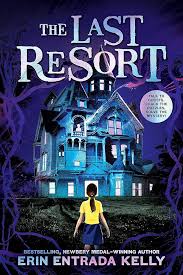
Book: The Last Resort Author: Erin Entrada Kelly Publisher: Scholastic Press Year: 2025 Rating: 4 out of 5 stars
Synopsis : “Just before her Grandpa Clem’s funeral, twelve-year-old Lila makes a shocking discovery. He didn’t die of natural causes – he was murdered. Possibly by someone who wanted to control his inn…and its secret portal to the afterlife. Now, a girl who’s vowed to become “less dramatic” must uncover her grandpa’s killer AND stop the ghosts desperate to make it back to our world.”
Review :The Last Resort is a super fun and enjoyable mid-grade read (grades 3-7) about the power of friendship, family, and finding places where you can be yourself. Lila, a twelve year old whose so-called best friends have described as “too much” and “overly dramatic” and, worst of all, “immature”, is ready for summer vacation so she can work on being as calm as a rock, as cool as ice, and as mature as her two besties think they are as they all head toward seventh grade next year. Her friends have stopped hanging out with her and have begun to hang out without her, she doesn’t have much time to regain their friendships. So when a relative she’s never met, Grandpa Clem, passes away unexpectedly and her family decides to travel out of state for his funeral, Lila is distraught. With the backdrop of frenemies / bullies who find Lila to be too much, we delve into Grandpa Clem’s world of ghosts, crystals, and portals to the world beyond the veil – a less than perfect scenario for a pre-teen who’s trying to be a lot less.
I thoroughly enjoyed this book, it was cute and fun and had some twists and turns that, while I saw coming, didn’t fully take shape until they’d arrived. It doesn’t talk down to the reader or assume the reader’s too young to understand new concepts and it presents unknowns and uncertainties in a way that makes it a true learning experience. I’m always pleased to find a middle grade read that doesn’t feel incredibly dumbed down for a kid to read and The Last Resort really held up. It did include some scary imagery, so I think this might be a proceed with caution book if you or your reader are a bit antsy when it comes to large spiders, the idea of death, or ghostly apparitions – but all in all I found it to be a safe and spooky walk on the paranormal side, perfect for fall! In the finished copy of the book, there will be ghostly illustrations who will come to life on the page via a QR code, which is such a fun addition to an already ghostly book, I think it’ll help bring the book to life in a way that’ll keep the reader thinking about it for a while.
While at Grandpa Clem’s inn, Lila meets a neighbor who’s her age, a boy named Teddy. It’s through Teddy’s friendship that Lila finds her place with someone who doesn’t view her as too much, who lets her be exactly who she is, and who doesn’t dismiss her as being an overly dramatic person. It’s an important lesson without being preachy, that bullies have no place in our lives, and that shrinking ourselves down to fit into the box of other people’s expectations makes us a shell of ourselves. In a world where even adults struggle with this concept, and even the concept of not being bullies to other adults, I found this messaging to be a refreshing change of pace from what we see day-to-day. Ultimately, Lila’s friendships are the cornerstone for this book, not the ghosts!
Finally, I gave this book 4 stars rather than 5 because I felt the ending was too abrupt and lacked the closure I wanted from it. It didn’t need to be drawn out or even significantly longer than it already is, but it would have benefitted from a little more than it received. I think the door was left open for further books down the road, and I’m not ashamed to tell you that this adult will absolutely be reading whatever Kelly comes up with next if she decides to continue this book into a series!
Advice : If you have enjoyed any iterations of Disney’s Haunted Mansion (including the ride), I think you’d enjoy The Last Resort! As advised above, if you or your reader have any squeamishness around spiders, near death experiences, dogs, crows, the threat of death, or ghosts, this might be one you approach cautiously. I think it’s the perfect amount of spooky and calm – a great way to dip the toes into a paranormal subject without diving in head first and scaring the bajeesus out of yourself.
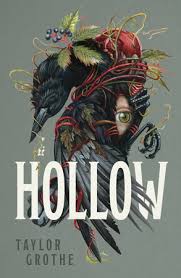
Book: Hollow Author: Taylor Grothe Publisher: Peachtree Teen Year: 2025 Rating: 3 out of 5 stars
Synopsis : “After a meltdown in her school cafeteria prompts an unwanted autism diagnosis, Cassie Davis moves back to her hometown in upstate New York, where her mom hopes the familiarity will allow Cassie to feel normal again. Cassie’s never truly felt normal anywhere, but she does crave the ease she used to have with her old friends. Problem is that her friends aren’t so eager to welcome her back into the fold. They extend an olive branch by inviting her on their backpacking trip to Hollow Ridge, in the upper reaches of the Adirondacks. But when a fight breaks out their first night, Cassie wakes to a barren campsite – her friends all gone. With sever weather approaching and nearing sensory overload, Cassie is saved by a boy named Kaleb, who whisks her away to a compound of artists and outcasts he calls the Roost. As Kaleb tends to her injuries, Cassie begins to feel – for the first time in her life – that she can truly be herself. But as the days pass, strange happenings around the Roost make Cassie question her instincts. Noises in the trees grow louder, begging the question : Are the dangers in the forest, on the trail, or in the Roost itself? In a world where autistic characters rarely get to be the hero of their own stories, Cassie Davis’ one-step-back, two-steps-forward journey to unmasking makes Hollow as much a love letter to neurodiversity as it is a haunting tale you’ll want to read with the lights on.”
Review : This is a strange review for me; I spent the majority of my time reading Hollow absolutely certain this would be a 5-star-review kind of book. It was impeccably written, impossible to put down, and left me with so many questions bouncing around in my mind – waiting, waiting, waiting for the big reveal that would tie things up and explain the nuances and mystery of the book. Sadly, within the last quarter of Hollow, the plot completely fell apart, the twists and turns Grothe had to take in order to explain the strangeness became overly complex, and left me with so few answers I am almost totally baffled as to why and how it ended the way it did. The sharp turn toward confusion is something I’ve been mulling over for two days since reaching the ending and I’m having a hard time coming to terms with this as a purposeful choice and not a mistake in storytelling.
It’s worth saying that Hollow is genuinely so well written for the majority of the story, it’s a dark and winding suspense-filled mystery of a book filled with nuance and palpable anxiety as we experience Cassie’s world both externally as her camping trip goes horribly awry, and internally as we bounce back and forth between flash backs to a bullying incident at her last school and her present internal world as she navigates a new autism diagnosis. Hollow as a whole is a beautiful metaphor for the neurodivergent experience of masking, or putting on a face for each set of specific circumstances one might find themselves in during a day-to-day existence. Cassie returns to her hometown after living in the city with her family, following a mental breakdown that lead to an autism and trichotillomania diagnosis. She’s lost touch with her friends and upon returning, in an effort to rekindle their friendship, she’s invited on their annual backpacking trip into the Adirondack Mountains. Everything seems fine, at least on the surface, until the first night of their trip leads to too much to drink, blacking out, and waking to find half of her friends have left the group behind. With an imminent storm approaching, Cassie leaves the campsite behind to find and rescue her friends before something terrible happens. It’s during her initial panic as she searches for the rest of her group that Cassie stumbles, spraining her ankle, and finds herself being rescued by a strange boy she’s never seen before – Kaleb. This is where things begin to take a strange turn.
Kaleb and his mother Stasha live in a remote part of the mountains in a small, off grid community called the Roost. It’s here that Cassie is allowed the space to rest and recover while the storm rages around them, taking a break from searching for her friends until the storm passes and they can get radio signal to the rangers down the mountain. Within the Roost are several families, most of whom have stumbled across the community and have chosen to stay, each living in a small home that seems to have been built by Kaleb’s parents. While staying at the Roost, Cassie discovers that there’s a secret language everyone speaks, some strange mixture of different dialects and languages from across the globe. The members of the Roost seem pleasant, though there’s never quite a sense of ease, as they continue to speak in a foreign language Cassie is unable to get a grasp of, and the books are all written in some unknown tongue she’s equally unfamiliar with. Kaleb continuously tells Cassie how unfair it is that her friends have left her on the mountain to fend for herself and says repeatedly that they’ll have to pay for what they’ve done, which gives a nice sinister backdrop for the scene Grothe has created. While in the Roost, Cassie begins to notice that there are carved wooden dolls…everywhere. They seem to surround the Roost, filling buildings with their haunting, carved faces, peering down from rafters, and generally giving an air of strangeness to the entire community. There are so many instances like this where Grothe is clearly making a point about neurodivergence, the way humans interact with a known dialect and jargon that doesn’t always reach the people who might stand on the fringes or feel as though they can never quite get a foothold in with those who so easily adapt. There’s a profound message of accessibility and acceptance within this storyline, but there’s also a lot left to be desired when it comes to unfolding the story outward into an ending that makes sense.
*Spoilers Ahead* As the book begins to really unravel at the end, so much comes to light about the Roost and the community of people who live there – really driving the point home that Cassie has simply never felt as though she belong, that in wearing a mask she’s as wooden as the dolls who surround the compound. The masks neurodivergent people are often forced to wear are ill fitting and a source of tremendous discomfort and I think Grothe does so well in addressing this concept with simultaneously creating a super creepy drama through which it might unfold. It’s how things come apart at the end that really left me struggling for answers; as Cassie finally starts to put the pieces of the Roost’s strangeness together, she realizes (too late) that Kaleb is actually her good childhood friend, Blake. Yet, in all the time she’s spent at the Roost – and this is another issue I find with the actual storytelling of the book, as the time she’s spent there seems to range from a week to several months with zero explanation beyond perhaps some kind of magic?? – she never once recognizes Kaleb as Blake, literally one of the friends on her camping trip. And not only that, somehow Kaleb / Blake is supposed to have created the entire Roost on his own, carved all the members of the community, and also kidnapped several hikers? Over the course of how long? The time frame, the inexplicable inability to recognize even Blake’s voice or mannerisms or scent (which she mentions multiple times), and the complete lack of explanation for all of the above lead the ending of the book to ultimately fall to pieces on top of a well written few hundred pages. I think there’s a singular moment early on where Cassie mentions briefly that she’s been diagnosed with face blindness, which I think might explain being unable to recognize Blake as Kaleb on it’s most base level, but it’s never mentioned again and without working a little harder to tie things together, it feels loose and confusing at best.
The unknown language spoken in the Roost and the unfamiliar written language in the books are never really explained, and while I can appreciate that the spoken language serves as an analogy for how Cassie feels disconnected from neuro-normative folks, the written language being something totally foreign to her feels like an aspect of the book that was written initially and then forgotten about when it came time to wrap things up. The ending of the book is unclear, deeply confusing, and left me with more questions than answers, which is an unsatisfying way to end a suspenseful, magical novel. I really do appreciate the parallels Grothe draws between those who stand on the fringes of the world and Cassie’s experience at the Roost, I love that Cassie was written to give neurodivergent individuals a place to be the hero, but I don’t know that it was completely successful when everything was all said and done. Cassie spends a lot of time back-and-forthing between staying in the Roost and leaving, even when her friends are dying around her, so much so that it felt as though the point was being made, mistakenly, over and over and over again. It felt like Grothe was hammering it home a little too hard, and in doing so neglected wrapping up crucial elements of the plot. I wanted to give this book 5 stars so badly! I wanted the ending to be better than it was, to make more sense than it did, and to give more of a feeling of completion than I was left with. Sadly, the ending spoiled most the book for me and I had to go with 3 stars. I think there’s room to figure things out and make it make more sense, but I also think it’s not super likely to happen at this stage and I’m sad for that and for Cassie’s story.
Advice : I think this book had a lot of potential – if you like crows, if you like something vaguely sinister, if you want to see a neurodivergent person be the hero, wow! You’ll definitely have something to dive into with Hollow. However, I want to recommend that you don’t get your hopes up for the puzzle pieces to fit together at the end – they don’t. This one might be best checked out from your local library first.
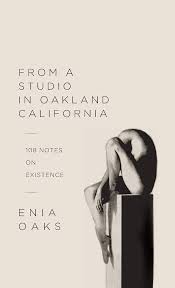
Book: From a Studio in Oakland California : 180 Notes on Existence Author: Enia Oaks Publisher: Self Published Year: 2025 Rating: 3.5 out of 5 stars
Synopsis : “This collection of poems and essays is for those who sit at the crossroads of past and future, wondering which way to turn. Those who have bravely restarted and are building new homes from within themselves. Those who believe in the grand experience of life and living it fully, even when it asks everything of them. Those hurting, healing, or transforming. For the ones who are seeking meaning or a deep exploration of the layers of existence.”
Review : Enia Oak’s debut book, From a Studio in Oakland California : 108 Notes on Existence is not to be read quickly, blown through, or breezed by; it’s made to be savored, slowly devoured, and meditated upon. It does not surprise me one bit to find this book of 108 missives to be a meditation – it’s spiritual in nature. Written in short blurbs, poems, and ideas, FASIOC is filled with logical life advice, imparted wisdom, and personal exploration. It is quite literally packed to the cover with information on how and why and when to grow, on the choices we make as humans, the way we stretch out for someone else to witness our lives, and how we might best look inward to see and gently tend our inner child as fully formed adults.
While Oaks’ synopsis / letter to the reader calls this book a “collection of poems and essays”, I would more likely call this an open letter to someone who’s going through therapy and doing the work to heal. Based on Oaks’ description, I was initially confused by the layout and conversive tone her poems and essays take. They don’t necessarily read as poems, certainly not so when you take the totality of the book under review, but they do read as essays directed toward the reader. Like I said, it reads like an open letter, not like a collection of poems. It really comes down to the naming of the thing, for me – if they weren’t named as poems, I wouldn’t take issue or feel surprised as a reader, but because I was expecting poetry, I found myself a bit taken aback and disconnected as I got into the meat of the book. I do feel that Oaks might have benefitted from a more formal editor / publisher rather than going the self-published route, it’s truly worth mentioning that I have dog eared this book from start to finish. While there are aspects that I feel read in a discordant way, small mistakes, and grammatical errors I wish weren’t included, Oaks has a distinctive point of view that has a place in this world. This book feels important for so many people.
I found Oaks’ work to be most successful in her most experimental forms, where we might call the style a poem (but again, I struggle to view most of these works as poetry), or where the style seems completely unique to the inner workings of Oaks’ mind. Most of the book is written in a direct way to “you”, perhaps at times the reader, perhaps at times the writer, perhaps at times our collective inner child. It’s less a work of interpretation for the reader, and more directions on how to live your life as told by a therapist – of whom Oaks is not, which is worth saying. I found so many pieces of this book aligning with my own lived experience, and while this did not feel profound, it did feel familiar. There were many reasons Oaks’ collection garnered 3.5 stars, but I want to remind you, reader, that that’s more than 50% and I did genuinely enjoy reading this one.
Advice : This book is already available to buy! If you’ve spent time in therapy I suspect you will enjoy this book. If you like a collection of small works that are quick and easy to read at your own pace with no deadline or need to speed your way through, I think you’ll enjoy this.
Book: The Tragedy of True Crime Author: John J. Lennon Publisher: Celadon Books Year: 2025 Rating: 4 out of 5 stars
Synopsis : “The Tragedy of True Crime is a first-person journalistic account of the lives of four men who have killed, written by a man who has killed. John J. Lennon entered the New York prison system with a sentence of twenty-eight years to life, but after he stepped in to a writing workshop in Attica Correctional facility, his whole life changed. Reporting from the cellblock and the prison yard, Lennon challenges our obsession with true crime by telling the full life stories of men now serving time for the lives they took. The men have completely different backgrounds – Robert Chambers, a preppy Manhattanite turned true-crime celebrity; Milton E. Jones, a seventeen-year-old who turned to burglary, only to be coaxed into something far darker; and Michael Shane Hale, a gay man caught in a crime of passion – and all are searching to find meaning and redemption behind bars. Lennon’s reporting is intertwined with the story of his own journey fro a young man seduced by the infamous gangster culture of New York City to a celebrated prison journalist. The same desire echoes throughout the four lives: to become more than murderers. A first-of-its-kind book of immersive prison journalism, The Tragedy of True Crime poses fundamental questions about the stories we tell and who gets to tell them. What essential truth do we lose when we don’t consider all that comes before an act of unthinkable violence? And what happens to the convicted after the cell gate locks?
Review :The Tragedy of True Crime is the answer to a question I’ve had but have not expressed : is there a sickness to our obsession with true crime? And the answer is a resounding yes. While this book is not exactly the deep dive into how or what the obsession with true crime does to a person, as the synopsis might have you believe, it does present a powerful insight into the nature of a life sentence and the desperate need in our country for prison reform. Written by a man who premeditated a brutal and senseless murder, The Tragedy of True Crime offers a truly unique look into the humanity of incarcerated people we tuck away into steel cages and so often forget. While I have my own thoughts about the prison industrial complex and what justice might look like, I found this book to be a compelling and imperative look into the reforms needed for people to truly experience healing – not just the victims, but the perpetrators themselves. We can carefully put a person behind bars, but if we do not provide them with the resources to heal, to understand, to self examine, and to potentially reform, then we do a disservice not only to the person, their victim(s), but to the community at large. After all, an eye for an eye only takes the world so far.
Our author, Lennon, dives deep into the lives of three men who are serving extended sentences for murder, but this is not a book about three men, it’s a book about four. As we navigate the life, crime, and life-after-sentencing of each of these three men, Lennon offers us a seemingly untarnished look into his own life, crime, and life-after-sentencing. I found Lennon’s own self reflection to be a necessary aspect of this book, but I would be remiss not to mention how deeply off-putting I found his own self review to be. In telling the stories of the three men in these pages, Lennon is kind, objective, and at times sympathetic to their struggles. He speaks gently about their crimes, about the scenarios that led them to their ultimate fate behind bars, allowing the reader to see the soft underbelly each man shelters away from the world. Lennon never once side steps or sugar coats their crimes, but he does strive to explain how each man might have come to the dire place where they committed a crime – or he at least attempts to as one of the men evades questions and makes excuses for himself; it’s with some semblance of a spoiler that I let you know we will likely never know what Robert Chambers did or how the murder he committed truly went down. But when it comes to Lennon’s own crimes, he’s brash, viewing the world in black and white terms, and his own self examination leaves me feeling as though the empathy he’s learned through journalism is no more than a mask he hides behind. But these are real humans I’m talking about and reviewing here, and I believe it would be harmful of me to speculate any further than that.
Perhaps it’s with no surprise that I tell you how conflicted this book has made me, how it’s forced me to examine my own feelings regarding those who take a life, and what I might reasonably expect out of someone’s incarceration. Again, these are real humans. Beyond any other aspect of the book, I find the humanization of these three incarcerated individuals to be the most compelling and important. There’s no question to guilt with any of these men, Lennon included, but there is a question of motivation. First, we have Michael Shane Hale (he goes by Shane), a man who experienced profound abuse as a gay child growing up in Kentucky in the 90s, and further abuse as a broken young adult living in New York on his own without a loving support system that might have shown him care and community – the aspects of gay culture our current world is trying so hard to dismiss and demolish. Shane committed a crime of passion, yes, but beyond that he committed a crime born of abuse, a crime against his abuser, and for that crime he was sentenced to the death penalty. And while Shane has spent decades in prison atoning for his crime (and subsequently having his sentence reduced once the death penalty was once more abolished), a man who committed similar crimes, though through different circumstances and with a serial pattern, was given a reduced sentence compared to Shane’s. He’s currently seeking release and it is with everything I have that I hope he receives clemency. Second, we have Milton E. Jones, a man who killed two priests in cold blood as a teenager, prompted to do so only because a friend suggested that he should. And while I struggle to be okay with this information, regardless of what he’s accomplished in prison (a master’s degree in a divinity program), what I find most disturbing about Milton’s story is that his time spent in prison has served only to provoke a mental illness that he was genetically predisposed to, and has subsequently caused intense damage to his mental and physical state. This is where our system fails people. Despite having a relationship with a family member of one of his victims, despite his friend receiving a reduced sentence, despite his accomplishments in school, he has little to no support for his mental health and, like all prisoners, he has little to no resources for how to heal the parts of himself that were damaged so many years ago before and during his crimes. Finally, we have Robert Chambers who is currently out of prison, having originally received a shortened sentence for manslaughter, but returned to prison on drug charges. And Chambers is perhaps the most frustrating of the three as we never quite get the fully story, we never quite hear his remorse. The motivation? We may never really know, and frankly that’s okay.
I found The Tragedy of True Crime to be an important and insightful narrative into the life of an incarcerated individual, living among rampant abuse from those who keep our prisons, among drug use and violence, often shuttled from place to place. This book made me question what I think and feel about our legal system in a way I found productive and necessary, but I did find Lennon’s writing to be a bit disjointed at times. As a long-form writer and contributor to magazines and print publications, it was clear to me that Lennon struggled a bit with a novel. This is where I find 4 stars rather than 5 to make sense, as there were multiple points throughout the book where I found myself going back to re-read due to complex and, at times, convoluted story telling. But it’s a first go and I suspect that’s to be expected. This book was thoughtful and worth the read, particularly if you do enjoy or partake in true crime retellings of crimes. But, like I mentioned above, I do not believe this book went as deeply into the tragedy of what true crime does to a person so much as it simply shone a light on our shared humanity and prioritized the need for prison reform. Take that how you will.
Advice : It’s worth stating that this book should come with some intense content warnings, such as murder, sexual violence, pedophilia, homophobia, transphobia, drug use, suicide, incest, power abuse, and mental illnesses. If you spend time in the world of true crime, I think this will be an important read for you. If you’ve often wondered how sick we might be for engaging with true crime, you’ll want to pick this book up.

 Paige Reviews Books