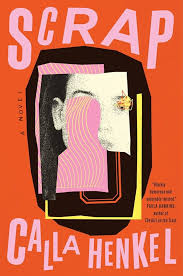
Book: Scrap
Author: Calla Henkel
Publisher: The Overlook Press
Year: 2024
Rating: 3.5 out of 5 stars
Synopsis : “Recently dumped and stuck with the mortgage, artist Esther Ray wants to burn down the world, but instead, she reluctantly accepts a scrapbooking job from the deliriously wealthy Naomi Duncan. The scrapbooks, a secret birthday gift for Naomi’s husband, Bryce, trace the Duncan’s twenty-five-year marriage. The conditions : Esther must include every piece of paper she’s been sent, must sign and NDA, and must only contact Naomi using the burner phone provided. Otherwise, she’ll spoil the surprise.
As Esther binges true-crime podcasts and works through the nearly two hundred books of Duncan detritus, she finds herself infatuated with the gilded family – until, mid-project, Naomi dies suspiciously. When Esther becomes convinced the husband killed her, she uses the scrapbooks’ trove of information to insert herself into the Duncan’s lives to prove it. But the more Esther investigates, the further she is dragged back to the scorched earth of her own past in the art world.
Laced with pitch-black humor and conspiratorial unease, Scrap is a razor-sharp examination of wealth and power, art and truth, of the line between justices and revenge – and who gets to cross it.”
Review : Sigh. Dear reader, I have struggled with how to write this review. In fact, this is my second try – my first felt…not quite right. I think the struggle I find with reviewing this book is, as I sit down to do this I find that I have reviewed this book before. And before you say anything, no I don’t mean you can scroll back and find Scrap reviewed in the annals of this blog, what I mean to say is this :
In the realm of thriller novels featuring a female narrator, there’s a pretty standard outline whose basic structure is as follows : a woman with some level of mental instability witnesses or becomes aware of some kind of crime; she attempts to investigate on her own despite a crumbling foundation of stability and awareness; she attempts to bring the crime to light by sharing what’s going on with the people in her life and / or the police; her credibility is questioned, maybe laughed at, never believed; she continues to investigate despite all logic saying otherwise; she finds herself in a stick situation where she very well might die; somehow, miraculously, she is saved from impending doom, the criminals are put behind bars, and her credibility is restored at least in part; the book ends.
Sound familiar? I’ve said it before and it remains true, you could head to your nearest bookstore, plant yourself in front of the thriller section, close your eyes, and grab a book at random and find the exact scenario outlined above in a good percentage of the modern thrillers you’d find on the shelf. In fact, this idea is so not unique to me, a mini series was made based on this exact premise : The Woman in the House Across the Street from the Girl in the Window. We’re being handed novel after novel after novel (written by different authors) all with the same regurgitated outline and being asked to be okay with it. Frankly, I’m not.
I wanted Scrap to be different; I hoped it would be unique. It was, sadly, not.
Henkel begins the novel by creating a world in which I cannot trust the storytelling right off the bat, by telling the reader that Esther and her now ex fiancé lived in a mountain cabin on 5 acres of land near Asheville, NC they bought for a whopping $110,000. Read that again. Now, I’m not sure what world Henkel lives in, where anything in the Asheville area would cost as little as $110,000, let alone a cabin with a garage slash workspace big enough to host a yoga class in, or say, 200 some boxes of papers for scrapbooking, on ANY acreage, but it certainly isn’t our 2024 world. Or our 2023 world. Or our 2022 world. And, while Esther is not reduced to the wine guzzling woman we so regularly see in these books, she does have a crumbling foundation, one foot barely grounded in reality as she binges true crime podcast after true crime podcast ad nauseam, working herself into an over exaggerated sense of justice.
We find Esther so hyped up by the idea that the police either can’t or won’t do their jobs that throughout the novel she comes to see herself as some kind of vigilante carrying out justice for those who might not otherwise see it served. As she begins to deep dive investigate the death of her employer, she begins to refer to herself as a podcaster, despite not even remotely having a podcast, spiraling further and further out of control. I found Scrap to be difficult to read at times, in a secondhand embarrassment kind of way, cringing at the lengths Esther would willingly go to, seemingly without any sense of self awareness, to find the so-called answers she was seeking. It was difficult to find myself wanting to continue to pick this book up.
I don’t think this book requires a long, drawn out review diving into the meaning of the book. It fit the outline I mentioned above, it was filled with plot holes (particularly at the end), and it was wholly unoriginal.
Advice : If you really, really enjoy thrillers, you just might like this one. If you like a queer FMC, a slow descent into madness, or the idea of an idyllic hippy village where you have to go down a mountain for wi-fi, you might just find yourself getting sucked into this one. If, however, you prefer something that makes you think, something that you can’t see coming a mile away, this is probably not going to be the one for you. And that’s okay.
 Paige Reviews Books