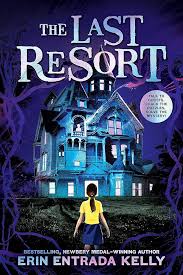
Book: The Last Resort Author: Erin Entrada Kelly Publisher: Scholastic Press Year: 2025 Rating: 4 out of 5 stars
Synopsis : “Just before her Grandpa Clem’s funeral, twelve-year-old Lila makes a shocking discovery. He didn’t die of natural causes – he was murdered. Possibly by someone who wanted to control his inn…and its secret portal to the afterlife. Now, a girl who’s vowed to become “less dramatic” must uncover her grandpa’s killer AND stop the ghosts desperate to make it back to our world.”
Review :The Last Resort is a super fun and enjoyable mid-grade read (grades 3-7) about the power of friendship, family, and finding places where you can be yourself. Lila, a twelve year old whose so-called best friends have described as “too much” and “overly dramatic” and, worst of all, “immature”, is ready for summer vacation so she can work on being as calm as a rock, as cool as ice, and as mature as her two besties think they are as they all head toward seventh grade next year. Her friends have stopped hanging out with her and have begun to hang out without her, she doesn’t have much time to regain their friendships. So when a relative she’s never met, Grandpa Clem, passes away unexpectedly and her family decides to travel out of state for his funeral, Lila is distraught. With the backdrop of frenemies / bullies who find Lila to be too much, we delve into Grandpa Clem’s world of ghosts, crystals, and portals to the world beyond the veil – a less than perfect scenario for a pre-teen who’s trying to be a lot less.
I thoroughly enjoyed this book, it was cute and fun and had some twists and turns that, while I saw coming, didn’t fully take shape until they’d arrived. It doesn’t talk down to the reader or assume the reader’s too young to understand new concepts and it presents unknowns and uncertainties in a way that makes it a true learning experience. I’m always pleased to find a middle grade read that doesn’t feel incredibly dumbed down for a kid to read and The Last Resort really held up. It did include some scary imagery, so I think this might be a proceed with caution book if you or your reader are a bit antsy when it comes to large spiders, the idea of death, or ghostly apparitions – but all in all I found it to be a safe and spooky walk on the paranormal side, perfect for fall! In the finished copy of the book, there will be ghostly illustrations who will come to life on the page via a QR code, which is such a fun addition to an already ghostly book, I think it’ll help bring the book to life in a way that’ll keep the reader thinking about it for a while.
While at Grandpa Clem’s inn, Lila meets a neighbor who’s her age, a boy named Teddy. It’s through Teddy’s friendship that Lila finds her place with someone who doesn’t view her as too much, who lets her be exactly who she is, and who doesn’t dismiss her as being an overly dramatic person. It’s an important lesson without being preachy, that bullies have no place in our lives, and that shrinking ourselves down to fit into the box of other people’s expectations makes us a shell of ourselves. In a world where even adults struggle with this concept, and even the concept of not being bullies to other adults, I found this messaging to be a refreshing change of pace from what we see day-to-day. Ultimately, Lila’s friendships are the cornerstone for this book, not the ghosts!
Finally, I gave this book 4 stars rather than 5 because I felt the ending was too abrupt and lacked the closure I wanted from it. It didn’t need to be drawn out or even significantly longer than it already is, but it would have benefitted from a little more than it received. I think the door was left open for further books down the road, and I’m not ashamed to tell you that this adult will absolutely be reading whatever Kelly comes up with next if she decides to continue this book into a series!
Advice : If you have enjoyed any iterations of Disney’s Haunted Mansion (including the ride), I think you’d enjoy The Last Resort! As advised above, if you or your reader have any squeamishness around spiders, near death experiences, dogs, crows, the threat of death, or ghosts, this might be one you approach cautiously. I think it’s the perfect amount of spooky and calm – a great way to dip the toes into a paranormal subject without diving in head first and scaring the bajeesus out of yourself.
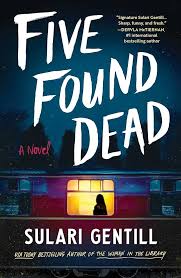
Book: Five Found Dead Author: Sulari Gentill Publisher: Sourcebooks Year: 2025 Rating: 3.5 out of 5 stars
Synopsis : “Crime fiction author Joe Penvale has won the most brutal battle of his life. Now that he has finished his intense medical treatment, he and his twin sister, Meredith, are boarding the glorious Orient Express in Paris, hoping for some much-needed rest and rejuvenation. Meredith also hopes that the literary ghosts on the train will nudge Joe’s muse awake and he’ll be inspired to write again. And he is; after their first eventing spent getting to know some of their fellow travelers, Joe pulls out his laptop and opens a new document. Seems like this trip is just what the doctor ordered… And then some. The next morning, Joe and Meredith are shocked to witness that the cabin net door has become a crime scene, bathed in blood but with no body in sight. The pari soon find themselves caught up in an Agathy Cirstie-esque murder investigation. Without any help from the authorities and with the victim still not found, Joe and Meredith are asked to join a group of fellow passengers with law enforcement backgrounds to look into the mysterious disappearance of the man in Cabin 16G. But when the steward guarding the crime scene is murdered, it marks the beginning of a killing spree that leaves five found dead – and one still missing. Now Joe and Meredith must fight once again to preserve their newfound future and to catch a cunning killer before they reach the end of the line.”
Review : It takes a certain level of gumption to write a new take on a famously done murder mystery, possibly none as more culturally known as Murder on the Orient Express, and while I enjoyed much of Five Found Dead, it simply did not live up to Agatha Christie’s famous work. Gentill, to her credit, does much work to lay a foundation wherein her novel would not simply be a retelling, but a fairly meta mystery involving an author, a couple podcasters, and a whole host of law enforcement attempting to sold a crime all while existing within a world in which Murder on the Orient Express might cloud ones perspective of such an incident. It is from this perspective that the entirety of the book ultimately begins to unravel – there are far too many characters, at least a few of whom we rarely interact with; far too much extraneous story-telling happening, some of which does seem to be an attempt at red herring; and far too many details to make this a succinct murder mystery, or really anything that might ever stand up to Christie’s work. And while I think it might be a bit unfair to compare Five Found Dead with Murder on the Orient Express, it’s also exactly what one asks to be done when writing a book about a murder (nay, murders) upon the very Orient Express Christie herself wrote about.
Joe Penvale, a famous murder mystery writer, has undergone an intense period of cancer treatment and upon finding himself in remission, has taken himself and his sister on the trip of a lifetime : a train ride on the famous Orient Express. Gentill managed to set a perfectly cozy scene aboard the train, and after reading her acknowledgments I can clearly understand why, for she herself endured medical treatments and a ride upon the Orient Express. Her understanding of what sets a cozy scene does feel perfectly in line with what I’d like in a murder mystery, even what I’d like within a locked door mystery, but beyond this scene setting, I found the gross majority of the book to be a conundrum. To begin, while Joe and Meredith are twin siblings with a shared family trauma, I found their relationship to be odd and uncomfortable at times. I’m not sure if they were mirrored after a family relationship Gentill has or if they were simply conjured out of thin air, but I did not find believability within their world in the least. If we can look past the strangeness of their written relationship, we find ourselves enmeshed within a world where Covid still has a grip – I was unable to determine during what time frame this story was set and we are given no clues beyond the fact that Covid is still creating new variants. Is there a new variant ravaging the world? Perhaps this was set a few years ago? Or even 2020? It’s unclear and the answer is never given. ***Any further reading will reveal SPOILERS AHEAD*** There is an entire subplot in which we find several passengers have tested positive for a new and deadly variant, a small detour I believe Christie would have used in her own writing, but nonetheless, without more details I found it to be added confusion in a story that is already more confusing than I necessarily agree with.
Upon awakening after their first night aboard the train, Joe and Meredith find that the man in the cabin next to theirs has been murdered or has at least gone missing. What follows is a strange and chaotic 24-48 hours whereby multiple passengers test positive for Covid, five people are murdered, and at we discover that at least seven of the passengers aboard are members of varying international police forces. We encounter so many needless characters that it quickly begins to feel superfluous and needlessly confusing – I suspect in part at least to mimic Christie’s work, but it simply doesn’t play out in a way that lends any ease to the reader. There are so many side trails and intentional red herrings that by the time we do finally unmask our criminal(s) it feels strange, tangled, and frustrating (which, to my mind, is the exact opposite of what you want from a murder mystery reveal). I will say, I was able to determine fairly easily who the man in the cabin next to the Penvale’s actually was, though this does not mean I was able to determine who the killer was. I warned you, here be spoilers. While I won’t reveal the exact nature of the crimes and perpetrators, I will tell you that in the end, it was anticlimactic and disappointing to find the truth. Not to mention, the final chapter reveals an entire podcast episode whereby Gentill undoes much of the convoluted work she’d laid out for us, creating further confusion and disappointment in the ending. I did not find myself pleased with the end result.
Gentill has managed to create a cozy atmosphere aboard the Orient Express, allowing the reader to feel, truly, as if they were on board themselves. Beyond that, however, I found the work to be needlessly convoluted and had to return to past pages to reread sections that didn’t make much sense. It wasn’t exactly what I was hoping for. The ending left much to be desired, the second ending even more so, and with a cast of characters limited to those aboard a train, I suspect many readers will be able to sniff out at least one of our criminal elements prior to the “big reveal”. To her credit, Gentill, unlike Christie, has given the reader enough breadcrumbs to figure things out on their own (for the most part) and, even if I didn’t agree with how it all turned out, I do enjoy that aspect of things. All in all, it was fine, I felt cozy, but it wasn’t deeply satisfying or even tremendously challenging. Take that how you will.
Advice : You may find this to be a worthwhile and perhaps even enjoyable read if you love the genre and consume anything you can within it. However, I suspect you will be comparing it to Christie’s works along the way and in that respect, you may not enjoy it at all. It’s 50/50 – maybe check it out from the library before committing to buying. Happy sleuthing!
To be honest, I fully intended to give each of these books their own individual reviews, but time got away from me and here we are! Let’s dive in :
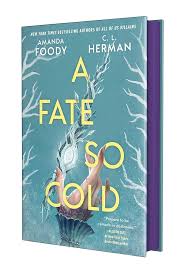
Book: A Fate So Cold Author: Amanda Foody & C. L. Herman Publisher: Tor Teen Year: 2025 Rating: 4 out of 5 stars
Synopsis : “For most of the year, Summer reigns peacefully over Alderland. Then, for six brutal weeks, Winter rages, obliterating towns and wreaking casualties. Magicians bond with powerful wands of Summer to defend the nation, a duty that costs many their lives. Domenic Barrow never wanted such responsibility – but destiny hasn’t granted him a choice. The greatest Summer wand has awakened for the first time in a century, warning that any icy cataclysm looms on the horizon. And despite his reputation as the last suited of his classmates, the and chooses Domenic to wield it. Ellery Caldwell spent years striving to be a perfect Summer magician – and burying her fears of her own power. But her worst suspicions are proven true when she accidentally creates the first ever Winter wand. Now, as the unprecedented Chosen Two, Domenic and Ellery must thwart the oncoming cataclysm together. And in trying to fulfill their destinies, they wonder if they were brought together for a second fate : to fall in love. Until they discover the unthinkable truth. The Chosen Two aren’t fated allies, but eternal rivals, and the only way to save their home is for one of them to slay the other.”
Review :A Fate So Cold is a quick and enjoyable page-turning ‘chosen one’ fantasy that left me wishing book two would come out already! Told between bouncing perspectives, it guides the reader through the winding world of Summer and Winter – and teases the idea that a peaceful world where Summer reigns for 90% of the year might not actually be the ideal. When our protagonist and budding antagonist are chosen by their wands, we fall headfirst into a sweet and idealistic closed-door romance that feels like just enough personal story in the midst of heart racing suspense. This is certainly no cozy fantasy story, so if a sweaty palm fantasy isn’t for you, you might want to skip this one. I found the story to be unique and enjoyable, though I did find small reminders and little hints toward outside inspiration like the Magicians trilogy, the obvious “Winter is coming” of it all as we might have read (or watched) in Game of Thrones, and the wand ceremony from Harry Potter. And while there were small reminders and hints to outside works, none of them felt like direct replicas or served to remove me from the story. All told, this was a fast paced and fun fantasy read with just enough suspense and just enough of a cliffhanger at the end to leave me ready for the next book.
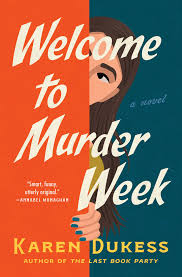
Book: Welcome to Murder Week Author: Karne Dukess Publisher: Scout Press Year: 2025 Rating: 4.5 out of 5 stars
Synopsis : “When thirty-four-year-old Cath loses her mostly absentee mother, she is ambivalent. With days of quiet, unassuming routine in Buffalo, New York, Cath consciously avoids the impulsive, thrill-seeking lifestyle that her mother once led. But when she’s forced to go through her mother’s things one afternoon, Cath is perplexed to find tickets for an upcoming “murder week” in England’s Peak District: a whole town has come together to stage a fake murder mystery to attract tourism to their quaint hamlet. Baffled but helplessly intrigued by her mother’s secret purchase, Cath decides to go on the trip herself—and begins a journey she never could have anticipated. Teaming up with her two cottage-mates, both ardent mystery lovers—Wyatt Green, forty, who works unhappily in his husband’s birding store, and Amity Clark, fifty, a divorced romance writer struggling with her novels—Cath sets about solving the “crime” and begins to unravel shocking truths about her mother along the way. Amidst a fling—or something more—with the handsome local maker of artisanal gin, Cath and her irresistibly charming fellow sleuths will find this week of fake murder may help them face up to a very real crossroads in their own lives. Witty, wise, and deliciously escapist, Welcome to Murder Week is a fresh, inventive twist on the murder mystery and a touching portrayal of one daughter’s reckoning with her grief, her past—and her own budding sense of adventure.”
Review : I absolutely adored Welcome to Murder Week! I had no idea a book about a fictional murder mystery game would be exactly what I needed in my life, but it turns out it was. I did refrain from a 5 star review, though, due to the slow start. I found myself moving at a snail’s pace as the book began, but once things got rolling, boy did they. Sweet, wholesome, and a wonderful good time, Welcome to Murder Week is perfect for anyone who grew up watching Poirot movies, reading Agatha Christie, enjoying Murder She Wrote, or lives for a cozy mystery in book, tv, or movie form. As three strangers work together to solve a fictional murder mystery in a quaint English town, they find themselves growing together as close friends. What began as a quirky tourist trip, though, quickly becomes a deeper and more meaningful adventure for our protagonist, Cath, that we could even have expected. In moments of tenderness, we find Cath retracing steps that seem strangely familiar, despite having never visited the English countryside; we witness the healing of generational trauma, and we experience the joy of watching her story completely turn on its head and unfold in the most beautiful way. This book will make you laugh out loud while simultaneously making you cry. It’s everything I didn’t know I needed and more. Absolutely well done.
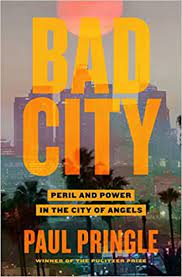
Book: Bad City Author: Paul Pringle Publisher: Celadon Books Year: 2022 Rating: 4.5 out of 5 stars
Synopsis: “On a cool, overcast afternoon in April 2016, a salacious tip arrived at the Los Angeles Times that reporter Paul Pringle thought should have taken, at most, a few weeks to check out: a drug overdose at a fancy hotel involving one of the University of Southern California’s shiniest stars – Dr. Carmen Puliafito, the head of the prestigious medical school. Pringle, who’d long done battle with USC and its almost impenetrable culture of silence, knew reporting the story wouldn’t be a walk in the park. USC is one of the largest private employers in the city of L.A. and it cast a long shadow. But what he couldn’t have foreseen was that this tip would lead to the unveiling of not one major scandal at USC but two, wrapped in a web of crimes and cover-ups. The rot rooted out by Pringle and his colleagues at the Times would creep closer to home than they could have imagined – spilling into their own newsroom. Pack with details never before disclosed, Bad City goes behind the scenes to reveal how Pringle and his fellow reporters triumphed over the city’s debased institutions, in a narrative that reads like L.A. noir. This is L.A. at its darkest and investigative journalism at its brightest.”
Review: I have to say, I feel like a bit of a schmuck giving a Pulitzer Prize winning author 4.5 out of 5 stars, but here we are. I want to start by disclosing that I did not finish this book, though I got 232 pages into it’s 270 pages of narrative and perhaps I could have finished it given how far I’d come, but boy did this one weigh on me. Let’s start by identifying the content warnings, because I’m not sure we can delve into a book based solely around drug abuse without first talking about what the book details. Bad City describes, often in detail, the supply and abuse of drugs by a person in power, the supply and abuse of drugs as a means of power and control, prostitution, both with and without drug abuse, sexual abuse, and sexual assault. It’s likely and possible that there are further warnings I should give you, as I stopped reading when we got to a section on blatant sexual abuse, medical misconduct, and USC’s history of enabling such behavior from its staff members.
This is one of those books that makes you want to rip your hair out, or rip pages out, or both maybe, while you scream at the top of your lungs. It is infuriating to read about how people in power work so hard to enable others within their sphere to do detrimental harm to those with less power and resources. It’s infuriating to see the struggle of someone who’s working to uncover the truth, particularly when their work is blocked at every turn. It’s infuriating to read this knowing that this is perhaps indicative of most major news networks through the country, wondering what else we aren’t privy to because people in power are using their seemingly unlimited resources and connections to tamp down any bit of truth. Carmen Puliafito, the former dean of USC’s medical school, behaved in a way that indicated he believed he was above the law. Pringle discovered that Puliafito had allowed himself, and even instigated, to be filmed in the presence of drugs and even using drugs (meth, I believe, but Pringle also uncovered that he was using heroin as well) all while he was not only leading future medical professionals, but continuing to operate, as a world-renown ophthalmologist. The head of USC was alerted to this danger, as were the editors of the Times and not one single person in these positions of power thought it was more important to ensure the safety of everyone involved by removing Puliafito than it was to uphold an image.
I gave this book half a star less than a 5 because it’s one of those books that has so many characters, some of whom share the same first name, most of whom have intricate job titles and functions within the newsroom, that in order for it to remain clear there needs to be a list of individuals and their relation to the story and/or narrator at the beginning of the book. There were times where Pringle would refer to someone exclusively by their last name within the newsroom, but would share email correspondences with them where their first name was used and things got confusing. I gave up on figuring out who some of the players in this story were about halfway through because I wasn’t sure when they’d been introduced in order to flip back and forth to figure out what role they were playing. While the majority of what I read was hard hitting and pointed, the name and occupation confusion definitely muddied the waters.
The synopsis indicates there are previously unreported aspects to this story that are only revealed with the publishing of Bad City and nothing about that was surprising to me as I read through it. This book, in fact, was not an advanced reader copy – the copy I got, while it arrived prior to the official publication date of July 19, is a final corrected version of the story. We were asked to write our reviews prior to the publication date, and I think there’s a lot said in those details alone. Pringle’s own editors were fired by the time all of the details about Puliafito and USC went live, some two years after the initial tip came across Pringle’s desk – their severance was preceded by an internal investigation that spanned a vast majority of senior management within the Times. There were many details Pringle was unable to publish at the time the story broke, due completely to the work of his editors who had close ties to USC.
I found myself fascinated by the inner workings and convoluted network of people who both graduated from USC and work to run the city of L.A. From city officials to the LAPD, the network of deception and rot spreads far and wide. While Pringle’s reporting was able to uncover important aspects of the network, I suspect we will never fully understand just how far reaching its roots run. I will say, there was something vindicating about finding out that the bad guys were sniffed out and got what was coming to them in terms of being fired and, in Puliafito’s case, losing his license to practice. While it’s so satisfying to see the corruption come into the light and the players involved get exactly what they had coming, all the things they thought they were so powerful and wealthy they could avoid, it doesn’t make up for the fact that in reading this book we still had to undergo reading the details.
Advice: If you like a good true crime story that doesn’t involve murder, this is a great read for you. It’s scandalous and corrupt and gives a detailed look behind the scenes of the investigation that uncovers the truth behind USC’s involvement in Carmen Puliafito’s career, resignation, and coverup. The synopsis was correct, this book reads like an L.A. noir and if that’s your jam then you’ll probably love Bad City. If you’re sick of seeing the bad guys get away with everything they think they can get away with then you’ll probably find this book satisfying and vindicating. If, however, you read through the content warning at the beginning of the review and felt like this might be too much, I can all but guarantee that it will be. Tread lightly here if you’re feeling overwhelmed already, this book is dark and heavy and a little too real.
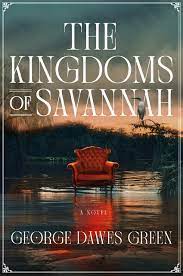
Book: The Kingdoms of Savannah Author: George Dawes Green Publisher: Celadon Books Year: 2022 Rating: 3.5 out of 5 stars
Synopsis: “Savannah may appear to be ‘some town out of a fable,’ with its vine flowers, turreted mansions, and ghost tours that romanticize the city’s history. But look deeper and you’ll uncover secrets, past and present, that tell a more sinister tale. It’s the story at the heart of George Dawes Green’s chilling new novel, The Kingdoms of Savannah. It begins quietly on a balmy southern night as some locals gather at Bo Peep’s, one of the town’s favorite watering holes. Within an hour, however, a man will be murdered and his companion will be “disappeared.” An unlikely detective, Morgana Musgrove, doyenne of Savannah society, is called upon to unravel the mystery of these crimes. Morgana is an imperious, demanding, and conniving woman, whose four grown children are weary of her schemes. But one by one she inveigles them into helping with her investigation, and soon the family uncovers some terrifying truths – truths that will rock Savannah’s power structure to its core. Moving from the homeless encampments that rings the city to the stately homes of Savannah’s elite, Green’s novel brilliantly depicts the underbelly of a city with a dark history and the strangely mesmerizing dysfunction of a complex family.”
Review: When I received this ARC, I was pleasantly surprised to find a little blurb by one of my favorite authors, Neil Gaiman, that called this book “The apotheosis of Southern Gothic Noir.” Of course this made me want to read it all the more, and what perfect timing it was, arriving just as I finished In the Shadow of Lightning, so I cracked it open right away. I found myself confused and disappointed, though, by the way Kingdoms played out and I feel fairly well baffled trying to explain the complexities that went wrong in this book. I think the only place to start is with the disparities between the synopsis and the actual book, so let’s begin there.
The back cover refers to Morgana Musgrove as an unlikely detective, leading one to believe this will unfold as a murder mystery should: with a detective, with clues unraveling, and with a clear and defined story arc. What actually happens is far from what I’ve described. While Morgana plays a central role in the first third of the book, she falls into the background as other members of her family take center stage. Told from several differing points of view, we’re lead to believe based on the foundation of the book that while we’d jump between a few different family members, we would ultimately come back to Morgana, the backbone of the story. What actually happens is we get a base that the book is built upon and rather than return to Morgana, we find ourselves spending the majority of the book with her granddaughter Jaq. And that would be okay, given that Jaq is and interesting character with a great point of view, but Jaq is conducting her own investigation into aspects of the events that aren’t really the same as what Morgana is looking into.
The second issue I have with the book is the way in which Morgana speaks. Granted, she’s married into old Savannah money but she actually comes from a small town in Georgia; however, she behaves and speaks in a manner that gives away none of her upbringing. We’re given a small glimpse into what her thought process was when she moved to Savannah and began to infiltrate upper society, but her background remains largely unknown other than a small section that mentions she never retained her country twang, assimilating smoothly into a more Savannah way of speaking. On page 16 (the first chapter still!) we get a flashback from her son, Ransom, into just what kind of absurd creature Morgana truly is and I can’t think of a better way to describe the outlandishness than by simply letting you see for yourself: “Then at the front steps he has one more memory. Thirteen years old. Standing out here awaiting the carpool to school and daydreaming, when his mother appeared on the balcony. Although it was a bright sunny morning, she was drunk. Clearly she’d been out partying the night before and hadn’t been to bed yet. She began to disparage him in the third person, one of her favorite pastimes. She said, “While the kid dawdles there like an idiot, gathering wool, concocting his little fantasies about how the world should be, the real world keeps marching on, doesn’t it? Clomp clomp clomp, crushing his little dreams. Does he even notice? No, he’s too stupid. Is he going to be a hobo? Well, yes, that’s certain, unless he gets some ambition and starts kiting checks. Ha ha ha.” I don’t know about you, but that does not a drunk monologue make.
My third problem with the book are the little tidbits thrown into the plot that seem to surely have somewhere to go but fizzle out without so much as another mention. Some spoiler alerts here, so be warned! As the story progresses, we find that one of the central characters is being held hostage in one of several underground tunnels that were used during prohibition era, tunnels that bootleggers would use to store and transport contraband. The character has been spirited away into the tunnels by a cylindrical tube out in the middle of the woods, but we’re told at a few different places in the story that Morgana’s late husband had relatives who made their money as bootleggers back in the day. This is such an important tidbit of information that Dawes Green spends no less than three different instances describing the ominous door in the basement of the Musgrove home that supposedly leads into these very tunnels – in fact there are other homes with similar doors, though the other home’s doors are rumored to be closed up and filled in. I kept waiting for someone to open the door in the Musgrove basement and find their way down into the tunnels, but after it’s mentioned several times it simply…goes away. We don’t hear of it again and it’s never turned into a distinctive plot point. There are several instances of tidbits of interest dissolving into nothing, leaving me feeling confused as to their purpose and frustrated that they were dangled in front of me for nothing.
The last issue I’m going to mention is the fact that Jaq is Black. There are so few descriptors in this book that when I realized Jaq was a member of the Musgrove family, I found myself flipping back and forth trying to determine if I’d entirely misread every aspect of the Musgroves. Were they actually Black too? Was I misunderstanding that they were a white old money family? It took another one, maybe two, chapters before Jaq’s connection and background were unveiled, which was far too long to go without an understanding of who and what I’m reading. I don’t always need extremely detailed descriptions of characters to feel fulfilled and confident reading a character, but the basics are important especially if you’re going to hinge the entire story on Black history in Savannah – another spoiler, perhaps. I left the book having essentially no idea what any of the characters look like, other than knowing that about halfway through the book it’s mentioned that Ransom, Morgana’s son, has a beard. At that point I was so baffled about what he may or may not look like that the beard fully threw me off and I gave up trying to discern anything about it. Turns out I didn’t need to, as he went the way of Morgana, a central figure in the beginning of the novel who fizzled out about halfway through the book.
There are a lot of twists and turns in Kingdoms, twists and turns we aren’t privy to as readers. When Morgana solves the mystery in the end, it’s a confounding aha moment that ends up being quite the let down. We haven’t seen much of Morgana by the time she reveals how she’s solved the mystery and we’re never really given any specifics as to how she was able to unravel the details. As readers, we’re able to see a lot of what’s going on and make our own deductions, but it’s never made clear how in the world Morgana might have come to the conclusions she makes, and that leaves me disappointed; it takes all the punch out of the ending, to be completely honest. On top of which, we spend the entire book reading whispers of a treasure, a hidden treasure somewhere in Savannah, a treasure so important that people are willing to kill for it. It’s built up and built up and built up in such a way that when it’s revealed and we find it’s not exactly what we’d been expecting or hoping to find, the treasure ends up being quite the let down as well. The fact of the matter is that the treasure reveal should have been the most amazing part of the entire story, the treasure (spoiler alert!!!) is not monetary at all, it’s an archeological finding of an entire free Black colony pre-civil war, living on an island in Savannah. What I love about this treasure story is that it’s actually historically accurate though no one has yet been able to find the archeological remains as the particular island they lived on was a secret and has such been lost to time. It’s likely that with time and money and some high tech ground penetrating radar, the remains could be found, and that’s exactly what happens in Kingdoms. The treasure that everyone is willing to die for is simply the rights to develop crappy condos and apartment buildings on a swampy island in the middle of nowhere. It’s…lacking.
At the end of the book, Dawes Green spends 6 total pages explaining some of the historical facts and significance of some of what he’s written about. Those 6 pages were more interesting to me and, in my opinion, more well written than the entire rest of the book, and I think that’s really something. I love all the details provided in Kingdoms, but at the end of the day in order to tell the story he wanted to tell, I think Kingdoms could have been written completely differently and it would have made a much greater impact. I didn’t leave this book continuing to chew over the details or stew about what did or didn’t go down, I finished it and I put it down, and that’s the mark of a book poorly designed. I have to think, surely there’s no way that Neil Gaiman read this book.
Advice: If you like Southern Gothic Noir fiction, I really don’t think this fits the brief other than it’s set in the old south and includes a murder or two. If you like murder mysteries, this might be something you’d be interested in, but realistically it didn’t satisfy this mystery lover. I think it’s worth the read if it’s given to you for free or if you find it on sale somewhere. Otherwise, pick it up in the bookstore, flip to the back and read the 6 pages that mention the historical accuracies included in it – that should lead you down a rabbit hole of books and topics that would be well worth your time.
 Paige Reviews Books