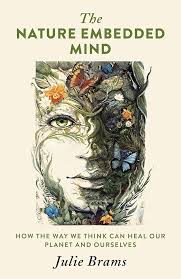
The Nature Embedded Mind Review

Book: The Nature Embedded Mind
Author: Julie Brams
Publisher: Changemakers Books
Year: 2025
Rating: 4 out of 5 stars

Synopsis :The Nature Embedded Mind explores some of the most vital questions our culture is facing, regarding the broken relationship between humans and nature. Our persistent and shared delusion that we are different from the rest of nature is at the heart of why we behave in ways that destroy our own habitat. Focusing on our personal and collective beliefs, The Nature Embedded Mind shows how we can begin healing the most important relationship we have, our relationship with Earth. These pages combine the latest scientific research, personal stories, and writing prompts that will allow you to expand your own thinking. Challenging Western psychology, this book aims to prioritize its offered repair as the new foundations for mental health and social wellness.”

Review : The Nature Embedded Mind, while written by a psychotherapist and geared toward therapists and allied professionals, is ultimately a book for everyone. You might think a book about letting our collective repair with that natural world expand outward into the repair necessary with other humans would be specifically for those who already feel a deep connection with the Earth, but realistically, the message of this book is for every person on this planet. That message is namely that if we can begin to reframe our human perception of the Earth and the other-than-human beings who live here with us as being less about hierarchy and more about coexistence with our siblings, we may very well be able to find ourselves in a place that is less caustic, less inflamed, and less ill.

Over the years I’ve read several books on the benefits of Forest Bathing and how one might go about participating in such an event. Brams has created a work that does more than delve into the positive impact Forest Bathing might have on a person’s psyche; she’s created a work that’s gathered scientific data around how we as humans interact with the natural world and how we not only gain benefits from it, but how we might benefit the world around us in a relationship of equal exchange. If you’re a fan of Robin Wall Kimmerer, not only will this concept not be new to you, it will likely be quite welcome to read. While not overt, Brams readily suggests a concept that will be familiar to anyone who’s studied yoga : we are the microcosm of the macrocosm. Meaning? What happens in the natural world is reflected within our own being and vice versa. Brams suggests that we’re experiencing a collective awakening and desire to return to something we may have only experienced in childhood, a freedom that comes from an unfettered connection to and collaboration with the world around us. When we stop viewing the world and the non-human life that exists within it as separate from ourselves, Brams says, we can start to experience the necessary perspective shift for a new way of life to unfold.

The Nature Embedded Mind reads like a both manual for reshaping and reframing our collective ideals about the natural world and an introduction into the world of Forest Therapy (Brams is certified by the Association of Nature and Forest Therapy, or ANFT, and regularly leads walks for those in her area). There are periodic writing and experiential prompts throughout the book that are geared toward gently shifting the reader’s mindset away from our standard collective idea that humans exist on a hierarchy outside of nature, somehow both separate from it and at the top of the pyramid within it. The prompts allow for playfulness and exploration, and paired with the way Brams speaks about nature, it’s a gentle shaking of the norms so that the reader has the freedom within a container to begin to safely consider how they think about and interact with the non-human world around them. Concluding with a prompt that comes directly from Nature Therapy, Brams has given the reader ample room to begin their own immersive journey into forest bathing techniques, or at minimum, to begin to explore the idea of what a deeper relationship with the Earth might look like outside of a modern, Western point of view.

I found this book to be incredibly necessary and timely. I’ve already recommended it to several friends : therapists, those in therapy, and other folks in allied professions that are doing the work on their own and beginning to question if the ways we interact with the world around us are truly serving our collective consciousness. I found Brams to be quite relatable as an author and enjoyed her perspective immensely. I expected as I dove into the book that I would already have a nature embedded mind, as I consider myself pretty connected to the planet, an outdoorsy kind of gal who views herself as part of nature rather than something disconnected from it, but Brams truly challenged my way of thinking and helped me turn some of my thought patterns around on their head. It’s easy to view humanity as the top of the food chain, sitting pleasantly at the top of a hierarchical caste of sorts, but the reality is that we live in tandem with the world around us, it’s completely intertwined and our own existence is reliant on the existence and persistence of the whole of the Earth. As we witness destruction on new and unparalleled levels each year, and seemingly worse each day, finding our way back to the understanding that we are no different than the other-than-human creatures who live on this planet feels imperative to the collective survival of, frankly, everyone and everything. If the soil is as similar to me as my own hand, wouldn’t I fight long and hard to keep the soil healthy? If I enjoy time in nature as I would time with a friend, wouldn’t I take the time to clean up some trash? To fight for legislation that keeps the body of Earth well? Wouldn’t I consider her my home rather than an object?

The Nature Embedded Mind is a quick read but it’s worth taking your time with. It explores the idea that we aren’t so different from the planet and that the planet isn’t so different from us. It’s a reminder that as humans we aren’t actually separate from nature at all, but truly part of nature just like everything else on this planet. And finally, it’s an invitation to explore ways in which you connect with the planet, inviting the reader to try their hand at simply existing with the planet, to forest bathe or to seek out forest therapy or to just sit and be connected with a friend (the Earth, her abundance, her creatures, and her cycles). It’s a necessary way forward. Perhaps it’s the only way forward.

Advice : If you experience the deep, unsettled feelings of doom connected to climate change, practice meditation, enjoy being in the woods or smelling flowers or watching bees flit from flower to flower, if you’re a therapist, a yoga or Ayurveda practitioner, an activist, or simply a human being navigating existence on a planet that feels daily more and more disconnected from your life, this book is truly for you. It’s a quick read but it’s packed full of insight and wisdom and filled with journal prompts and ideas for how you might connect more deeply with the world around you and ultimately reshape your understanding of the Earth and your relationship with it.
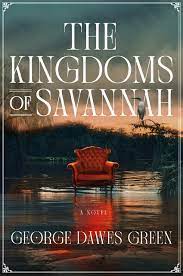
The Kingdoms of Savannah Review

Book: The Kingdoms of Savannah
Author: George Dawes Green
Publisher: Celadon Books
Year: 2022
Rating: 3.5 out of 5 stars

Synopsis: “Savannah may appear to be ‘some town out of a fable,’ with its vine flowers, turreted mansions, and ghost tours that romanticize the city’s history. But look deeper and you’ll uncover secrets, past and present, that tell a more sinister tale. It’s the story at the heart of George Dawes Green’s chilling new novel, The Kingdoms of Savannah.
It begins quietly on a balmy southern night as some locals gather at Bo Peep’s, one of the town’s favorite watering holes. Within an hour, however, a man will be murdered and his companion will be “disappeared.” An unlikely detective, Morgana Musgrove, doyenne of Savannah society, is called upon to unravel the mystery of these crimes. Morgana is an imperious, demanding, and conniving woman, whose four grown children are weary of her schemes. But one by one she inveigles them into helping with her investigation, and soon the family uncovers some terrifying truths – truths that will rock Savannah’s power structure to its core.
Moving from the homeless encampments that rings the city to the stately homes of Savannah’s elite, Green’s novel brilliantly depicts the underbelly of a city with a dark history and the strangely mesmerizing dysfunction of a complex family.”

Review: When I received this ARC, I was pleasantly surprised to find a little blurb by one of my favorite authors, Neil Gaiman, that called this book “The apotheosis of Southern Gothic Noir.” Of course this made me want to read it all the more, and what perfect timing it was, arriving just as I finished In the Shadow of Lightning, so I cracked it open right away. I found myself confused and disappointed, though, by the way Kingdoms played out and I feel fairly well baffled trying to explain the complexities that went wrong in this book. I think the only place to start is with the disparities between the synopsis and the actual book, so let’s begin there.


The back cover refers to Morgana Musgrove as an unlikely detective, leading one to believe this will unfold as a murder mystery should: with a detective, with clues unraveling, and with a clear and defined story arc. What actually happens is far from what I’ve described. While Morgana plays a central role in the first third of the book, she falls into the background as other members of her family take center stage. Told from several differing points of view, we’re lead to believe based on the foundation of the book that while we’d jump between a few different family members, we would ultimately come back to Morgana, the backbone of the story. What actually happens is we get a base that the book is built upon and rather than return to Morgana, we find ourselves spending the majority of the book with her granddaughter Jaq. And that would be okay, given that Jaq is and interesting character with a great point of view, but Jaq is conducting her own investigation into aspects of the events that aren’t really the same as what Morgana is looking into.

The second issue I have with the book is the way in which Morgana speaks. Granted, she’s married into old Savannah money but she actually comes from a small town in Georgia; however, she behaves and speaks in a manner that gives away none of her upbringing. We’re given a small glimpse into what her thought process was when she moved to Savannah and began to infiltrate upper society, but her background remains largely unknown other than a small section that mentions she never retained her country twang, assimilating smoothly into a more Savannah way of speaking. On page 16 (the first chapter still!) we get a flashback from her son, Ransom, into just what kind of absurd creature Morgana truly is and I can’t think of a better way to describe the outlandishness than by simply letting you see for yourself:
“Then at the front steps he has one more memory. Thirteen years old. Standing out here awaiting the carpool to school and daydreaming, when his mother appeared on the balcony. Although it was a bright sunny morning, she was drunk. Clearly she’d been out partying the night before and hadn’t been to bed yet. She began to disparage him in the third person, one of her favorite pastimes. She said, “While the kid dawdles there like an idiot, gathering wool, concocting his little fantasies about how the world should be, the real world keeps marching on, doesn’t it? Clomp clomp clomp, crushing his little dreams. Does he even notice? No, he’s too stupid. Is he going to be a hobo? Well, yes, that’s certain, unless he gets some ambition and starts kiting checks. Ha ha ha.”
I don’t know about you, but that does not a drunk monologue make.

My third problem with the book are the little tidbits thrown into the plot that seem to surely have somewhere to go but fizzle out without so much as another mention. Some spoiler alerts here, so be warned! As the story progresses, we find that one of the central characters is being held hostage in one of several underground tunnels that were used during prohibition era, tunnels that bootleggers would use to store and transport contraband. The character has been spirited away into the tunnels by a cylindrical tube out in the middle of the woods, but we’re told at a few different places in the story that Morgana’s late husband had relatives who made their money as bootleggers back in the day. This is such an important tidbit of information that Dawes Green spends no less than three different instances describing the ominous door in the basement of the Musgrove home that supposedly leads into these very tunnels – in fact there are other homes with similar doors, though the other home’s doors are rumored to be closed up and filled in. I kept waiting for someone to open the door in the Musgrove basement and find their way down into the tunnels, but after it’s mentioned several times it simply…goes away. We don’t hear of it again and it’s never turned into a distinctive plot point. There are several instances of tidbits of interest dissolving into nothing, leaving me feeling confused as to their purpose and frustrated that they were dangled in front of me for nothing.

The last issue I’m going to mention is the fact that Jaq is Black. There are so few descriptors in this book that when I realized Jaq was a member of the Musgrove family, I found myself flipping back and forth trying to determine if I’d entirely misread every aspect of the Musgroves. Were they actually Black too? Was I misunderstanding that they were a white old money family? It took another one, maybe two, chapters before Jaq’s connection and background were unveiled, which was far too long to go without an understanding of who and what I’m reading. I don’t always need extremely detailed descriptions of characters to feel fulfilled and confident reading a character, but the basics are important especially if you’re going to hinge the entire story on Black history in Savannah – another spoiler, perhaps. I left the book having essentially no idea what any of the characters look like, other than knowing that about halfway through the book it’s mentioned that Ransom, Morgana’s son, has a beard. At that point I was so baffled about what he may or may not look like that the beard fully threw me off and I gave up trying to discern anything about it. Turns out I didn’t need to, as he went the way of Morgana, a central figure in the beginning of the novel who fizzled out about halfway through the book.

There are a lot of twists and turns in Kingdoms, twists and turns we aren’t privy to as readers. When Morgana solves the mystery in the end, it’s a confounding aha moment that ends up being quite the let down. We haven’t seen much of Morgana by the time she reveals how she’s solved the mystery and we’re never really given any specifics as to how she was able to unravel the details. As readers, we’re able to see a lot of what’s going on and make our own deductions, but it’s never made clear how in the world Morgana might have come to the conclusions she makes, and that leaves me disappointed; it takes all the punch out of the ending, to be completely honest. On top of which, we spend the entire book reading whispers of a treasure, a hidden treasure somewhere in Savannah, a treasure so important that people are willing to kill for it. It’s built up and built up and built up in such a way that when it’s revealed and we find it’s not exactly what we’d been expecting or hoping to find, the treasure ends up being quite the let down as well. The fact of the matter is that the treasure reveal should have been the most amazing part of the entire story, the treasure (spoiler alert!!!) is not monetary at all, it’s an archeological finding of an entire free Black colony pre-civil war, living on an island in Savannah. What I love about this treasure story is that it’s actually historically accurate though no one has yet been able to find the archeological remains as the particular island they lived on was a secret and has such been lost to time. It’s likely that with time and money and some high tech ground penetrating radar, the remains could be found, and that’s exactly what happens in Kingdoms. The treasure that everyone is willing to die for is simply the rights to develop crappy condos and apartment buildings on a swampy island in the middle of nowhere. It’s…lacking.

At the end of the book, Dawes Green spends 6 total pages explaining some of the historical facts and significance of some of what he’s written about. Those 6 pages were more interesting to me and, in my opinion, more well written than the entire rest of the book, and I think that’s really something. I love all the details provided in Kingdoms, but at the end of the day in order to tell the story he wanted to tell, I think Kingdoms could have been written completely differently and it would have made a much greater impact. I didn’t leave this book continuing to chew over the details or stew about what did or didn’t go down, I finished it and I put it down, and that’s the mark of a book poorly designed. I have to think, surely there’s no way that Neil Gaiman read this book.

Advice: If you like Southern Gothic Noir fiction, I really don’t think this fits the brief other than it’s set in the old south and includes a murder or two. If you like murder mysteries, this might be something you’d be interested in, but realistically it didn’t satisfy this mystery lover. I think it’s worth the read if it’s given to you for free or if you find it on sale somewhere. Otherwise, pick it up in the bookstore, flip to the back and read the 6 pages that mention the historical accuracies included in it – that should lead you down a rabbit hole of books and topics that would be well worth your time.