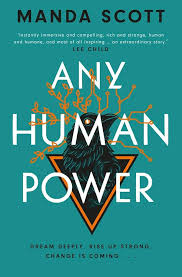
Book: Any Human Power
Author: Manda Scott
Publisher: September Publishing
Year: 2024
Rating: 5 out of 5 stars
Synopsis : “As Lan lies dying, she makes a promise that binds her long into the Beyond. Fifteen years later, her teenage granddaughter, Kaitlyn, triggers an international storm of outrage that unleashes the rage of a whole betrayed generation. For one shining fragment of time, the world is with her. But then the backlash begins and soon she and those closest to her find themselves facing the wrath of the old establishment, who will use every dirty trick in the book to fight them off.
Watching over the growing chaos is Lan, who taught them all to think independently, approach power skeptically and dream with clear intent. She knows more than one generation’s hopes are on the line. Nothing less than the future of humanity stands in the balance.
Grand in scope, rich in courageous characters who breathe new life into ancient wisdom, here is a dream of a better future : a world we’d be proud to leave to our children and their children and on, generations down the line.”
Review : It all started with a tweet. Fifteen years after the death of our narrator, Lan, we find her teenage granddaughter, Kaitlin, checking in with her Uncle Niall before sending a single incendiary tweet into the world, to be seen by her many thousands of followers, a tweet that holds the power to change the entire world. It seems impossible, doesn’t it? Before I began this book, I couldn’t fathom what kind of power a single tweet might have in the landscape of our ever moving headlines : where horrifying news breaking nearly hourly is the norm, where all one needs to do is step out of the limelight for a comment that didn’t age too well to be forgotten, where we brush aside some of the most horrific statements from politicians on a regular basis. And then I read Any Human Power and I understood.
Let me back up. Before we dive into this book, before I recommend you read this book (and believe me, I will), you need to know what you’re getting yourself into. Content warnings for Any Human Power include existential themes such as climate change, a sense of impending doom, depression, anxiety, suicidal thoughts and ideations, examples of characters committing suicide on page, gun violence, political extremism, stalking, doxxing, harassment, paparazzi, discussions of addiction, and death both as a tangible concept (ie, death of a loved one) as well as Death / Afterlife as a location. That sounds like a lot and frankly, it is, but my greatest hope is that this list will simply prepare you for the reality of this book and not keep you from diving in. At the end of the day Any Human Power is a mirror reflecting our current reality back to us and that can feel quite overwhelming, particularly in the form of a 500 page book, but believe me when I tell you this book is a blueprint for a better world. We need only read to understand.
I was given this book as a review copy after it’s publication, not as an advanced copy, and I was told it was a thrutopian novel. Now, this was a new word for me and I had to go googling to figure out what thrutopian might mean, so if you’re in the same boat I found myself in, let me help : “It’s not dystopian. It’s not utopian. It’s a thrutopia where people fight through the obstacles to get to the future that we want…[books that] inspire you that hope and optimism are not only possible, but critical to changing the ending of our story as human beings.” (Aya de León) Trutopian, indeed. Any Human Power, as stated above, offers a blueprint for how our world might genuinely change, we need only find those with the drive, the resources, and the determination to see real and lasting change for the greater good rather than the individual or individual groups as part rather than the whole.
So, like I said, it all started with a tweet. Or rather, it all started with the death of a matriarch, Lan. On her deathbed, mere moments before departing our world for Beyond, Lan makes a single promise to her young grandson, Finn : if he ever needs her, if it’s possible, if it’s within her power, she will come. As she steps into the Beyond and meets her guide, a Crow she met previously within the world of Dreams, she realizes she cannot pass beyond this intermediary space; the power of her promise has tethered her to Finn until he releases her or dies. Little does she know her promise will be a beacon of light and a powerful thread of hope in the darkness of her family’s collective lives over the next two decades as her promise grows and her power to hold her family together intensifies.
Through Any Human Power we experience not only hyper-realistic depictions of our current reality (though, it’s worth noting that if you’re in the US and not in the UK, not every aspect of this book will be quite as easily relatable) from Gen Z very real worry that they are not guaranteed a career and a mortgage or even a habitable planet if things do not dramatically change with immediacy, to the political extremism that infiltrates social platforms, radicalizing those who are most vulnerable, leaving a trail of bodies in its wake. To be completely honest, this book required a solid break about midway through for me. I was unable to read it through in one go, I had to pick up a few lighter books before I was able to finish it – gun violence will do that to you. Some things are truly too real, simultaneously, some things should not be looked away from. The two are true within this book. Any Human Power holds a mirror up to our lives and asks us to take an unflinching look at how tremendously wrong life has gone, all in service of the almighty Capitalism. It asks us not to shy away, because we’ve shied away for far too long. Now is the time for witnessing, for collective action, and for liberation through community care.
Scott has truly created a timely, powerful, and wildly important masterpiece. I would go so far as to call this a work of genius. Not only does she shine a light on the intensity and immeasurable suffering our world experiences at the hands of corruption and out of control consumerism, they also pave a way forward step by step with meticulously detailed instructions. There are somewhere around 200 pages of this book that are dedicated to answering the question what now? Scott tackles governmental reform and from this space a domino effect takes place – once we reform how our governments operate and where their priorities lie, then we begin to reframe and reshape our corporations, our communities, and our globe. My only note about this book is that Scott resides in the UK and their characters reside within the UK, so govermental reform is dedicated to Parliament which I have only the most rudimentary understanding of. There were many aspects of this plan that would not translate to government within the United States, and even priorities which are not quite as high on the list of things that might need to be adjusted here as there, but beyond these technicalities, in the right hands…my god. This book could serves as the catalyst for true global change. Any Human Power asks that we put people first, that we consider communities as more important than money, and insists on full financial transparency within the government and corporations. It has completely challenged me and changed me – I cannot express the gratitude I feel enough. The relief to know what life could be is profound.
While so much of Any Human Power exists within a deeply grounded reality, equally we spend time in the Beyond, Between life and after-life with Lan, with those beings who are beyond gods, beyond time and space and all human concept. We exist in a world that layers itself on top of ours, we enter into the void and parse timelines with intense precision while sweat drips down our brow, and we come to understand that the truest, greatest human power is love.
Advice : Any Human Power quotes both Ursula K. LeGuinn and Angela Y. Davis to remind us that capitalism is not the be-all, end-all and to encourage us to live each day as if a better world was possible – because it is. If you have climate anxiety, if you work in the realm of grassroots organization, if you want to see things change and change for good and change with speed, if you have resources available or know people who do, if you’re on the cutting edge of technology, or if you work in tech at all, if you love people, if you want to see community care prevail in the face of an ever-widening political canyon, if you believe in cooperative living, if you refuse to take your eyes off the suffering of the world, if you can’t see a future for yourself, your age group, or those younger than you…read this book. Don’t look away when it gets hard. Keep reading. Keep going. Run. Don’t walk. Pick this one up immediately.



 Paige Reviews Books