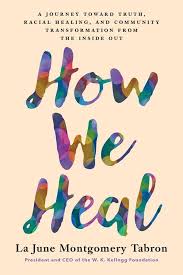
Book: How We Heal
Author: La June Montgomery Tabron
Publisher: Disruption Books
Year: 2025
Rating: 5 out of 5 stars
Synopsis : “From a vivid portrait of her childhood in 1960s Detroit to her leadership of one of the world’s largest philanthropic institutions, La June shares her full-circle, American story – a coming-of-age journey where she gains a firsthand understanding of how systemic racism prevents our children and communities from thriving and learns about the transformative role healing can play in helping all of us transcend the legacy of racial inequity.
As she rises to her position as the first female and first African American leader of the W.K. Kellogg Foundation, La June experiences the power of sharing and listening with empathy. And with the help of mentors and colleagues, she refines the message that will guide the foundation’s mission for years to come : Healing can begin only with truth telling.
Empowered by the mission set forth by its founder to support children and families, the foundation explores a racial healing framework that transforms communities and individuals around the world – from small rural towns and big cities across the United States, including La June’s own beloved Detroit, to Mexico, Haiti, and beyond.
How We Heal serves as a testament to the power of transformation and a blueprint for how each of us, no matter who we are or how we lead, can use racial healing to move from trust to empathy, from understanding to repair – one conversations and one connection at a time.”
Review : Whew. That’s a heck of a synopsis, isn’t it? And though How We Heal is a mere 212 pages long (in ARC form), much like the back-cover synopsis, it packs a lot into those 200-odd pages. While La June spends time detailing what her childhood was like growing up in Eastside Detroit both prior to and after the Detroit Rebellion in 1966, it’s worth noting that the majority of the book describes in detail the work she has and continues to do at the W.K. Kellogg foundation, first as COO and currently as CEO, among other titles. How We Heal is less about La June herself and more about the work that’s been facilitated through the Foundation and through the people who have been impacted by the Foundation’s charitable worn. While the start of the book engages the reader as, perhaps not strictly memoir, but more so memoir adjacent, it’s worth knowing before you dive in that it is decidedly not a memoir.
La June, a direct descendant of Isaiah Thornton Montgomery, the founder of the Reconstruction era town of Mound Bayou, Mississippi, describes the pitfalls and structures of power imbalance that have served to create racial imbalances and divides throughout the United States. And while she would have every right to broach this topic with hate-laced accusations and pointed fingers, La June instead describes what she calls the empathy deficit to explain much of what has stunted racial equity and growth, if not rolled back progress entirely. Rather than assuming that the growth of opportunities and formulation of protections around basic human rights might take all of the above away from those who are not Black or Hispanic or Asian or Indigenous, empathy reminds us that we are all worthy and capable of having access to spaces of growth, stable and safe housing, and quality job opportunities with good wages. When racial equity exists, when we find ourselves within diverse communities, studies show time and time again that we all thrive. It isn’t an us vs them narrative presented within How We Heal, it is very much so the opposite, with La June asking us to imagine a world in which our country outgrows its flawed beginnings and continuous, subsequent failings. As La June says “…through inclusivity, we could make the table bigger.” (How We Heal)
Detailing her decades of work at the Kellogg Foundation, La June describes how the Foundation transformed from a world in which race was an unmentionable topic to a world in which the Kellogg foundation runs multiple racial healing circles throughout the world in order to bridge divides between any number of groups of people. Describing the necessary work at play within the Foundation’s days in the early 2000s as it began to transition into a space that directly addressed racial divides and inequity, a member of the board of trustees, Joe Stewart said (paraphrased by Montgomery Tabron) “Either work to fulfill the dreams of everyone in this nation or tear down the Statue of Liberty.” Because we come from a country whose very foundation was built on the backs of enslaved people and Indigenous massacre, we cannot simply step into the realm of reconciliation without actively addressing the root problems, working toward transformation, and find ways to unite. Enter : TRHT, or Truth, Racial Healing, and Transformation – a project created by those working within the Kellogg Foundation to bring spaces of true healing into diverse communities impacted by racism, a history of redlining, systemic poverty, gun violence, even apartheid. Racial healing circles are designed based on Indigenous practices worldwide and TRHT has been facilitating circles of healing, understanding, and equity for decades, attempting to reach as many people as possible. When it comes to a blueprint for healing, this is it. La June shares so many stories of positive impact within these racial healing circles, it feels almost hard to believe at times. Rather than creating spaces where fingers are pointed and injustices are gripped tightly to, racial healing circles exist to create spaces of radical transformation through understanding and forgiveness. When we are able to fully hear and see where those who have different lived experiences than us are coming from, we can begin to repair something that began as fundamentally broken.
While How We Heal read at times like a proposal for a board meeting, it was deeply informative, well researched, and concise. It laid out a foundation for our path forward, it did more than present the scary facts and figures, it laid out the work the Kellogg Foundation has been doing for a century to combat those figures – going even further to explain how individuals and groups around the globe could be (and have been) taking steps of their own using the very blueprint the Kellogg Foundation uses to create radical healing where it’s so desperately needed. It’s encouraging to me to read a book like this, particularly as we see racial divides deepening, knowing that healing has a way forward. It can and does exist. There’s hope here. And that’s something you can’t buy – or maybe you can, in the form of this book. I found myself crying multiple times during my reading of this book – the stories of hope, forgiveness, healing, and transformation are incredibly moving. It’s well worth the read.
Advice : I think this is a worthwhile read for anyone who is genuinely interested in seeing healing take place on a global scale, anyone who lives in cities with racial disparities (that’s most of us!), or anyone who’s interested in a new take on an old problem. You’re going to want to read this one.
 Paige Reviews Books