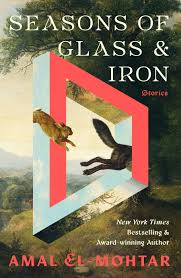
Book: Seasons of Glass & Iron Author: Amal El-Mohtar Publisher: Tor Publishing Group Year: 2026 Rating: 5 out of 5 stars
Synopsis : “Full of glimpses into gleaming worlds and fairy tales with teeth, Seasons of Glass And Iron : Stories is a collection of acclaimed and awarded work from New York Times bestselling author Amal El-Mohtar.”
Review :Seasons of Glass & Iron is a lyrical, deadly, and captivating peek through the looking glass into worlds unknown; full of whimsy and wonder, joy and horror, it is a dream and a nightmare tangled in the same web, woven and unwoven, creating a gleaming portrayal of humanity and, at times, something a bit other than humanity. El-Mohtar has deftly curated a collection of perfectly layered stories, giving the reader just enough to whet their appetite before moving swiftly on to the next. As someone who prefers long-form, I cannot speak highly enough of how intentional this collection is, how smooth the transitions, and how seamless the tie-ins. El-Mohtar shares in the introduction that this book may not have much of a “coherent aesthetic argument”, rather, it’s a love letter to women. Regardless of whether the introduction is read or not, you cannot simply pick this book up and not come to the conclusion that the author has a profound love for womankind in all her forms.
Seasons of Iron & Glass is queer, sapphic, and beautifully pro-Palestine. It wiggles a little deeper under the skin with each story, like an ear worm attaching itself in your brain, hooking it’s little fingers into your heart and tugging at just the right moments. It is a profound work of love and loss and becoming and undoing and redoing all over again. There are gorgeous poems written to those surviving the genocide in Gaza, retellings of Welsh fairy tales, stunning creations of fantasy, and incredible stories of unbelievable creativity and artistry. When I read the final words, I cried.
I fear my words do a disservice to how artfully and skillfully crafted this collection is. El-Mohtar states that these works were written between the years of 2008 and 2023 and there are stories that I can easily align myself with, the energy and understanding of them being laid out on LiveJournal or Tumblr feels so visceral I can almost taste it. Yet, each story weaves a broader narrative that cannot be unseen – despite ranging broadly in time, in place, and in content. There are stories I desperately wish were part of a broader narrative, stories I crave to know more of, and still each story is carefully wrapped up in the end, perfectly beginning and ending in ways that, while imperfect, as short stories are, is truly perfect. At the end of the day, try as I may, I can hardly come up with the words to do this book justice, all I can simply say is read this book.
Advice : If you have any interest in Welsh folklore, in short stories, in fantasy, in reading tales of women, then this book is for you. If you want to read folklore that takes the narrative out of the hands of awful gods and puts it back firmly in the hands of the so often downtrodden and abused women in them, this book is for you. I genuinely believe everyone should read it. It’s perfection. Mark your calendars for March 2026, place an order ahead of time, you don’t want to miss this one.
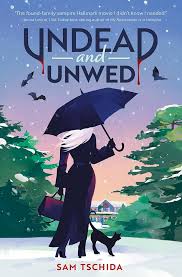
Book: Undead and Unwed Author: Sam Tschida Publisher: Quirk Books Year: 2025 Rating: 1.5 out of 5 stars
Synopsis : “Tiffenie may be three hundred years old, but she’s still a hot mess. The vampire is tragically single, works a dead-end job at a blood bank, and spends her nights marathoning Hallmark Channel moves with her cat. When Tiffenie inherits a fixer-upper home in Valentine, Vermont, thanks to a case of mistaken (okay, stolen!) identity, she seizes the chance to get her life back on track. With her newly undead neighbor (it was an accident!) in tow, Tiffenie is determined to live out her holiday rom-com dreams in this picture-perfect town. But between the mystery of her stolen identity, small-town drama, and the arrival of her insufferable vampire ex-boyfriend Vlad, getting her happily ever after with a smoking-hot Christmas tree farmer won’t be easy. Tiffenie must embark on a journey of self-acceptance – with the help of a few therapy sessions – for the first time in her immortal life.”
Review : Over the last few years of writing ARC reviews, I believe I’ve only given two other books a star rating lower than 2. I give a truly low review only when it feels absolutely necessary – sparingly, you might even say. While my reviews are always honest and truthful and they may be, at times, scathing, I’m always hesitant to give someone a low rating for something they’ve crafted. It feels deeply embarrassing to me that Undead and Unwed has garnered as high a review as 3.5 stars on GoodReads, which is really all I need to say when I tell you that I do not use or read GoodReadsreviews. Having read over 100 advanced reader copies (sorry, only 90 of those have made it here), I can honestly tell you that I have never received an advanced copy as unfinished and unpolished as this book was. It’s not a surprise to find small errors in an advanced copy, some grammatical mistakes, misspellings, an unfinished sentence here or there – it is a surprise to find a book with so many glaring mistakes as Undead and Unwed, and to be completely frank, that’s not even what scored this book 1.5 stars for me. It’s just part of the chaos and nonsense of the entire experience.
This is the first time I’ve wanted to say this : I read Undead and Unwed so you don’t have to. Please. Take my word for it. You don’t have to put yourself through this. The most frustrating aspect of this entire journey through such an incredibly poorly written book and nearly unreadable premise is that I actually liked the initial idea behind the plot. It could have been so much better, it could have been something readable. Execution, however, has failed. We find Tiffenie, a 300 year old vampire, living and working in L.A. at a blood bank – okay, expected, at least to some degree. She’s depressed, doesn’t know how to stand up for herself, and has little will to live beyond caring for her cat, Cat. We learn fairly early on that for a vampire to continue to exist in the world in any kind of feasible manner, they need to take on someone else’s identity in order to rent an apartment or buy a car or work a job – you know, they need a social security number and a real life name. Tiffenie is currently living under the stolen / bought name Tiffany Amanda Blair, an identity she purchased via the “black market” (I’m using quotes here as there’s no real explanation for this and it’s glossed over, so one can really only assume). When she receives a letter in the mail informing her of an inheritance in her namesake’s hometown of Valentine, Vermont, she hops in a hearse (yes, really) and heads out of town. Of course, I’m glossing over a lot of the minutiae here, but this is how things unfold : girl assumes identity, girl receives inheritance meant for the person whose identity she assumed, girl moves to claim the inheritance. Meanwhile, Tiffenie has accidentally drained her neighbor within an inch of her life and is forced to turn her into a vampire and take her on the road to Vermont because…well, just because. There are so many instances where things happen in the book without a good reason, the reader is forced to go along with what’s happening just for funzies because Tschida said so and it makes for poor storytelling.
Evidently, it’s been just ten years since the real Tiffany has moved away from her hometown of Valentine, yet even though Valentine is a tiny, rural town and Tiffany lived there for her entire life as a child and adult, ten years is somehow enough for Tiffenie to show up as a totally different person under the assumed identity of Tiffany and pass for this other person with an entire backstory and history in the town. And no-one blinks an eye. This was the first (of many) glaring issues I took with Undead and Unwed, as an assumed identity does not mean you also look like the person whose identity you stole! We only get a small explanation by way of Tiffenie dying her hair blonde because Tiffany was also a blonde. Yes, you read that correctly. In all other accounts, everyone Tiffenie runs into, be they old flames, friends from high school, or people who knew her family, all really, truly believe that Tiffenie is actually Tiffany. It is as asinine as it sounds. Next, we encounter the trouble with Tiffenie’s bank account – namely, she was dirt poor in L.A., working a job for peanuts, somehow living alone, and yet when she moves to Vermont without a job, she has enough money to start paying thousand dollar fines for living in a condemned building. There’s no explanation for this change in circumstances beyond the inheritance of a condemned property. There hasn’t been some grand windfall, no change in her lifestyle, only that she’s gone from L.A. to Vermont.
If this isn’t enough, Tiffenie is written just as the synopsis describes, as a hot mess. She’s flaky, irresponsible, somehow and for some unknown and never fleshed-out reason, she’s obsessed with not drinking blood, and she has a shopping problem. I don’t love this characterization, but I can get on board with it if it’s how she’s written, unfortunately, Tschida goes back and forth between our modern-day Tiffenie and the Tiffenie of the past who had children, knew how to bake for her family, and lived a real life with big ideas and plans. It’s a stark contrast and the jumping back and forth between these two versions of the self is stilted, as though Tschida threw them in at random without any planning or thought. Further, the conversations are so choppy and robotic, they’re nearly impossible to read. When it comes to story writing, Tschida has landed so far from the mark it’s almost laughable. There are so many instances where someone’s speaking and the only response will be “Yes.” that it became impossible to read with any semblance of seriousness. At one point I actively questioned whether this book was even written or whether it was dictated based on the glaring errors staring back at me from the page. There were multiple instances throughout where the paragraph was re-written but the original was never taken out, so I was presented with multiple directions in which this ARC might go, unsure of which would eventually be chosen for the final copy, and one instance where an entire paragraph was broke up with bullet points. These kinds of errors are not commonplace in an advanced copy, they’re sloppy and lazy and do the author a tremendous disservice – in this instance, Tschida needed all the help she could get and her publishing house did her dirty.
Undead and Unwed is an unreadable mess. I can only hope that by the time it’s actually ready for print it will look dramatically different than it does in it’s advanced copy form, but from my experience this is rarely the case. I suspect this book will be slightly more readable, but I don’t believe it will have improved by much at that point. The concept of a Hallmark Channel-ish story where a vampire moves to Vermont and restores a property, finds a chosen family, and eventually love is actually such a cute idea and I’m actively upset that this book ended up being as poorly written as it was. It needs a significant amount of work, perhaps it would even be worth scrapping the whole thing and starting over, or maybe it would be better to never have started in the first place.
Advice : Don’t. Just, don’t. Don’t fall for the 3.5 GoodReads score. Don’t spend your money. If you really feel drawn to this book, request it at your local library and save your money for something else.
To be honest, I fully intended to give each of these books their own individual reviews, but time got away from me and here we are! Let’s dive in :
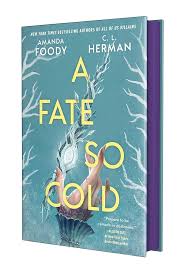
Book: A Fate So Cold Author: Amanda Foody & C. L. Herman Publisher: Tor Teen Year: 2025 Rating: 4 out of 5 stars
Synopsis : “For most of the year, Summer reigns peacefully over Alderland. Then, for six brutal weeks, Winter rages, obliterating towns and wreaking casualties. Magicians bond with powerful wands of Summer to defend the nation, a duty that costs many their lives. Domenic Barrow never wanted such responsibility – but destiny hasn’t granted him a choice. The greatest Summer wand has awakened for the first time in a century, warning that any icy cataclysm looms on the horizon. And despite his reputation as the last suited of his classmates, the and chooses Domenic to wield it. Ellery Caldwell spent years striving to be a perfect Summer magician – and burying her fears of her own power. But her worst suspicions are proven true when she accidentally creates the first ever Winter wand. Now, as the unprecedented Chosen Two, Domenic and Ellery must thwart the oncoming cataclysm together. And in trying to fulfill their destinies, they wonder if they were brought together for a second fate : to fall in love. Until they discover the unthinkable truth. The Chosen Two aren’t fated allies, but eternal rivals, and the only way to save their home is for one of them to slay the other.”
Review :A Fate So Cold is a quick and enjoyable page-turning ‘chosen one’ fantasy that left me wishing book two would come out already! Told between bouncing perspectives, it guides the reader through the winding world of Summer and Winter – and teases the idea that a peaceful world where Summer reigns for 90% of the year might not actually be the ideal. When our protagonist and budding antagonist are chosen by their wands, we fall headfirst into a sweet and idealistic closed-door romance that feels like just enough personal story in the midst of heart racing suspense. This is certainly no cozy fantasy story, so if a sweaty palm fantasy isn’t for you, you might want to skip this one. I found the story to be unique and enjoyable, though I did find small reminders and little hints toward outside inspiration like the Magicians trilogy, the obvious “Winter is coming” of it all as we might have read (or watched) in Game of Thrones, and the wand ceremony from Harry Potter. And while there were small reminders and hints to outside works, none of them felt like direct replicas or served to remove me from the story. All told, this was a fast paced and fun fantasy read with just enough suspense and just enough of a cliffhanger at the end to leave me ready for the next book.
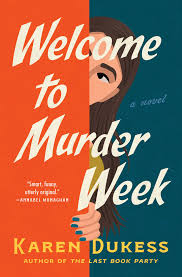
Book: Welcome to Murder Week Author: Karne Dukess Publisher: Scout Press Year: 2025 Rating: 4.5 out of 5 stars
Synopsis : “When thirty-four-year-old Cath loses her mostly absentee mother, she is ambivalent. With days of quiet, unassuming routine in Buffalo, New York, Cath consciously avoids the impulsive, thrill-seeking lifestyle that her mother once led. But when she’s forced to go through her mother’s things one afternoon, Cath is perplexed to find tickets for an upcoming “murder week” in England’s Peak District: a whole town has come together to stage a fake murder mystery to attract tourism to their quaint hamlet. Baffled but helplessly intrigued by her mother’s secret purchase, Cath decides to go on the trip herself—and begins a journey she never could have anticipated. Teaming up with her two cottage-mates, both ardent mystery lovers—Wyatt Green, forty, who works unhappily in his husband’s birding store, and Amity Clark, fifty, a divorced romance writer struggling with her novels—Cath sets about solving the “crime” and begins to unravel shocking truths about her mother along the way. Amidst a fling—or something more—with the handsome local maker of artisanal gin, Cath and her irresistibly charming fellow sleuths will find this week of fake murder may help them face up to a very real crossroads in their own lives. Witty, wise, and deliciously escapist, Welcome to Murder Week is a fresh, inventive twist on the murder mystery and a touching portrayal of one daughter’s reckoning with her grief, her past—and her own budding sense of adventure.”
Review : I absolutely adored Welcome to Murder Week! I had no idea a book about a fictional murder mystery game would be exactly what I needed in my life, but it turns out it was. I did refrain from a 5 star review, though, due to the slow start. I found myself moving at a snail’s pace as the book began, but once things got rolling, boy did they. Sweet, wholesome, and a wonderful good time, Welcome to Murder Week is perfect for anyone who grew up watching Poirot movies, reading Agatha Christie, enjoying Murder She Wrote, or lives for a cozy mystery in book, tv, or movie form. As three strangers work together to solve a fictional murder mystery in a quaint English town, they find themselves growing together as close friends. What began as a quirky tourist trip, though, quickly becomes a deeper and more meaningful adventure for our protagonist, Cath, that we could even have expected. In moments of tenderness, we find Cath retracing steps that seem strangely familiar, despite having never visited the English countryside; we witness the healing of generational trauma, and we experience the joy of watching her story completely turn on its head and unfold in the most beautiful way. This book will make you laugh out loud while simultaneously making you cry. It’s everything I didn’t know I needed and more. Absolutely well done.
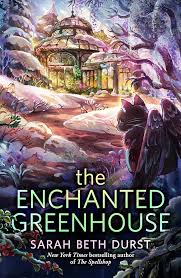
Book: The Enchanted Greenhouse Author: Sarah Beth Durst Publisher: Bramble Year: 2025 Rating: 4.5 out of 5 stars
Synopsis : “Terlu Perna was lonely, so she broke the law. She cast a spell and created a magically sentient spider plant. As punishment, she was turned into a wooden statue and tucked away in an alcove in the North Reading Room of the Great Library of Alyssum. And that was the end of her story. Until… Terry wakes in the cold of winter on a nearly deserted island full of hundreds of magical greenhouses. She’s starving and freezing and the only other human on the island is a grumpy gardener. To her surprise, he offers Terlu a place to sleep, clean clothes, and freshly baked honey cakes – at least until she’s ready to sail home. But Terlu can’t return home and doesn’t want to – the greenhouses are a dream come true, each more wondrous than the next. When she learns that the magic that sustains them is failing – causing the death of everything within them – Terlu knows she must help. Even if that means breaking the law again. This time, though, she isn’t alone. Assisted by a gardener and a sentient rose, Trull must unravel the secrets of a long-dead sorcerer if she wants to save the island – and have a fresh chance at happiness and love.”
Review : I’ll be the first to admit that the concept of anything talking that wouldn’t normally talk is one of my least favorite fantasy tropes – I find talking animals to be disconnected from my expectations and there’s rarely a time when I feel differently. So the concept of a book in which most of the characters are talking plants was immediately something I entered into with trepidation. I love a fun new world of fantasy novels, but for some reason, I just cannot generally get on board with talking creatures. I’m happy to report, however, that The Enchanted Greenhouse is the exception. Durst has successfully created a fantasy world with this novel that needs very little extra work – the entirety of the novel takes place in a massive series of enchanted and magical greenhouses, on an island with just one other inhabitant beyond our protagonist (Terlu Perna, purple skin, purple eyes…human). The plants we encounter in the greenhouses, while some seem to be otherworldly, largely reflect what we might find in our own world, and while there is a flying cat and several magical creatures spelled to do some work in the greenhouses, there’s little beyond the inherent magical quality of the book that wouldn’t be found in our own world.
I realized about a chapter into The Enchanted Greenhouse that this is in fact a sequel to a previous book that I haven’t read, but the mark of a great book is that it can stand alone without much explanation needed, and Durst certainly achieved that feat. Had I not read the letter from the author, I would never have known this wasn’t a stand alone novel, the recap at the beginning of the book felt less like a recap and more like the necessary introduction to Terlu Perna and the magical world she resides within. And though the world she lives in is magical, it’s also filled with rules about who can and can’t do magic – for good reason, as magic can be dangerous – only trained sorcerers are allowed to even attempt to perform spells. However, Terlu casts a spell to create sentience in a plant friend of hers, and in doing so finds herself made an example of and is turned to wood. During her years as a statue, though, the Empire falls and the rules of what magic is and isn’t allowed are changed. To save Terlu from the fires of the resistance, Terlu’s old boss ships the statue formerly known as the living Terlu (along with the spell to awaken her from her statue slumber) to a remote island of greenhouses run by a lone gardener named Yarrow. Having sent letters to the government begging for help with his magically failing greenhouses, Yarrow believes Terlu is a sorcerer sent to help him. When Terlu awakens and Yarrow realizes she’s just a girl who cast a spell one time, he becomes sullen and grouchy. But the greenhouses continue to fail, and Terlu is determined to help.
I’ve read several books over the last few years that have billed themselves as being similar to Legends and Lattes by Travis Baldree, and while some have come close to the cozy fantasy he’s crafted in his series, none have really been what I would compare to his works. While The Enchanted Greenhouse wasn’t labeled as such, had it been, it would have been the first book I’ve read since Legends and Lattes that made me feel the same way Baldree did. Durst has created a cozy, low-stakes fantasy with the most wonderful cast of characters. It did have a slow start, hence the 4.5 stars, but once I got into it, things really picked up in a sweet, cozy, romantic sort of way. And it’s worth saying that even though this book was published by Bramble, it is definitively not a romance novel – it’s a love story. And who would have though I’d have spent an entire novel crying my eyes out over a lovable rag-tag crew of talking plants? Not me, that’s for sure. But cry I did. Durst has created something truly magical with this work, weaving the concept of empathy into her tale in such a way that I can’t imagine anyone who read this book could walk away unchanged. Not only is it a beautiful tale of found family, it’s also a deeply political tale as well, and perfectly timed, at that. I won’t spoil it for you, but know that it doesn’t read as political, it’s just that you cannot come away from this book on the side of the oppressor. You simply can’t.
Advice : If you enjoy quiet, cozy, low-stakes fantasy novels with flying cats and miniature dragons and honey cakes…well, do I have news for you. Add this one to your list, pre-order it now before it’s release in June. Trust me.
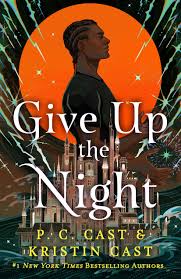
Book: Give Up the Night Author: P.C. Cast and Kristin Cast Publisher: Wednesday Books Year: 2025 Rating: 3 out of 5 stars
Synopsis : “Since becoming Moonstruck on her eighteenth birthday, Wren Nightingale has found herself thrust into a world filled with deception, danger, and murder. Uncovering that their magic was fractured and limited when the original Moonstruck ritual was broken by Selene, Wren is determined to find a way to restore it. But the Elementals are split into two factions – some want the ritual completed and their freedom – and others are so terrified of change that they’re willing to end Wren before she can reach the center of the island where the ritual Selene ruined can be completed. Between his overbearing father’s arrival, Rottingham delegated him more and more responsibility, and Celeste taking a special interest in him, Lee Young has been struggling to find his own path. As much as Lee wants to take his place in the Moonstruck hierarchy, he knows something’s not right at the Academia de la Luna. He thinks if he can talk some sense into Wren and get her to return to the Academia, that everything will turn out alright. As Wren and Lee both battle for what they believe is right, they’ll have to uncover who their true allies are…and if they’re even on the same side of this magical fight.”
Review : Dear reader, to be completely honest with you, I’m not sure how I ended up with this early copy. Not only is Give Up the Night a sequel, to a book I didn’t read, mind you, but it’s been co-authored by two people I’m familiar with; if you’ve been here for a little while, you may remember that I reviewed the first and second books in a different trilogy written by P.C. Cast and Kristin Cast, and if not, you can find them here and here – as an aside, I didn’t realize the earlier of the two reviews was written all the way back in 2021 and now I must sit in shock that I’ve been receiving review copies for four years before I can continue on.
I make a point not to request sequels, and after my last two not-so-kind reviews of the Cast’s work, I’m a little more than surprised to find this book sitting in front of me. I must have made a mistake. Nonetheless, much like last year, my plans for this year include reading and reviewing every advanced copy that comes my way, so I did read Give Up the Night even though I didn’t read Draw Down the Moon, the inaugural book in the Moonstruck trilogy. To their credit, the Casts made it easy for someone to jump in without needing a total refresher of the first book – enough details were organically rehashed by the characters within the first chapter that I didn’t struggle to understand what was happening, despite jumping in at a pivotal moment. However, I do find it difficult to review a sequel without having read the first book, so this review will likely be quite short.
I find the Casts to be adequate writers, and by that I mean they do just fine if you’re not bored with a tired trope, ready for fresh material, or want a truly new, enticing, or compelling story. It’s just fine. Nothing more. I realize this is an advanced copy, but this book was riddled with errors, something I don’t tend to see in the more well put together books I receive – so that’s worth noting. Reading this book had me wondering how much might change between an advanced copy and a first edition; for example, if you have a nonbinary character, it might be worth your time as an author to ensure that you get your own character’s pronouns correct. It might even be worth your time to figure out the pronouns of the magical beings you’ve written into your novel, wouldn’t you think? Rather than jumping around confoundingly between he and she with no real clear reasoning as to why it’s jumping around – no, this is no gender fluid creature, it’s simply poor writing. The storyline matched every damn fantasy storyline you might be familiar with and that felt like an insult to the reader : young woman in a magical world finds herself bestowed with incredible! unbelievable! magical powers after spending time thinking something is wrong with her because her peers are developing their powers as normal while she lags behind; magical creature becomes magically attached to said young woman; young woman becomes marked as special, must go on magical quest to set things right / free everyone / do something spectacular that no one else has ever been able to do before. The “quirky” and “special” angle feels wildly overplayed – I can think of four books without even trying that fit the same mold. It’s overdone.
Lastly, I did find the majority of Give Up the Night to be fairly compelling, inasmuch that I continued to turn pages for a while before I got bored. I’ve said it before and I’ll say it again, a book doesn’t have to be well written to be compelling. Poorly written books with compelling storylines still turn pages. As we neared the ending of this book, however, things took a turn. The clear-cut narrative turned muddled, the geography became redundant, and the quest the characters found themselves on turned on it’s head in a way that made no clear sense. It felt like writing for the sake of wrapping up a book with a wild and crazy twist, not like something necessary to the storytelling at all. It was all a ploy to introduce book 3, which is fine, but not for me. Anyway, like I said…this book was fine. No more.
Advice : If you’re familiar with the Casts’ work already and enjoy it, I’m sure you’ll enjoy Give Up the Night. If you’re not or you’re looking for something that doesn’t read like a watered down Fourth Wing…try again. This one won’t be for you.
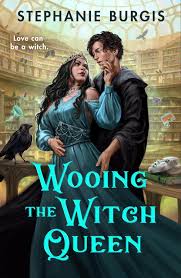
Book: Wooing the Witch Queen Author: Stephanie Burgis Publisher: Bramble Year: 2024 Rating: 3.5 out of 5 stars
Synopsis : “Queen Saskia is the wicked sorceress everyone fears. After successfully wrestling the throne from her evil uncle, she only wants one thing : to keep her people safe from the empire next door. For that, she needs to spend more time in her laboratory experimenting with her spells. She definitely doesn’t have time to bring order to her chaotic library of magic. When a mysterious dark wizard arrives at her castle, Saskia hires him as her new librarian on the spot. “Fabian” is sweet and a little nerdy, and his requests seem a bit strange – what in the name of Divine Elva is a fountain pen? – but he’s getting the job done. And if he writes her flirtatious poetry and his innocent touch makes her skin burn, well… Little does Saskia know that the “wizard” she’s falling for is actually an Imperial archduke in disguise, with no magical training whatsoever. On the run, with perilous secrets on his trail and a fast-growing yearning for the wicked sorceress, he’s in danger from her enemies and her newfound allies, too. When his identity is finally revealed, will their love save or doom each other?”
Review : Wooing the Witch Queen was a cute, quick romantasy-ish book about two people who are ultimately misunderstood by those around them. I call it romatasy-ish because while it is a fantasy and it’s being published under Bramble, a romance novel imprint of Tor Books, the actual romance aspect of this book was…light. I think if this were a movie it might be rated PG-13 for implied nudity; the romance aspect of the book was mild, took the entire book to develop, and was about as closed-door as it gets without actually being a closed-door romance, take that how you will!
Outside the actual romance of the novel, which the synopsis seems to more than imply is the majority of the book, the actual plot of Wooing the Witch Queen centers around Saskia’s immediate threat to the throne she stole from her uncle – largely from her neighbors, seemingly under the order of the Archduke Felix.
** Warning, spoilers ahead! **
Being as quick as this read was, there’s very little I could say here that wouldn’t be a fairly immediate spoiler, so let’s just dive into it. What Saskia, or the rest of the surrounding kingdoms for that matter, doesn’t know is that Felix is simply a figure-head, someone who has been held prisoner, who has no formal diplomatic training, and who has no say in what his kingdom does or doesn’t do. On the night his traitorous family is poised to murder him and turn him into a martyr, Felix makes an escape to the only Imperial who has been able to hold off his in-laws : Saskia. Wearing what he doesn’t realize is the cloak of a dark wizard, Felix escapes while donning a swooping hooded cape. When he arrives at Saskia’s court, she assumes he’s a dark wizard answering her call for a temporary laborer to arrange her magical library. Without allowing Felix to get a word in edgewise, Saskia hires him and permits him to wear a mask – something that is, apparently, typical for dark wizards.
The remainder of the book follows this path : Felix bumbles his way through his task, only capable of organizing a magical library because he’s only ever been allowed to participate in the arts, Saskia falls for his gentle personality, and no one seems to be any wiser until he finally reveals himself to her at the end of the book. Ultimately, I found this story to be mildly cute but of no great importance or need to be told, the romance was more actually romantic than what you might expect out of a romance novel, and Felix’s character is written like the reversal of every female protagonist written by a man – deeply hard to believe, full of strange character traits that sound more like a woman who didn’t have any diversity in her beta readers, and not all that interesting when it’s all said and done.
Finally, I found the plot to be thin and weak, Felix’s background was never fleshed out, and I found myself with questions I didn’t ultimately find answers to. I think the trouble with writing a fantasy novel is you have to create a story that’s compelling enough that the reader finds themselves willingly reading about the politics of a world that is wholly made up – if you create a world the reader isn’t invested in, there’s then no incentive for them to involve themselves with the minutiae. Sadly, Burgis did not succeed in compelling me to care about the politics of the world she crafted and so during moments of political discourse (which comprised a good deal of the book), I found myself bored and uninterested. I was never given the chance to become invested in the world when the book moved so quickly and never fully explained the main characters backgrounds in a way that felt satisfactory. Overall, this book was fine.
Advice : If you pick up any romantasy you can get your hands on, maybe this will be for you! If you prefer more romance, more fantasy, more everything…well, maybe this isn’t going to be the one. It might be worth checking out from your local library.
Book: The Queen of Days Author: Greta Kelly Publisher: Harper Voyager Year: 2023 Rating: 3 out of 5 stars
Synopsis : “For Balthazar and his family of thieves, stealing a statue during the annual celebration of the god Karan’s was just a good bit of fun…or a way to stick it to the governor who murdered his parents. And yeah, the small fortune in reward doesn’t hurt – even if his boss also hired the mysterious Queen of Days to join the crew as “the weapon of last resort…” Whatever that means. But Bal doesn’t know the ceremony isn’t simply the empty words and dusty tradition; it’s true magic. The kind of magic that rips open a portal for the god himself. Only the idol that Karan’s planned on using for a body now lies broken at the Queen of Days’ feet. And half of it is missing. With the aid of a lovable brawler, a society lady turned bomb maker, a disgraced soldier, and a time-eating demon, Bal must hunt down the missing half of the statue if he has any hope of earning his money, keeping his crew alive…and perhaps even saving all of humanity. But as his journey sends him racing through the city – and across realities – he discovers that doing all this might just doom the city.
The city be damned. It’s time to kill a god.”
Review :The Queen of Days bounces between two points of view; Balthazar (Bal), the leader of a crew of thieves called the Talion gang; and Tassel Janae (Tass), aka The Queen of Days. Bal and his crew have been commissioned by a mysterious patron for what’s supposed to be a simple smash and grab at a largely symbolic ceremony of ruling class elites within Bal’s home city of Cothis. We learn early on that Bal and the members of the Talion gang are not only related to each other, some through illegitimate affairs on Bal’s father’s behalf, but were once the children of the previous ruling elite of Cothis themselves – before Bal’s family was ousted (and killed) by the members of the city for a superstitious belief that they had angered the god of water, Karanis. Several years of drought will do that.
Though the Talion gang are a crew of experienced thieves with years of work under their belts, their patron has a singular request : they must hire and work with the Queen of Days, a masked mercenary with a reputation that precedes her. She’s rumored to be able to defy the laws of nature, to have extraordinary powers, and worst of all, to be a demon of the Nethersphere. She comes to the Talion gang rather mysteriously herself, all but proving the rumors true and creating fear and suspicion within the gang, particularly when she asks for payment in days off their lives rather than in coin. As Bal, Tass, and the rest of the crew work to layout a plan, they become increasingly fractured and disorganized and it takes the remainder of the book to bring them back together into a family unity again.
Spoilers Ahead
As the crew attempts their simple robbery (with a huge payout, mind you), they almost immediately come to find it isn’t quite as simple as they were promised. When the symbolic ceremony turns anything but, Tass takes matters into her own hands and smashes the statuette they were commissioned to steal. Realizing that the ceremony was designed to draw down the god Karanis from the Nethersphere, Tass acts without explanation, saving the youngest member of the Talion gang, Bal’s sister Mira, and escaping the ceremony. When Karanis arrives and finds his vessel destroyed, he takes possession of the current city’s ruler (and Bal’s father’s usurper) Paasch – a move that will not allow Karanis to exist within this world for long. He must find the statue, it must be restored, or he will wreak unstable and unmeasurable damage upon the world. What ensues is about 300 pages of Bal, Tass, and the crew working to figure out what’s really going on, where the pieces of the statue may have ended up, and how they can save themselves in the process.
I chose to give TQOD 3 stars because I found this book to be quite long and difficult to get through. I don’t actually mind an almost 400 page book, I enjoy a lengthy tale, particularly if it’s something I can’t stop thinking about, but that’s exactly the problem I had with this one. I’ve often said that it doesn’t take quality writing to create a compelling story, there have been many books I’ve found lacking when it came quality that kept me turning pages simply because I couldn’t stop thinking about what was going to happen. Unfortunately, TQOD didn’t hit the mark for me. I found myself distinctly disconnected from the characters, I would put the book down and easily walk away, I found myself thinking of other things when I was reading and often had to go back and reread passages in order to figure out what was happening because I was so lacking connection. There were about 100 pages right at the end that found me turning pages to see what was going to happen, but sadly the 200 something pages that preceded it were so uninteresting enough that the final 100 weren’t enough to make me want to give this book a higher rating.
I will say, it was written quite well and utilized a trope many people thoroughly enjoy : found family. I found the world building to be fair, but not great, as I had a lot of unanswered questions about the world Kelly created. It didn’t help that I was so disconnected from the story, I think had I found more connection with the characters I might have found more connection with the world, but there still remain many unanswered questions about the world, what it looks like, and how it interacts with the characters, and why it does the way it does – for example, Kelly mentions a flood mythology that exists within this world, much like exists within our world. I have questions. Fortunately for readers, TQOD is very clearly the first of at least two books so there will be time and room for questions to be answered, but that does rely on readers finding their own connections that will compel them to continue reading, and of that I’m not sure they will.
Advice : If you enjoy fantasy, the found family trope, and don’t mind reading several hundred pages, you just might like this one. I personally found it lengthy and difficult to get through, but if you like a series, enjoy thievery and magic and gods who aren’t really gods, I think this would be worth the time.
Book: The Magicians, The Magician King, The Magician’s Land Author: Lev Grossman Publisher: Penguin Year: 2007 – 2014 Rating: 2.5 out of 5 stars
Synopsis: (from The Magicians) “Quentin Coldwater is brilliant but miserable. A high school math genius, he’s secretly fascinated with a series of children’s fantasy novels set in a magical land called Fillory, and real life is disappointing by comparison. When Quentin is unexpectedly admitted to an elite, secret college of magic, it looks like his wildest dreams may have come true. But his newfound powers lead him down a rabbit hole of hedonism and disillusionment, and ultimately to the dark secret behind the story of Fillory. The land of his childhood fantasies turns out to be much darker and more dangerous than he ever could have imagined…. The Magicians is one of the most daring and inventive works of literary fantasy in years. No one who as escaped into the worlds of Narnia and Harry Potter should miss this breathtaking return to the landscape of imagination.”
Review: To fill you in on a little background, I found The Magicians through a show on the SciFi channel appropriately named The Magicians. It was compelling, I was immediately struck by what a massive budget the show must have had, and I was completely sucked in by the quality effects and overall put-together-ness you often miss with fantasy and sci-fi shows. It wasn’t until this year, though, that I realized the show was originally a book series so without much thought I dove right in. I’ve struggled to find ways to review this series without also reviewing the show, continuously finding ways to compare what was done in the show to what was written in the book, seeking out plot holes between the two, and being somewhat marveled by the apt characterization of each person in the show vs the book. It’s already a bit of a strange review, attempting to review a series rather than each book individually, but I found the stories blended so seamlessly, I could have been reading from one enormous book. Despite plowing through this series in under a week, I chose to rate these books with ultimately 50% because I’ve found, particularly in more recently popular fiction, one does not have to be a great writer to turn pages. One only needs to be compelling, and Lev Grossman writes stories that are nothing if not compelling. If we look past the glaringly obvious copy-cat of The Chronicles of Narnia, we’re still confronted with an author who wields the trope of a miserable, privileged teenage boy as if it’s a blazing sword of originality. It isn’t. I remarked recently, in the show you’re presented with Quentin as a miserable, privileged boy in a way that points to the remarkably pathetic nature of his character, in the book, however, we’re supposed to believe wholeheartedly in his “nothing is ever good enough” facade. Was it meant to be written in a way that makes you want to gag slightly over how rough Quentin has it with his genius IQ that allows him access to a magical world he’s been dreaming about his whole life only to continue pining for something more (a something more that included access to every ivy league school he could possible wish for)? I doubt it. I think we’re truly meant to feel sorry for him and that’s not something I can find myself doing. Poor rich boy, with his magic and his smarts and all the doors opening for him – it hits harder when we realize that his best friend, a girl who is likely better at magic and just as smart as him, didn’t gain access to the magic world for reasons that are never fully explained in the book. Moving on. Grossman is cavalier with his use of mental illness, he relies heavily on fat shaming, and throws around words I wouldn’t dare use as a conversational piece. Looking at the published date of 2007, I’m not entirely surprised by some of the language he uses, but it doesn’t stop Grossman from continuing to make light of horrific sexual trauma and deep depression even as his writing moves further into the 2010s. That alone is enough to knock the rating down at least two points, in my opinion. It neither adds to the story nor furthers any action, it merely serves to show how little Grossman cares for an audience that often seeks fantasy and sci-fi to escape from the realities of life; mental illness, trauma, abuse, and bullying. Something I found hard to move past in this trilogy is the way in which Grossman sets up magic; it’s unattainable to the average person and unless you have an IQ higher than practically everyone you know, the idea that you could insert yourself into this world he’s created is implausible. He builds a world we are meant to love and wish to escape to and then holds it so high over the heads of his readers to keep them out that we couldn’t reach it if we jumped. It’s impossible to insert yourself as a reader into a world like that, and frankly isn’t that what sci-fi and fantasy are about? How can we, as readers, be expected to escape to a beautiful world of magic if it’s so far beyond our intellectual reach? Grossman writes in such a way that I thought perhaps he was simply trying to convey how pretentious Quentin and his friends are throughout the series, but the more I progressed through the books the more I realized it isn’t Quentin and his fellow magicians who are pretentious, it’s Grossman. I found myself looking up words I absolutely never hear or read – thrown into books that read at a YA level, words that, again, don’t further the plot or move the action along; they serve merely as yet another tool to keep his readers at arms length. Finally, as I finished the trilogy, I began to see the book devolve into a tangled mess of “probably”. I didn’t have the time, energy, or heart to go back through the entirety of the third book, but I did sift through a few of the final chapters (26-28) and found the word probably used over fifteen times – often as the start of a sentence, used both in narrative and conversation. What’s the point? I’m really not sure. Did the other two books and maybe even the remainder of the third contain more of the p-word than I realized? Probably.
Advice: These books are compelling, they really are. I found it hard to put them down, wanting to know what was going to happen next, reading quickly because the plot moved quickly. It’s an enjoyable read if you don’t think about it too much, or if you’ve watched the series and found it to be something you liked. It’s not an enjoyable read for a myriad of other reasons and I will likely not be reading anything further from Grossman in the future.