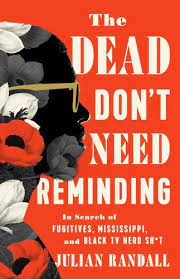
Book: The Dead Don’t Need Reminding Author: Julian Randall Publisher: Bold Type Books Year: 2024 Rating: 5 out of 5 stars
Synopsis : “The Dead Don’t Need Reminding is a braided story of Julian Randall’s return from the cliff edge of a harrowing depression and his determination to retrace the hustle of a white-passing grandfather to the Mississippi town from which he was driven amid threats of tar and feather. Alternatively wry, lyrical, and heartfelt, Randall’s voice bursts off the page with verve, humor, and poet’s eye for detail. In this book, Randall transforms pop culture moments into deeply personal explorations of grief, family, and the American way. He envisions his fight to stay alive through a striking medley of media ranging from Spiderman and Jordan Peele movies to BoJack Horseman and the music of Odd Future. Pulsing with life, sharp, and wickedly funny, The Dead Don’t Need Reminding is Randall’s journey to get his ghost story back.”
Review :The Dead Don’t Need Reminding is one of those books you read the way you eat a great meal, slowly, purposefully, savoring every single bite. Comprised of essays, TDDNR is a lyrical work of pop culture references, self inquiry, depression, chronic pain, and what it means to exist within a queer, Black body in America. Randall weaves a narrative that’s steeped with grief, tugging on a thread that unravels to reveal ancestral history, the kind that dips through an entire body, tethering each generation to the last, reminding us what it is to search for yourself amongst the dead. I devoured this book quickly, at first, then slowly, so slowly, asking the narrative to slow down, to keep from ending. You know how it is.
My copy of The Dead Don’t Need Reminding is now filled with dogeared pages, underlined, read again and again. It is one of those books you never stop reading. Filled with longing, Randall takes the reader on his journey through life-long destabilizing depression, suicidal ideations (and intentions), chronic pain that interjects throughout the narrative in the way only chronic pain can do, racism, and an endless running list of cultural references he uses to bind us to a better understanding of his own inner (and outer) world. Randall explains that he thinks in quotes, in lyrics, in movies and tv shows, using examples from BoJack Horseman, Spiderman, Kanye West (Ye), Drake, Odd Future, and more to open his heart and mind to the page, to the reader. Even without a complete knowledge of the totality of his references, the impact is striking. I enjoy reading about the things other people enjoy, particularly if it’s done in a way that doesn’t require me to have the references handy at all times, and this is that book. Randall takes quotes and clips and concerts and makes them sing on the page, brings them to life for a reader who maybe doesn’t have every single quote or clip or concert in their own mind. They do now. It works.
Speaking with so much ache, Randall winds us through a collection of essays into the heart of his grief, into the empty crater of depression, and into the humid search for an ancestral burial ground – a gravesite in Mississippi, proof of life.
I’ve struggled with how to write this review. How do you review a book you can’t quote, not yet? How can I review this book without showing it to you, without flipping to a dogeared page and reading an underlined verse? How do I explain the depth this book sunk me into? It is a stunning masterpiece, exploring boyhood tenderness that transmits itself into adulthood tenderness, fear, longing, and the desire to live – the choice to live – while haunting a family line in search of ghosts.
Advice : Run. Don’t walk. You’re going to want to read this one.
Book: Shanghailanders Author: Juli Min Publisher: Spiegel & Grau Year: 2024 Rating: 5 out of 5 stars
Synopsis : “The year is 2040, and wealthy real estate investor Leo Yang – handsome, distinguished, a real Shanghai man – is on the train back to the city after seeing his family off at the airport. His sophisticated Japanese-French wife, Eko, and their two eldest children, Yumi and Yoko, are headed for Boston, though one daughter’s revelations will soon reroute them to Paris. While the years rewind to 2014, Shanghailanders rotates perspectives, drawing readers into the shared and separate lives of the Yang family, parent by parent, daughter by daughter, and through the eyes of the people in their orbit. As their world shifts and brings change for each of the Yangs, universal constants remain : love is complex, and family will always be connected by blood, secrets, and longing.”
Review :Shanghailanders is a complex work of creative genius, told not just from shifting perspectives, but also from an unwinding timeline, the book spans from 2040 to 2014, with each subsequent chapter unwinding time just a tiny bit more. Min’s first novel, Shanghailanders is a breathtaking debut novel filled with family history, peeling back the curtain, giving us a glimpse into the Yang family’s dynamic; toxicity, growth, rejection, and all the layers the meld together to form a family. Beginning and Ending with Leo, the patriarch of the Yang family, Min has bookended her work with a man whose chapters hardly revolve around his inner world at all. I found it fascinating that throughout the entirety of the novel, Min chose to only reveal the Yang family through three male-centered chapters, two of which are Leo, the third being the family’s driver – all three of whom serve only to point us back toward the matrilineal family line.
Shanghailanders is a novel that addresses the fragility of time both in narrative and construct, giving us the smallest glimpses into the years that make up a family, revealing small clues and inward peaks that create the structure the Yangs have crafted their world(s) into. Speaking broadly of time, of bloodlines, and of familial connection, Min paints a much more detailed picture with the narrative, showing rather than telling us that Leo, and likely Yoko as well, has an anxiety disorder that causes apocalyptic dread, that drives his need to see his daughters sinking into independence and stability, that, at times, pushes his family to the brink, threatening to shatter their bubble; that Yuki, the youngest, at sixteen is facing the loss of innocence and the heartache of love lost; that while each family member feels tethered to the other, neither feels the thread of love as connection, that love is not a given. This is a novel filled with longing, with logic, with dread, and the potent, ever present realization that time is a fragile filament that tugs at us all.
I think the most successful aspect of this book is the format, rewinding through the narrative from 2040 until, finally, 2014. Taking us briefly through the years of improved technology, covid, and finally into those pre-pandemic years where the children are barely formed, where love is new, and anxieties aren’t quite realized yet. Each chapter invites us into a new realm of the Yang family, masterfully written, weaving webs so delicate behind the scenes that we cannot see each thread until the final page has turned. Each chapter left me craving more, desperately wishing the timeline was reversed, that I could follow this family into further detail, into more solid ground, wishing and hoping I would be given glimpses into the characters and storylines I most enjoyed. Alas, with each passing chapter, each character faded, each storyline slipped away, and I was transported to younger versions, the groundwork of each prior chapter laid out ahead of me. The longing I felt. Perfection.
Advice : This is a truly remarkable work created with a unique vision. If you enjoy epics, this might just be for you. Spanning 26 years in the reverse, this scratches the epic itch while fulfilling a creative interest and need. I’d mark this one on the calendar.
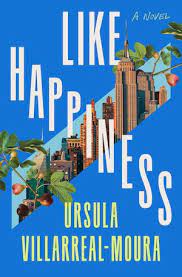
Book: Like Happiness Author: Ursula Villarreal-Moura Publisher: Celadon Year: 2024 Rating: 5 out of 5 stars
Synopsis : “It’s 2015 and Tatum Vega feels that her life is finally falling into place. Living in sunny Chile with her partner, Vera, she spends her days surrounded by art at the museum where she works. More than anything else, she loves this new life for helping her forget the decade she spent in New York City orbiting the brilliant and famous author M. Domínguez. When a reporter calls from the US asking for an interview, the careful separation Tatum has constructed between her past and present begins to crumble. Domínguez has been accused of assault, and the reporter is looking for corroboration. As Tatum is forced to reexamine the all-consuming but undefinable relationship that dominated so much of her early adulthood, long-buried questions surface. What did happen between them? And why is she still struggling with the mark the relationship left on her life? Told in a dual narrative alternating between her present day and a letter from Tatum to Domínguez, recounting and reclaiming the totality of their relationship, Like Happiness explores the nuances of a complicated and imbalanced relationship, catalyzing a reckoning with gender, celebrity, memory, Latinx identity, and power dynamics.”
Review :Like Happiness, as Villarreal-Moura writes in the acknowledgements, “is a book about loving books”. Incredibly literary, not only did it tick all the boxes in my soul that feel like satisfying brain-floss, it also rang some bells of familiarity that cannot be overlooked. This is a powerfully moving debut novel detailing the uneven footing of the power dynamic between a popular contemporary male writer and a younger female fan (notably, eight years younger). Feeling out of place with few friends at her Massachusetts college during her undergrad program, texas native Tatum makes a bold move one evening, penning a letter to the author of her new favorite book, Happiness. The author, M, is gaining popularity with his breakout novel of short stories detailing the lives of Latinx individuals in the United States. Feeling seen and understood in a way she has not felt in literary circles yet, particularly on a nearly all white college campus where she’s an art history, english lit double major, finding herself immersed in required reading of white Euro centric authors, Tatum feels at home with M’s book. She writes to M and within a few weeks, he writes back, thus beginning a multi-year long relationship between Mateo (M) and Tatum.
Like Happiness is a dual perspective book, though it doesn’t bounce around nearly as much as you may be accustomed to in a book with multiple narrators or points of view. Told largely through the lens of 2015 Tatum, far removed from her relationship with Mateo, writing a detailed account of her often one-sided relationship with Mateo, and a slightly earlier 2015 version of Tatum, receiving a phone call from a reporter in the States, calling because her relationship is celebrated fact and Mateo has been publicly criticized and outed as an abuser. It has been years since Tatum has spoken to Mateo and while she never experienced the abuses so many women are stepping forward to name, she is sure he isn’t an innocent party, both with the other women and with her. Choosing to tell her story to the reporter, she simultaneously decides to tell her story to Mateo and afford herself the closure she was never granted in the past.
Villarreal-Moura spins a tale of power imbalances, grooming behavior, and codependency that at times feels so real it’s hard to remember this is fiction and not a memoir. Over the span of nearly 300 pages, she outlines patterns of abuse so subtle they could almost go overlooked, laying them out chronologically, revealing a masterpiece of manipulation when the final product is fully revealed. **Spoilers Ahead** Laying the groundwork for Mateo’s ultimate betrayal quite early on, Villarreal-Moura is an expert at building a scene. Not only is Mateo a college professor and author, he is a force of magnetism and power in Tatum’s life. He pulls her into his orbit and expects her to stay just where she is, mesmerized and fawning over his very being. He relies on her for attention, commitment, and praise while expecting her to simply go along with whatever he wants to do – and she does. He so encompasses her world that when he’s in it all others cease to exist. Mateo subtly punishes Tatum when she gets a serious boyfriend, though she and Mateo have never approached much more than a platonic relationship, he cuts her down and pokes fun of her intelligence when she doesn’t give him exactly what he wants, and pays off $20,000 of her school loans, leaving her helpless to the encompassing power he now wields over her.
I don’t want to give away the ending, but know these subtle manipulations are nothing compared to the ultimate betrayal Tatum experiences at the hands of Mateo in the end. Putting a final nail in the coffin of their friendship, she is finally able to extricate herself from the leeching parasite of M, allowing her to write her final letter, this book, to him; knowing it will be the closure she needs in order to fully live her life without his shadow in it. As I read, I couldn’t help but be reminded of an article a read a few years ago about an author whose work I’d read and loved, Nick Flynn. And as I thought about that article, I couldn’t help but be reminded of another, similar, articled I’d read around the same time about another author whose work I’d read and loved, Junot Diaz. Both were published authors, one a professor and the other a keynote speaker, both took advantage of women who were younger than them, women who were still in college. Flynn, in particular, has since been accused by multiple women of abuse and misconduct. There is nothing new about this story, though that doesn’t in any detract from Like Happiness; if anything, I found it gave this book extra connective tissue. There’s a precedent here : men in positions of power who wield that power over unsuspecting women who are at a disadvantage due either to their age or their position (a student vs a professor). It’s common. And therefor, it needs to be told. Villarreal-Moura did a profoundly wonderful job telling it.
Advice : If you love reading books about people who love reading books, Like Happiness is truly wonderful. Villarreal-Moura has introduced me to so many things, though none quite as exciting as my new favorite snack of frozen grapes. If you love reading fiction that’s so perfect and timely that it could easily be memoir, this is it. I highly recommend it.
Book: Fruit of the Dead Author: Rachel Lyon Publisher: Scribner Year: 2024 Rating: 5 out of 5 stars
Synopsis : “Camp counselor Cory Ansel, eighteen and aimless, afraid to face her high strung single mother in New York, is no longer sure where home is when the father ozone of her campers offers and alternative. The CEO of a Fortune 500 pharmaceutical company, Rolo Picazo is middle-aged, divorced, magnetic. He is also intuited boy Cory. When Rolo proffers a childcare job (and an NDA), Cory diets and internal warning and allows herself to be ferried to his private island. Plied with luxury and opiates manufactured by his company, she tires to assure herself she’s in charge. Her mother, Emer, head of a teetering agricultural NGO, senses otherwise. With her daughter seemingly vanished, Ever crosses land and sea to heed a cry fro help that only she can hear. Alternating between the two women’s perspectives, Rachel Lyon’s Fruit of the Dead incorporates its mythic inspiration with a light touch and devastating precision. The result is a tale that explores love, control, obliteration, and America’s own late-capitalist mythos. Lyon’s reinvention of Persephone and Demeter’s story makes for a haunting and electric novel that readers will not soon forget.”
Review : I was a little skeptical about Fruit of the Dead at first, feeling as though I was about to walk onto Jeffrey Epstein’s island with the back-cover synopsis, not so much a modernized retelling of Persephone’s descent into the underworld and Demeter’s journey to retrieve her. Oh, how wrong I was. Rachel Lyon has spun a masterful tale of persuasion, adoration, and tragedy; a poignant retelling and perfect stand-alone novel. Lyon has completely grasped the fever dream of drug use in such a way that left me feeling dizzy and unmoored as I read Cory’s descent into addiction – a powerful parallel to Persephone’s own descent.
Lyon brings Cory into alignment with Persephone, goddess of both spring and the Underworld, quickly and with ease, as she gets to know Rolo Picazo, her new employer. As the CEO of a big pharma corporation, he has access to medications, drugs, opiates that have not yet been granted FDA approval, most notably a small, gel coated, gleaming red pill called Granadone, Grannies for short. A perfect, ripe, shining pomegranate seed, the demise of Persephone herself. Picazo shares a drink recipe with Cory, a mixture of vodka, pomegranate juice, lime, and, you guessed it, the contents of a Granny; called? Fruit of the Dead. And with her first sip, not even 100 pages in, Cory is snared.
After having been camp counselor to Picazo’s seven year old son, becoming a live-in nanny for his son and slightly younger daughter is easy as can be. Plied with as much alcohol and Grannies as she wants, Cory finds Picazo’s island intocicating. And while Picazo himself (middle aged, bloated, sad) is intriguing to her, she only finds herself (eighteen, unsteady, uncertain) mildly attracted to him in ever-so-brief moments that feel more like the intrigue of someone who grew up without a father. Meanwhile, Picazo expresses clear interest in being both a father figure as well as a romantic partner to Cory right off the bat. And like all master manipulators, he removes his mask and reveals himself nearly immediately, declaring himself a narcissist and reading Cory for the perfect victim she, in fact, is. And like most victims, Cory brushes it all aside, looks beneath the lumpy exterior, and attempts to see the good within. All whilst sinking further and further into a fever dream of addiction and loss of control.
This seems as good a point as any to talk about some content warnings, because, believe me, this book is a walking content warning. Not only does the entire book revolve around the explicit experience and physical sensation of being high and / or drunk, it also speaks in detail about sexual assault, physical assault, and the trauma that results from both. This book is not for the faint of heart, nor should it be read lightly. And while it is written with breathtaking prose, if you do decide to read it, please be careful and gentle with yourself if any of the above are problematic for you.
Bouncing back and forth between an elder teen who does not yet know who she is, who has been the victim of sexual assault and has entirely lost herself because of it, who is then scooped up by a predator and fed mouthfuls of little red happy pills; and a devastated mother who begins to unravel and become feral when she cannot get in touch with her daughter, Fruit of the Dead is nothing short of a masterpiece. We not only glimpse behind the curtain of a well curated mother, a woman who manages an NGO, who hobnobs with google executives, who pulls a few strings and gets her daughter prized internship after internship, who works her magic and lands Cory a scholarship to an all girls private school in Manhattan, we are privy to her downward spiral into mania as she loses herself in the search for her missing daughter. While we find Cory grasping at the very idea of her own identity, we see Emer, Cory’s mother, whose identity no longer fits, a mask that slips, falls, and shatters. The two are wrapped together, entangled in a connection neither can escape.
As a true retelling of Demeter and Persephone, the book does not end with a neat little bow tied on it. After all, Persephone returns to the underworld once every six months, leaving our world to the decay of autumn and the darkness of winter. I won’t completely spoil the book for you, but just know that this is not a happy ending. It is a realistic ending. And for that I am profoundly grateful. A perfect, feral, fever dream of a book.
Advice : I encourage you to read my content warning before deciding if this book is for you. If, however, you read the warning and feel okay with the content, I think you should run as fast as you can to your nearest bookstore on March 5th, 2024 and buy a copy of this book.
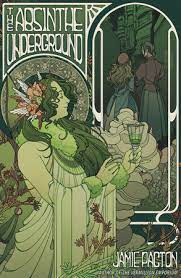
Book: The Absinthe Underground Author: Jamie Pacton Publisher: Peachtree Teen Year: 2024 Rating: 3.5 out of 5 stars
Synopsis : “For Sybil Clarion, the Belle Epoque city of Severon is a wild, romantic dream, filled with cares, cabarets, and glittering nightclubs. Eager to embrace the city’s freedom after running away from home, she’s traded high-society soirees for empty pockets and barren cabinets. At least she has Esme, the girl who offered Sybil a home, and maybe – if either of them dared – something more. Ever since Esme Rimbaud brought Sybil back to her flat, the girls have been everything to each other – best friends, found family, and secret crushes. While Esme would rather spend the night tinkering with her clocks and snuggling her cats, Sybil craves excitement and needs money. She plans to get both by stealing the rare posters the crop up around town and selling them to collectors. With rent due, Esme agrees to accompany – and more importantly protect – Sybil. When they’re caught selling a power by none other that its subject, Maeve, the glamorous girl doesn’t press charges. Rather, she invites Sybil and Esme to the Absinthe Underground, the exclusive club she co-owns, and reveals herself to be a green fairy, trapped in this world. She wants to hire thieves for a daring heist in Fae that would set her free, and is willing to pay enough that Sybil and Esme never have to worry about rent again. It’s too good of an offer to pass up, even if Maeve’s tragic story doesn’t quite add up, and even if Sybil’s personal ties to Fae could jeopardize everything she and Esme have so carefully built.”
Review : The Absinthe Underground is a sweet and fun adventure, that, while not low stakes, somehow ended up feeling just low stakes enough that it didn’t trigger any anxiety while reading it. Pacton crafted a beautiful scene by introducing us to the world of Fae, showing us rather than telling us what an intoxicating other-world might look like to two girls from this world. However, where she did a fantasy world justice, I felt she let the reader down with her depictions of the city of Severon. With a name like Severon and very little explanation to the time frame of the book, I was at first convinced this story was not only fantasy but science fiction. It wasn’t until I read the author’s note (at the end, after finishing the book in it’s entirety) that I realized Severon was meant to be an 1890’s Parisian equivalent. Something got lost in translation, figuratively speaking.
Likewise, Pacton included real world names like Toulouse and Mucha when discussing poster artists whose work is often stolen for it’s one of a kind collector status, which lent a bit of confusion and complication that felt unnecessary to the story. Sybil and Esme live in the top of a clock tower in a made up city that contains real world artists, something that I have a hard time wrapping my mind around when it comes to necessity. Not enough of the pre-Fae exploration of TAU connected me to Paris in the late 1800s for the real world examples to make sense, Pacton could have made a more significant impact on the story by placing greater emphasis on the time frame and reality of the world Sybil and Esme live in, then trying to tie it to our world. She lost me there.
Spoilers Below
That aside, the Absinthe Underground itself was beautifully described and the subsequent adventure Sybil and Esme embark upon is quite endearing. I did feel, though, that there were several loose ends Pacton left untied; it’s unclear whether they were left untied for a reason or because they were simply overlooked in the editing process. However, one seemingly purposeful loose end does find Sybil and Esme’s adventure into Fae and back into the real world marred by a broken promise to free a human they encountered in Fae and help her find her way back through the door – I find the prospect of another book exciting, I can’t wait to see what Pacton does next! She left several threads throughout the story, dropped like leaves, and I wonder if she’ll pick the all back up in the upcoming book or if we’re simply left to speculate why a forest hag might be frightened of a kitten, whether Sybil’s father was a magician, and why he tried so hard to marry her off and turn her into a “proper” young woman before she ran away. There were small explanations planted throughout the book, but not enough to satisfy the weight each of the aforementioned interactions had on the plot.
TAU was a cute, low-ish stakes middle grade adventure book that has great potential for future iterations, I think there’s room for improvement, but that improvement could surely come in additional books. Overall, I found it easy to read and enjoyable, if not a little slow and sleepy at times.
Advice : If a low-stakes adventure through a fairy realm sounds up your alley, you’ll want to give this one a read when it debuts in February. If you like a bit of a nail biter or a faster paced adventure, this might not be your jam.
Book: The Fury Author: Alex Michaelides Publisher: Celadon Year: 2023 Rating: 2.5 out of 5 stars
Synopsis : “This is a tale of murder. Or maybe that’s not quite true. At it’s heart, it’s a love story, isn’t it? Lana Farrar is a reclusive ex-movie star and one of the most famous women in the world. Every year, she invites her closet friends to escape the English weather and spend Easter on her idyllic private Greek island. I tell you this because you may think you know this story. You probably read about it at the time – it caused a real stir in the tabloids, if you remember. It had all of the necessary ingredients for a press sensation: a celebrity, a private island cut off by the wind…and a murder. We found ourselves trapped there overnight. Our old friendships concealed hatred and a desire for revenge. What followed was a game of cat and mouse – a battle of wits, full of twists and turns, building to an unforgettable climax. The night ended in violence and death. But who am I? My name is Elliot Chase, and I’m going to tell you a story nine any you’ve ever heard.”
Review : When I requested an ARC of The Fury, I didn’t realize it was by an author whose work I’d previously reviewed before. If you’ve been here for a while, you may remember when I reviewed The Maidens and gave it a withering 2 out of 5 stars (though I don’t check GoodReads for reviews, I know several others who read and disliked the execution of The Maidens), The Fury was written by none other than Maidens author, Alex Michaelides. Now, we already know I serve some hot takes on this blog, which is largely why I choose not to check other reviewers opinions prior to writing my own, but I was fairly astonished to find that The Maidens has been optioned into a television series by Mirimax. Small rant aside, I was grateful to get into a new book after trudging through my last review copy, and while The Fury didn’t garner more than 2.5 stars, in my opinion, it was at least a compelling read.
A few things right off the bat really started to rub me the wrong way, contributing at least in part to my 50% positive review. First of all, The Fury is narrated by a singular character who I found immediately off-putting. It’s possible that was Michaelides intention, but given the number of twists and turns throughout the book and the sheer effort he took to convince the reader that the narrator, Elliot, was someone they should be sympathetic to, leads me to believe that it wasn’t at all. Elliot is instantly pretentious and annoying, someone I had zero interest in reading through the eyes of for an entire book, which was unfortunate given that he was exactly who we’d spend the entire book reading through. Rather than laying out exactly who each character in the story was, what their relationship might have been, and allowing us to simply come to the conclusion that Elliot was an unreliable narrator, he began almost immediately by interjecting his own telling of the story to make cheeky comments about how much he’d tried to keep his own opinions out of the story but obviously hadn’t. There’s no room for the reader to do any work, Elliot does it all for us. Rather than reading and inferring, assuming the reader will be smart enough to come to their own conclusions, Michaelides treats us like we’re too dumb to read critically and tells us what’s going on. Personally, I take offense to this style and find it pandering at best, patronizing at worst.
The Fury, set on a remote Greek island, centers around Elliot’s friend and so-called soul mate of a friend, Lana Farrar. Through a series of twists and turns, Elliot convinces Lana to confront both her husband and best friend when she finds out they’ve been having an affair. What happens when she does, however, is a twisted nightmare of toxic relationships, bad choices, and manipulation. However, as we read through the book, we come to find that we’re getting only a fraction of the story from Elliot, revealing only tidbits of information to lead the reader down a path of his own design – which, had it been executed well, would have been intriguing and maybe even exciting to read. However, like I mentioned before, Elliot tells us right from the beginning that he’s an unreliable narrator and it was within the first chapter that I had already solved the murder.
Spoilers Ahead
The question, though, is which murder did I solve? Because this damn book has so many plot twists – arguably TOO many – that it isn’t until we reach the end that we find out who really died and who really murdered them. But, good news for me, the murder I solved in chapter one was, in fact, both the correct murder and correct murderer. Bad news for Michaelides.
When it comes to a murder mystery, or a murder retelling I suppose, in this case, I don’t want plot twist after plot twist after plot twist. I want a singular twist that I can’t see coming from a mile away. I feel so strongly that had Michaelides trusted us as an audience, I would not have seen the murderer coming from the jump. It would have been more interesting, better executed, and a surprise to read. Instead, it became contrived and boring. Michaelides had an infuriating habit of leaving each chapter on an ambiguous teaser, which I don’t mind if done appropriately and sparingly, but when you end every. single. chapter. with words like “He was just a kid, playing make-believe. And kids shouldn’t play with guns.” (59) it not only loses its impact but it loses its appeal. There were so many reasons for me to genuinely dislike this book, it’s hard to cram them all into a single review, but I think I’ve covered the most grievous here. It was compelling, I’ll give Michaelides that much, I kept turning pages, but it was a poor book. And for that I give it 2.5 out of 5 stars.
Advice : Sigh. I suppose if you enjoyed The Maidens you might actually enjoy The Fury. If, however, you don’t enjoy being patronized or a mystery you can solve from the very beginning, I don’t think this will be the one for you. It’s probably worth checking out from the library if you’re curious about it, but by no means should you waste money on this one.
Book: Camp Damascus Author: Chuck Tingle Publisher: Nightmare Year: 2023 Rating: 2.5 out of 5 stars
Synopsis : “Welcome to Everton, Montana: home to a God-fearing community with a heart of gold.
Nestled high up in the mountains is Camp Damascus, the self-proclaimed “most effective” gay conversion camp in the country. Here, a life free from sin awaits. But the secret behind that success is anything but holy.”
Review : I’ve been a little hesitant to review Camp Damascus because, well, I didn’t like it very much. Structurally, I couldn’t find much fault with it, even for a review copy. There were few errors and the narrative flowed well enough, at least for a middle grade read, which I don’t necessarily find this to be, but it was written that way, so it appears it may be. I’ve struggled with how to review this book knowing that it isn’t bad, but also feeling strongly that it doesn’t move the cultural narrative forward or do any work to provide any kind of cultural healing. Maybe that’s too much to put onto a book, frankly it’s what’s kept me from being able to concisely put my words onto the page, maybe I’m asking too much of a book like this. But Tingle himself said something in the note to the reader that makes me think that maybe it isn’t too much, maybe it’s just enough : “Currently, there are conversion therapy camps working hard to strip the personalities and inner truths from thousands of queer youths. These camps see one’s identity as something that can be ground down and chiseled away, creating a new and improved version of something that was never broken to being with. This barbaric attempt to crush the glorious reality of young LGBTQ people needs to end. It’s my hope that Camp Damascus can be a voice in the choir of artists and writers standing up to shout “no more”.”
Camp Damascus follows a 20-year-old autistic girl named Rose as she begins to unravel her known reality, living within the confines of a small town whose population largely attends church who hosts what’s known as the nation’s most effective conversion camp, boasting a 100% success rate. Early on, Rose notes that the commercials for Camp Damascus don’t have a need to hire actors because of their extremely high success rate, however no one that she knows who she’s spotted in the commercials have any recollection of having ever being participants at Camp Damascus. Tingle weaves a web of confusion and strangeness right out of the gate, creating a book that is immediately a horror novel, with Rose vomiting up piles of strange mayfly type bugs, witnessing a horrifying visage anytime she begins to feel anything that may resemble same-sex attraction (though this connection isn’t made clear to Rose until part-way through the book), and some bizarre breaks in reality where she remembers things as being other than they are.
Rose begins to tug at the thread of strangeness, unraveling the world around her, and in doing so she begins to lose her faith. As the object of her affection is murdered by what she grows to learn is a demon and her reality becomes more and more skewed, Camp Damascus becomes more and more of a supernatural horror / thriller. Rose grows to learn that she was, in fact, a former conversion therapy camp attendee, having had a previous relationship with another girl named Willow, but having little to no recollection of the relationship and absolutely no memory of attending the camp. Because she’s driven by the need to know more and more information, to structure her world into a way that makes sense, Rose is able to begin to parse what’s happening and methodically works her way through people who’ve been to Camp Damascus before, hoping to understand why they’re all witnessing demons and barfing up flies. Rose finds solace in a friend from camp (though she doesn’t remember him), Saul, and together they plot to take down Camp Damascus and help save those who’ve been through the program and have subsequently lost their memories and found themselves tethered to a demon.
The point of the demonic tethering in Camp Damascus is to bring about something truly terrifying and out of alignment with reality anytime the tethered human experiences any form of same-sex attraction, pushing them to avoid the feeling or avoid the person who has lead them to “sin”. While the concept is true of conversion therapy, the execution is obviously made-up, but it is in this execution that I find the biggest flaws with the book. Tingle is attempting to draw a parallel to the fear that Christianity uses to convert, “fire insurance” if you will, by using literal demons in his book as a means of fear based conversion. In Rose’s research, though, she’s able to determine that the Demons are real beings from another, perhaps alternate, world. They can walk through walls and disappear at will, but they are flesh and blood like people. She gets a glimpse at real deal hell, as well, and is able to see exactly how the demons torture humans who sin. It’s here that I take the most issue. Rose loses her faith because she finds what the church is doing to be completely out of alignment with the idea of love and salvation, but the prospect of real hell continues to exist for her. I think by continuing to draw lines to the idea of fear through hell being a real place really does a disservice to what Tingle and other authors are clearly trying to do. If Christians are using fear to convert and fear to turn anyone who identifies as other into their perfect idea of a “sinless” human, then Tingle is no different by (spoilers ahead) having the demons drag bigoted church members to literal hell in the end of the book.
While I believe Tingle is making a point to show that being gay isn’t a sin, by allowing for hell to be a real place and for the demons to really be torturing humans who sin, his work no longer moves the cultural narrative forward. I believe that Tingle’s book comes from a place of anger, and rightfully so, particularly as a member of the LGBTQ community. Tingle has every right to be angry. He even has every right to write a book out of that anger. BUT if Tingle wants to join the growing chorus of voices saying “no more” then I think the chorus of voices needs to create spaces for forward movement and instead what he’s done is create a space of convoluted anger and continued fear that by acting certain ways we’ll be dragged to hell and tortured for eternity. I think this book missed the mark in terms of saying “no more” and bringing spaces of healing and momentum toward something different and better into the world. Rather, Tingle perpetuated the idea of a literal Christian hell and continued to create spaces of fear and fear-based conversion (though, not conversion in the conversion camp sense), and to me that makes this book disappointing and sad, no different than movies that perpetuate the fear we have over war and disease during times of war and disease. I think collectively we need spaces where we can grapple with what cultural reality looks like, but (and this is coming from someone who has not been through conversion camp, so take my opinion with a grain of salt) I don’t think this was quite it.
Advice : If you like horror, particularly supernatural horror, you will probably find this fairly enjoyable. If you have any form of religious trauma or trauma surrounding conversion therapy, I would steer clear of this one. Although, it’s possible you may find it cathartic – but I think there are definite themes that would be potentially triggering to those with PTSD, so bear that in mind. It was a miss for me, but if you love horror it may be a hit for you.
Book: The Saint of Bright Doors Author: Bajra Chandrasekera Publisher: Tor Dot Com Year: 2023 Rating: 5 out of 5 stars
Synopsis: “Fetter was raised to kill, honed as a knife to cut down his sainted father. This gave him plenty to talk about in therapy. He walked among invisible powers: devils and antigods that mock the shape of man. He learned a lethal catechism, lost his shadow, and gained a habit for secrecy. After a blood-soaked childhood, Fetter escaped his rural hometown for the big city and fell into a broader world where divine destinies are a dime a dozen.”
Review: Before I sat down to write this review, I made the mistake of reading some of the GoodReads reviews on The Saint of Bright Doors. The average review was 3.5 stars and they were littered with “did not finish” (DNF) reviews from people calling this book pretentious and confusing. Before I had even finished Saint, I vehemently told my partner this book needs to be a summer reading book for AP English students. NEEDS TO BE. I have to assume that those who were DNFing this book have never read Catch-22 or One Hundred Years of Solitude (and if they have, I would hate to see their impending reviews about how terrible they are), but I think that’s probably a rant for another time.
It has taken me several days since finishing Saint to finally get the nerve to sit down and write this. Chandrasekera has written an absolute masterpiece; it’s hard to know where to begin. The Saint of Bright Doors weaves a web of myth and legend, beginning with our protagonist, Fetter, losing his shadow as a newborn. His mother, Mother-of-Glory, in an attempt to make Fetter her perfect killing machine, rips his shadow from his body with a nail. This loss finds Fetter no longer tied to the laws of gravity, able to simply float upward at the slightest unclenching of a muscle in his abdomen. Mother-of-Glory spends the first twelve years of Fetter’s life preparing him to kill his estranged father, The Perfect and Kind, a mystical holy-person and the leader of a cult-like religion called The Path Above (not to be confused with The Path Behind or any of the other offshoots of The Path Above, each as convoluted as the next, professing completely opposing beliefs, assured they are each the correct way forward).
Spoilers Below
When Fetter is twelve, Mother-of-Glory throws him out of the house, assuming the world would make him hard, perfecting the process she has already begun. Fetter, however, finds his way to an island called Luriat, rejects the killing lifestyle, and attempts to live his life in a new way. We spend the remainder of the book in Luriat, for the most part, and watch as Fetter grows to love this strange and mixed up island. The political and religious system of the world Chandrasekera has created are confusing and complicated, often convoluted, and always at odds with whatever political or religious system has recently been overthrown, often seeing buildings and streets renamed for the new political or religious system in place, thus leaving spaces to be named and renamed and renamed over again, sometimes bouncing back and forth between names when one system overthrows another and is then overthrown by the previous system. It’s complex, I understand why some people found this difficult to process, but it only serves to show how strange the world Fetter lives in is.
We spend most of the book assuming that Fetter’s parents are otherworldly in some way because they’re both, seemingly, hundreds or thousands of years old. What we come to learn, though, is that, around the time of Fetter’s birth, The Perfect and Kind simply reshapes the world and in doing so creates thousands of years of political and religious systems in the memories of those alive, throwing Mother-of-Glory into a space where, though only 15-20 years old, she remembers her original homeland but also remembers all that has come to pass since then – false memories that were created with the reshaping of the world. In this reshaping, the island of Luriat comes into existence for the first time. I find this reshaping to be a fascinating part of this tale and I’ll tell you why! As I read through Saint, I kept thinking “this is an epic”, though it’s not necessarily an epic in the traditional sense. It covers a span of time, it’s a decently long book, but realistically we’re only spending about 30 years with Fetter from the start of the book, at his birth, to the end of the book. It doesn’t quite make it an epic, and yet…it’s an epic. Chandrasekera has created an epic in the same way that The Perfect and Kind has recreated the world, building history into something that is thousands of years younger than it seems. It’s nothing short of masterful.
The Saint of Bright Doors is a book about choosing our own destinies despite the destinies we may often find thrust upon us. It’s about autonomy in the face of somewhat mystical forces. Fetter joins a group of people in Luriat, a self help group if you will, called the Unchosen. People who come from all kinds of different mystical and mythical backgrounds, those with equally magical and powerful families and family members, people who came close to being the chosen ones, but just didn’t quite make it. Each person in the group has their own story and their own magical abilities, and they each set out to become something else. I suspect that at least one person in the group actually is a chosen one, but the story of their legacy is so muddled by the time it makes its way to them, that they are unable to fulfill their particular destiny. Fetter, similarly, has a legacy he is unable to fulfill at the time he finds the group because he’s never been introduced to his father and is unable to A) become the heir to The Perfect and Kind or B) kill is father as Mother-of-Glory has raised him to do.
Fetter spends much of the book wondering who he is, exactly. He slips into different personas in order to fit into the caste system of Luriat and do the work he wants to do, which is studying the bright doors around the city – doors which, if closed for too long and put under the right amount of pressure, will turn into something magical. No one knows or understands what the doors do, but Fetter can see that they are actually open doorways to other worlds and realities, through which devils can cross and enter the world Luriat exists in.
Fetter, appropriately named for one who is tied down, spends his life in this book attempting to escape the destinies that his parents see for him, to escape the destinies that are thrust upon him by institutions, political and religious systems, or even by those he considers his friends. He wonders who he is in relation to the secrets and lies he’s constructed in order to fit in, and I can’t think it’s a coincidence that he finds himself most at home on an island that shouldn’t even exist – an island that has simply chosen it’s own destiny. Fetter finds himself drawn to bright doors, turning into magical portals when given the time or attention to become what they want to be, again spending his time with creations that have chosen their own destinies. In the end, Fetter leaves us with this : “‘Every lost past is a world,’ Fetter says. ‘I learned that from my…from the Perfect and Kind himself. I think it might be the only thing I learned from him that matters. Behind every bright door is a world full of lost hearts. It matters.’ […] “‘I need you to understand me, here. I know this isn’t your politics, and I swear to every devil I know I’m not turning my back on that, because I’m fucking here, aren’t I? I’m here, this time But I need you to understand what I mean when I say I am the world.’ Koel laughs, shortly. ‘And you’ve changed it?’ ‘And I’ve changed it,’ Fetter says.”
Advice: If you read One Hundred Years of Solitude and found it easy to keep track of the timeline, you will have absolutely no trouble keeping track of the intricacies of The Saint of Bright Doors. If you read Catch-22 and found the politics laughable and relatable, you will have absolutely no trouble seeing the politics in The Saint of Bright Doors for what they are. If you enjoy an epic, world building, myths, and strangeness, this is the book for you. If you can read critically and analyze what you’re consuming, dive the heck in! You don’t want to miss this one.
Book: The Angel Maker Author: Alex North Publisher: Celadon Books Year: 2023 Rating: 3 out of 5 stars
Synopsis : “Growing up in a beautiful house in the English countryside, Katie Shaw lived a charmed life. At the cusp of graduation, she had big dreams, a devoted boyfriend, and a little brother she protected fiercely. Until the day a violent stranger changed the fate of her family forever.
Years later, still unable to live down the guilt surrounding what happened to her brother, Chris, and now with a child of her own to protect, Katie struggles to separate the real threats from the imagined. But then she gets the phone call: Chris has gone missing and needs his big sister once more.
Meanwhile, Detective Laurence Age is facing a particularly gruesome crime. A distinguished professor of fate and free will has been brutally murdered just hours after firing his staff. All the leads point back to two old cases: the gruesome attack on teenager Christopher Shaw, and the despicable crimes of a notorious serial killer who, legend had it, could see the future.”
Review : Why is it that the books that come with the coolest ARC packaging always turn out to be the biggest duds? The Angel Maker arrived with several envelopes, each with a sticker dictating after which chapter you should open each. Inside the envelopes were cute little references to the revelations in each corresponding chapter: a small card, a newspaper article, and a box of matches. I love getting ARC packages, they are always an extremely enjoyable aspect of receiving and reviewing books, but what I’ve come to notice is that if a book has a detailed and intricate package, it’s likely to be pretty rough reading.
The Angel Maker did not disappoint in terms of living up to the ARC package let-down. North, a former New York Times best seller, wrote a book with a unique story in a truly bizarre way. I found myself wondering several times if he had simply hit “replace all” for certain words, given the strange wording of so many of his sentences. There were many instances of sentences that seemed to go nowhere, that wove a strange web of words that didn’t go together, it felt almost as if it had been poorly translated into English. I found myself baffled more than not reading through this one – and I realize it’s an uncorrected proof so it’s probably pretty likely that by the time it’s available to buy these problems will have been corrected, but I think it speaks volumes when an ARC reads so poorly.
I will give North credit, though, the story he’s created is interesting and strange. It unravels at the speed you’d hope from a suspense/thriller novel. Told from the point of view of several people, it hops between the present and the past, unveiling more and more details as you read. Something North did that I didn’t enjoy, however, was relying on the unreliable female narrator trope – once again we see a female protagonist, Katie Shaw, who’s had two whole glasses of wine and suddenly no one around her can possibly believe a word she says, so what does she do? Investigates on her own, of course! What else could she possibly do? This is the trope. It’s old, it’s over done, it’s worn out, and it’s lazy. And I’m not exaggerating, she had two glasses of wine in one single scene and suddenly her husband no longer believes a word she’s saying. But let’s not even focus on the fact that her husband regularly leaves their five year old daughter alone to watch tv by herself while he makes music in the basement with the door closed, a fact that Katie finds bothersome and irritating while her husband, Sam, finds completely acceptable.
I find it hard to want to read a book that employs the aforementioned trope, particularly as a woman. Not only is it overdone, but it plays into a stereotype that honestly isn’t a good look coming from yet another male author. I was slow to read The Angel Maker for all of the above reasons, it took me longer than most of the ARCs I’ve read this year because, while the story was interesting, it was written so poorly and in such a lazy way that it was no longer even a compelling read. It’s unfortunate that an author can take a quality premise and mess it up so badly that it isn’t even worth turning pages to see the finale. I’ve said many times that a book doesn’t have to be well written to be compelling, and unfortunately The Angel Maker is neither well written nor compelling.
Advice: Unless Alex North is your favorite author, this is a pass for me. It contains depictions of attempted and successful murder, snuff films, houselessness, substance abuse, and gaslighting. If you enjoy a book with worn out tropes, you might actually like this one. If you don’t, this isn’t it.
Book: Into the Light Author: Mark Oshiro Publisher: Tor Teen Year: 2023 Rating: 4.5 out of 5 stars
Synopsis: “It’s been one year since Manny was cast out of his family and driven into the wilderness of the American Southwest. Since then, Manny lives by self-taught rules that keep him moving – and keep him alive. Now, he’s taking a chance on a traveling situation with the Varela family, whose attractive but surly son, Carlos, seems to promise a new future.
Eli abides by the rules of his family, living in a secluded community that raised him to believe his obedience will be rewarded. But an unsettling question slowly eats away at Eli’s once unwavering faith in Reconciliation: why can’t he remember his past?
But the reported discovery of an unidentified body found in the hills of Idylwild, California, will draw both of these young men into facing their biggest fears and confronting their own identity – and who ethyl are allowed to be.
For fans of Courtney Summers and Tiffany D. Jackson, Into the Light is a ripped-from-the-headlines story with Oshiro’s signature mix of raw emotions and visceral prose…but with a startling twist you’ll have to read to believe.”
Review: In both the ARC pamphlet I received with this book and the author’s note at the end of the book, Oshiro alludes to a childhood trauma that inspired and birthed this book, what I suspect, based on little tidbits throughout Into the Light, was conversion camp. The air of conversion, of being forced to undergo something dangerous, something heartless, and cruel at the hands of the people who should be the most loving and protective forces in your life, runs throughout this book. While it isn’t at all about that type of conversion, it is about the damage that the church causes at the hands of people who have no business holding positions of power.
Into the Light follows Manny, a young adult who grew up with his sister Elena, bouncing from foster home to foster home, seeing the worst of the worst, and finding that as he gets older the likelihood of seeing a real adoption happen grows smaller and smaller. Manny and Elena, however, find themselves being adopted blindly into a family with direct ties to a cult-ish christian community called Christ’s Dominion. The family quickly decides that Manny needs to participate in something called Reconciliation and sends both he and his sister to a three-day “retreat” in the Californian mountains. What Manny experiences at Reconciliation is not quite conversion camp, but it is detrimental, traumatic, and extremely dangerous. He arrives to find that all the families in attendance are white with adoptive children who are not, across the board, most have come directly from other countries, several from within the foster system, and all with something deemed wrong with them – whether that be their gender identity, their sexual preferences, or the color of their skin.
Into the Light is told from Manny’s perspective, jumping from the present, as he lives his life with the newly found Varela family traveling the country trying to find his sister Elena, to the past as he experiences Reconciliation, and yet from a third time period as he (known as Eli, having succeeded in Reconciliation in some ambiguous, nebulous way) lives his life at the compound in the mountains, sharing his success story with newcomers and their “wrong” children. I found this style to be confusing, as the chapters had no headings to tell you what point of view you would be reading – the perspective shift was shown by a slight change in font that got more confusing as the story ramped up and all three perspectives were being shared closer together than they had previously in order to get to the climax of Manny’s journey with Christ’s Dominion. I think some headers would have been a huge help particularly as the book wrapped up, jumping quickly from one perspective to another in order to round out the entirety of the narrative.
My biggest issue with this book is the plot twist at the end, I think it detracted from the weight of the story, took away from the very real issues being discussed in the book, and didn’t serve a function. We read through 90% of the novel as a realistic fiction book, yes quite troubling and pointed, but not a horror novel in that sense. With about 10% of the book remaining, the “truth” is revealed and the book becomes sci-fi or horror in an unrealistic kind of way, which I tend to enjoy but not when it shifts the entirety of the book into a new genre with no time to spare. I felt like there were some many important aspects of this book, so many important things being discussed in a first-person narrative that need to be spoken, that need to have a light shed on them, that when Oshiro changed the book with a strange plot twist that took Manny’s separation from Eli from being explainable as trauma, which he absolutely endured, to being explainable as a sci-fi impossibility it lessoned the weight of what Oshiro was trying to get across. Suddenly we have nothing more than a science fiction book with a weird ending that’s so disjointed from the majority of the book that I don’t know how to reconcile the two, and frankly I think that does a huge disservice to what Oshiro could have achieved.
With a rise in anti-LGBTQIA+ legislation, a rise in christian nationalism, and a rise in spoken hatred, books like Into the Light that share what children are really experiencing at the hands of people who should be doing their best to protect them are incredibly important. I found it disappointing that this book shifted in the way it did, that the twist wasn’t more seamlessly included throughout the rest of the book, and I left it thinking more about how disjointed it was than I did thinking about how realistic the rest of it was for thousands of teens and young adults across the country. Manny’s story, and by proxy, Oshiro’s personal story, deserve to be told and heard and believed with compassion and care and love. I fear that the twist has only served to detract from something so important.
Advice: This book contains depictions of the foster care system, of sexual harassment of a minor, of religious trauma, of conversion, of racism, of parental abandonment, of physical assault, and of very real trauma and ptsd experiences following. It is, however, a great read that moves swiftly and keeps you reading to see what’s going to happen. I think if you like a singular viewpoint told from multiple timeframes, you’ll probably read through this and really enjoy it. If you find that style to be confusing, this might not be the best or easiest book to read. If you have experienced religious trauma or conversion, this may be a pretty intense and difficult read for you as well.