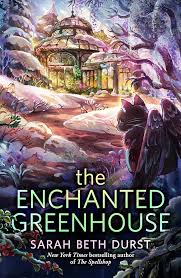
The Enchanted Greenhouse Review

Book: The Enchanted Greenhouse
Author: Sarah Beth Durst
Publisher: Bramble
Year: 2025
Rating: 4.5 out of 5 stars

Synopsis : “Terlu Perna was lonely, so she broke the law. She cast a spell and created a magically sentient spider plant. As punishment, she was turned into a wooden statue and tucked away in an alcove in the North Reading Room of the Great Library of Alyssum. And that was the end of her story. Until…
Terry wakes in the cold of winter on a nearly deserted island full of hundreds of magical greenhouses. She’s starving and freezing and the only other human on the island is a grumpy gardener. To her surprise, he offers Terlu a place to sleep, clean clothes, and freshly baked honey cakes – at least until she’s ready to sail home.
But Terlu can’t return home and doesn’t want to – the greenhouses are a dream come true, each more wondrous than the next. When she learns that the magic that sustains them is failing – causing the death of everything within them – Terlu knows she must help. Even if that means breaking the law again.
This time, though, she isn’t alone. Assisted by a gardener and a sentient rose, Trull must unravel the secrets of a long-dead sorcerer if she wants to save the island – and have a fresh chance at happiness and love.”

Review : I’ll be the first to admit that the concept of anything talking that wouldn’t normally talk is one of my least favorite fantasy tropes – I find talking animals to be disconnected from my expectations and there’s rarely a time when I feel differently. So the concept of a book in which most of the characters are talking plants was immediately something I entered into with trepidation. I love a fun new world of fantasy novels, but for some reason, I just cannot generally get on board with talking creatures. I’m happy to report, however, that The Enchanted Greenhouse is the exception. Durst has successfully created a fantasy world with this novel that needs very little extra work – the entirety of the novel takes place in a massive series of enchanted and magical greenhouses, on an island with just one other inhabitant beyond our protagonist (Terlu Perna, purple skin, purple eyes…human). The plants we encounter in the greenhouses, while some seem to be otherworldly, largely reflect what we might find in our own world, and while there is a flying cat and several magical creatures spelled to do some work in the greenhouses, there’s little beyond the inherent magical quality of the book that wouldn’t be found in our own world.

I realized about a chapter into The Enchanted Greenhouse that this is in fact a sequel to a previous book that I haven’t read, but the mark of a great book is that it can stand alone without much explanation needed, and Durst certainly achieved that feat. Had I not read the letter from the author, I would never have known this wasn’t a stand alone novel, the recap at the beginning of the book felt less like a recap and more like the necessary introduction to Terlu Perna and the magical world she resides within. And though the world she lives in is magical, it’s also filled with rules about who can and can’t do magic – for good reason, as magic can be dangerous – only trained sorcerers are allowed to even attempt to perform spells. However, Terlu casts a spell to create sentience in a plant friend of hers, and in doing so finds herself made an example of and is turned to wood. During her years as a statue, though, the Empire falls and the rules of what magic is and isn’t allowed are changed. To save Terlu from the fires of the resistance, Terlu’s old boss ships the statue formerly known as the living Terlu (along with the spell to awaken her from her statue slumber) to a remote island of greenhouses run by a lone gardener named Yarrow. Having sent letters to the government begging for help with his magically failing greenhouses, Yarrow believes Terlu is a sorcerer sent to help him. When Terlu awakens and Yarrow realizes she’s just a girl who cast a spell one time, he becomes sullen and grouchy. But the greenhouses continue to fail, and Terlu is determined to help.

I’ve read several books over the last few years that have billed themselves as being similar to Legends and Lattes by Travis Baldree, and while some have come close to the cozy fantasy he’s crafted in his series, none have really been what I would compare to his works. While The Enchanted Greenhouse wasn’t labeled as such, had it been, it would have been the first book I’ve read since Legends and Lattes that made me feel the same way Baldree did. Durst has created a cozy, low-stakes fantasy with the most wonderful cast of characters. It did have a slow start, hence the 4.5 stars, but once I got into it, things really picked up in a sweet, cozy, romantic sort of way. And it’s worth saying that even though this book was published by Bramble, it is definitively not a romance novel – it’s a love story. And who would have though I’d have spent an entire novel crying my eyes out over a lovable rag-tag crew of talking plants? Not me, that’s for sure. But cry I did. Durst has created something truly magical with this work, weaving the concept of empathy into her tale in such a way that I can’t imagine anyone who read this book could walk away unchanged. Not only is it a beautiful tale of found family, it’s also a deeply political tale as well, and perfectly timed, at that. I won’t spoil it for you, but know that it doesn’t read as political, it’s just that you cannot come away from this book on the side of the oppressor. You simply can’t.

Advice : If you enjoy quiet, cozy, low-stakes fantasy novels with flying cats and miniature dragons and honey cakes…well, do I have news for you. Add this one to your list, pre-order it now before it’s release in June. Trust me.
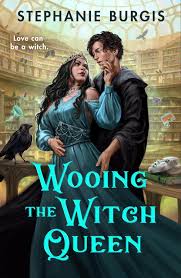
Wooing the Witch Queen Review

Book: Wooing the Witch Queen
Author: Stephanie Burgis
Publisher: Bramble
Year: 2024
Rating: 3.5 out of 5 stars

Synopsis : “Queen Saskia is the wicked sorceress everyone fears. After successfully wrestling the throne from her evil uncle, she only wants one thing : to keep her people safe from the empire next door. For that, she needs to spend more time in her laboratory experimenting with her spells. She definitely doesn’t have time to bring order to her chaotic library of magic.
When a mysterious dark wizard arrives at her castle, Saskia hires him as her new librarian on the spot. “Fabian” is sweet and a little nerdy, and his requests seem a bit strange – what in the name of Divine Elva is a fountain pen? – but he’s getting the job done. And if he writes her flirtatious poetry and his innocent touch makes her skin burn, well…
Little does Saskia know that the “wizard” she’s falling for is actually an Imperial archduke in disguise, with no magical training whatsoever. On the run, with perilous secrets on his trail and a fast-growing yearning for the wicked sorceress, he’s in danger from her enemies and her newfound allies, too. When his identity is finally revealed, will their love save or doom each other?”

Review : Wooing the Witch Queen was a cute, quick romantasy-ish book about two people who are ultimately misunderstood by those around them. I call it romatasy-ish because while it is a fantasy and it’s being published under Bramble, a romance novel imprint of Tor Books, the actual romance aspect of this book was…light. I think if this were a movie it might be rated PG-13 for implied nudity; the romance aspect of the book was mild, took the entire book to develop, and was about as closed-door as it gets without actually being a closed-door romance, take that how you will!

Outside the actual romance of the novel, which the synopsis seems to more than imply is the majority of the book, the actual plot of Wooing the Witch Queen centers around Saskia’s immediate threat to the throne she stole from her uncle – largely from her neighbors, seemingly under the order of the Archduke Felix.

** Warning, spoilers ahead! **

Being as quick as this read was, there’s very little I could say here that wouldn’t be a fairly immediate spoiler, so let’s just dive into it. What Saskia, or the rest of the surrounding kingdoms for that matter, doesn’t know is that Felix is simply a figure-head, someone who has been held prisoner, who has no formal diplomatic training, and who has no say in what his kingdom does or doesn’t do. On the night his traitorous family is poised to murder him and turn him into a martyr, Felix makes an escape to the only Imperial who has been able to hold off his in-laws : Saskia. Wearing what he doesn’t realize is the cloak of a dark wizard, Felix escapes while donning a swooping hooded cape. When he arrives at Saskia’s court, she assumes he’s a dark wizard answering her call for a temporary laborer to arrange her magical library. Without allowing Felix to get a word in edgewise, Saskia hires him and permits him to wear a mask – something that is, apparently, typical for dark wizards.

The remainder of the book follows this path : Felix bumbles his way through his task, only capable of organizing a magical library because he’s only ever been allowed to participate in the arts, Saskia falls for his gentle personality, and no one seems to be any wiser until he finally reveals himself to her at the end of the book. Ultimately, I found this story to be mildly cute but of no great importance or need to be told, the romance was more actually romantic than what you might expect out of a romance novel, and Felix’s character is written like the reversal of every female protagonist written by a man – deeply hard to believe, full of strange character traits that sound more like a woman who didn’t have any diversity in her beta readers, and not all that interesting when it’s all said and done.

Finally, I found the plot to be thin and weak, Felix’s background was never fleshed out, and I found myself with questions I didn’t ultimately find answers to. I think the trouble with writing a fantasy novel is you have to create a story that’s compelling enough that the reader finds themselves willingly reading about the politics of a world that is wholly made up – if you create a world the reader isn’t invested in, there’s then no incentive for them to involve themselves with the minutiae. Sadly, Burgis did not succeed in compelling me to care about the politics of the world she crafted and so during moments of political discourse (which comprised a good deal of the book), I found myself bored and uninterested. I was never given the chance to become invested in the world when the book moved so quickly and never fully explained the main characters backgrounds in a way that felt satisfactory. Overall, this book was fine.

Advice : If you pick up any romantasy you can get your hands on, maybe this will be for you! If you prefer more romance, more fantasy, more everything…well, maybe this isn’t going to be the one. It might be worth checking out from your local library.

Sword Crossed Review

Book: Sword Crossed
Author: Freya Marske
Publisher: Bramble
Year: 2024
Rating: 4 out of 5 stars

Synopsis : “Mattinesh Jay, dutiful heir to his struggling family business, needs to hire an experienced swordsman to serve as best man for his arranged marriage. A sword-challenge at the ceremony would destroy his desperate bid to restore his family’s wealth.
What he can afford, unfortunately, is a part-time con artist and full0time charming menace, Luca Piere.
Luca, for his part, is trying to reinvent himself in a new city. All he wants to do is make some easy money and try to forget the crime he committed in his hometown. He didn’t plan on being blackmailed into giving sword lessons to a chronically responsible – and inconveniently handsome – wool merchant like Matti.
However, neither Matti’s business troubles nor Luca himself are quite what they seem. As the days count down to Matti’s wedding, the two of them become entangled in the intrigue and sabotage that have brought Matti’s house to the brink of ruin. And when Luca’s secrets threatened to drive a blade through their growing alliance, both Matti and Luca will have to answer one question : How many lies are you prepared to strip away, when the truth could mean losing everything you want?”

Review : The ARC messaging for this book compares it to Travis Baldree’s Legends and Lattes – my second ARC this year that’s been compared to my favorite cozy, low stakes fantasy world. While I wouldn’t necessarily pick this book up and immediately think “This reminds me of Legends and Lattes“, Marske did deliver on low-stakes and I appreciate that. Marske has created a fantasy world with all the world-building one might hope for and absolutely none of the fantasy, which made the book a bit hard to get through at first – though, the close proximity and suspense of it all made things flow a lot easier as we got into the relationship between Matti and Luca. This is ultimately what led me to give this book four instead of five stars, as there wasn’t a perfect balance between mind-numbingly slow and send-shivers-up-your-spine anticipation. I think the balance could have been struck a bit more seamlessly, but ultimately the writing was great, particularly for an ARC, the storytelling felt solid, and the world-building was pretty good.

I think it’s an interesting concept to create a fantasy book but to include absolutely no fantasy whatsoever. True, there’s some talk of the gods – actually, this ended up being my favorite aspect of the novel, each swear lending itself to more and more ridiculous descriptions of the god’s particular anatomy (someone’s pube being my personal favorite) – but there’s not a single mention of any kind of fantastical creature, anyone who might be anything other than human, or forces that might be beyond anyone’s control. What Marske has created, instead, is a book filled with the day-to-day politics of guild houses and merchant families, what their lives look like as everyday folk who trade and run factories and forge alliances with each other. And ultimately, this is where the book finds Mattinesh Jay – the heir to a guild house that manufactures wool, a guild house that’s fallen on more than it’s fair share of hard times, that’s struggling to survive, and so two families must marry in order to keep the house name from utterly failing. It isn’t a nail biter, there isn’t threat of life or limb (for the most part), and there aren’t any interactions with creatures. From that perspective, I’m not sure if cozy is the right word, so much as slow might be, but low-stakes it most certainly is. There’s absolutely no anxiety-causing battle sequences or war-time scenes, rather we see the politics of daily life and from there our story grows.

I found the pacing to be a bit frustrating, jumping back and forth between incredibly dull and incredibly interesting, it actually took me about half the book before I started to really enjoy the storytelling. I found it dull and hard to follow, though not because it was poorly written, simply because I wasn’t interested in the politics of guild houses. Once things began to get rolling, though, I came to find myself turning pages with gusto, returning to the book to see how the story would play out, and hoping for a bright future for the main characters. In fact, I finally began to enjoy the book so much that the end made me cry a little – so how’s that for making a turn around!

Advice : If you love a slow-burn, low-stakes fantasy or sword fighting, this might just be for you! If you aren’t into queer romance novels, lots of talk about guild houses, or the politics of a fantasy world, you might struggle with this one.