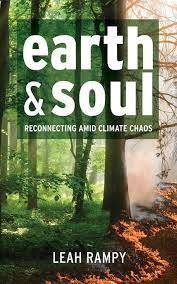
Book: Earth & Soul : Reconnecting Amid Climate Chaos
Author: Leah Rampy
Publisher: Bold Story Press
Year: 2024
Rating: 2.5 out of 5 stars
Synopsis : “Facing directly into the devastation of climate chaos and biodiversity loss, Rampy leads her readers on a soul journey through grief and loss to also claim the beauty, joy, and possibilities available when we reconnect with Earth. As we follow the author’s compelling personal experiences and engagingly lyrical stories of whales, cedars, sparrows, and more, we see the necessity and urgency of learning from the wisdom of our kin in the natural world. Writing at the intersection of spirituality, ecology, and story, Rampy charts a course for living deeply connected to Earth in ways that are both vitally important for and uniquely suited to these times. Even now when the worlds as we once knew it is ending and a new story lies beyond what we can envision, we hold the potential to lay stepping stones toward a diverse and vibrant world of oneness and mutual flourishing.”
Review : I have so many conflicting thoughts as I sit down to review this book. It gives me no joy to give a book about climate change a 50% review, particularly as the publicist for this book sent this book to me because of my own work in the world of sustainability. I wanted to love Earth & Soul, but I didn’t. Let’s start at the beginning : Leah Rampy, while boasting a PHD, does not have a background in biology, climate sciences, or ecology – her doctorate is in curriculum. While I don’t think it’s necessary for an author to hold an advanced degree, I do believe it hinders the work and the words she’s trying to communicate. Because her field of study has nothing to do with the subject matter, Rampy relies heavily on the works of others, paraphrasing (and citing) books I have been privileged enough to have read in the past. While this might function well in an academic paper or blog post, I find the distillation of the work of others to be an unfortunate book choice. I don’t think there’s anything wrong with a book filled with cited sources, don’t get me wrong! I love a well researched book. Where I take issue is how a story is told; Rampy rarely sheds light on her own experiences, choosing instead to simply share what others have written.
Rampy barely pulls the curtains back on her own life, something I think does a true disservice to the impact this book could have made. As I mentioned, she relies heavily on the work and words of others to bolster her narrative rather than allowing her own connection and experiences with Earth to drive the narrative forward. Referencing Robin Wall Kimmerer’s Braiding Sweetgrass eight times in 180 pages, Rampy clearly seeks to emulate Wall Kimmerer’s foundational work. Unfortunately, it reads as someone who’s read Braiding Sweetgrass and is relaying it to a friend who doesn’t want to read it themselves. As I have recently finished reading Braiding Sweetgrass myself, I found this particularly glaring. Rampy references indigenous wisdom and knowledge, which I appreciate a great deal as the scientific world is finally coming to understand just how much indigenous wisdom could have helped us over the last several hundred years; I couldn’t help but feel that I would rather be reading about indigenous wisdom right from the source, rather than distilled by a white woman. For reference, there was a singular moment in this book that brought me to tears and it was, unfortunately, a retelling of a Wall Kimmerer story. I found the writing style to be choppy and stilted, there was little flow to this narrative, though in the few places where it did flow (interestingly enough, found during the few brief descriptions of Rampy’s own personal experiences with the Earth), it was quite enjoyable to read.
Rampy’s style seems to be tell, rather than show, which you may know I find an incredibly condescending method of writing. In a chapter entitled “Kith and Kin”, Rampy uses the words kith and kin a combined total of twenty six times over the course of a mere fifteen pages, beating us over the head with the words rather than showing us what they mean to her. The words will go on to haunt the remainder of the book, interspersed so often than you cannot get away from them. I would rather be shown what kith and kin might look like than be told over and over again what it might mean – the impact is lessened this way, becoming more of an annoyance than a moment of understanding. In other books I’ve reviewed, I’ve found the occasion for telling vs showing often comes from an author’s disbelief that the reader would be intelligent enough to figure things out for themselves, to Rampy’s credit, Earth & Soul did not read this way. It did, however, read as though Rampy didn’t know how to show us rather than telling us, and perhaps that comes from her time spent as a lecturer; perhaps she will learn that as she grows as an author, but for now it leaves me continually frustrated by the way she steals the powerful impact this book could have made right out from under herself.
As someone who is invested in the world of sustainability, I found frustration with this book. Rampy discloses at regular intervals that she has lead, what she refers to as, Pilgrimages all over the world. However, she never once discusses what kind of carbon impact she has on the planet by flying to multiple locations all across the globe with groups of people – in a time when many people are assessing their own carbon impact and coming to the conclusion that regular flight travel has a negative impact on the climate, I find it to be a stark omission. I also wish Rampy would have addressed the privilege that comes from having access to around the world flight travel, of the kind of people who might have the disposable income to go on such a journey, the people who are paying money to gaze upon nature without being tasked with making their own sustainable choices. It’s entirely possible that I’m pegging this all wrong, but Rampy doesn’t discuss any part of her climate footprint or the privilege that comes from these trips, so I can only tell you how it feels, which is…not good. During an early discussion revolving around meditating on nature, Rampy shares an anecdote from one such pilgrimage in which someone left a strand of yarn around an area of Earth with a sign telling people to stop and enjoy. Unfortunately, all I could think about was how that person had littered – sewing continued frustration on my end, as someone who works very hard to keep people from littering and to clean up litter that exists in nature already.
Likewise, Rampy twice discusses the use of cairns, both as a suggestion for the reader and as an example of what her pilgrimages entail. Again, as someone who works in the realm of sustainability, I find it problematic and ignorant on Rampy’s part to suggest readers create cairns. I have learned, and you can find this on many signs in many forest nation wide, to take only photographs and keep only memories, meaning you are to leave nature as you found it (or in my personal opinion, better than you found it). Creating cairns is frowned upon within the sustainability and naturalist worlds for (largely) two reasons : the first being that cairns created by park rangers exist for a specific reason, they are made to mark trails and creating your own can make a negative impact on carefully constructed cairns used for designating directions; the second being that many creatures, like salamanders, take shelter under or lay their eggs under stones, removing them from where they exist already may either damage eggs, damage habitat, or create fewer available spaces in which an animal may find shelter or lay their eggs.
I left this book deeply frustrated. Rampy spends much time discussing the horrifying facts, figures, and statistics of climate change and biology loss, but she spends precisely zero time discussing who’s at fault for climate change. She doesn’t offer any suggestions for moving forward, ways in which we can reduce our carbon footprint, how we might engage with our local government to facilitate change, or what we can implement into our own lives in order to start the process of making change – all of which I suspect would lead to some unpleasant realizations of her own. She doesn’t discuss the greed, resource lust, or corporate entities who have created this world we find ourselves living within and I find that to be another disservice to what she’s attempting to accomplish. At the end of the day, yes, we have to find ways as individuals to create a world that flourishes around us, but the climate issue is not an individual problem and cannot be addressed as such. Rampy fails in this arena.
Advice : This is a first attempt, I believe that’s clear. This book doesn’t read like something that’s meant for those of us who are already working in the world of sustainability, greatly aware of the impacts of climate change on the natural world. It does read like someone who was not so much a believer in climate change and has since changed their mind, which seems fairly evident in Rampy’s own confessions throughout the book – another frustration as she professes to spending her time teaching others about the climate despite not having a background in the sciences. I think, if you are like me, you would benefit from reading Braiding Sweetgrass by Robin Wall Kimmerer instead. I believe Earth & Soul is directed toward people who have not spent much time thinking about the climate and are beginning to change how they interact with the world – this book will lead them toward other resources that will impact them on a much deeper level.
 Paige Reviews Books