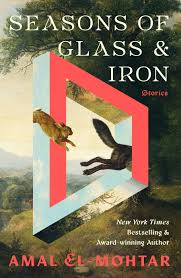
Book: Seasons of Glass & Iron Author: Amal El-Mohtar Publisher: Tor Publishing Group Year: 2026 Rating: 5 out of 5 stars
Synopsis : “Full of glimpses into gleaming worlds and fairy tales with teeth, Seasons of Glass And Iron : Stories is a collection of acclaimed and awarded work from New York Times bestselling author Amal El-Mohtar.”
Review :Seasons of Glass & Iron is a lyrical, deadly, and captivating peek through the looking glass into worlds unknown; full of whimsy and wonder, joy and horror, it is a dream and a nightmare tangled in the same web, woven and unwoven, creating a gleaming portrayal of humanity and, at times, something a bit other than humanity. El-Mohtar has deftly curated a collection of perfectly layered stories, giving the reader just enough to whet their appetite before moving swiftly on to the next. As someone who prefers long-form, I cannot speak highly enough of how intentional this collection is, how smooth the transitions, and how seamless the tie-ins. El-Mohtar shares in the introduction that this book may not have much of a “coherent aesthetic argument”, rather, it’s a love letter to women. Regardless of whether the introduction is read or not, you cannot simply pick this book up and not come to the conclusion that the author has a profound love for womankind in all her forms.
Seasons of Iron & Glass is queer, sapphic, and beautifully pro-Palestine. It wiggles a little deeper under the skin with each story, like an ear worm attaching itself in your brain, hooking it’s little fingers into your heart and tugging at just the right moments. It is a profound work of love and loss and becoming and undoing and redoing all over again. There are gorgeous poems written to those surviving the genocide in Gaza, retellings of Welsh fairy tales, stunning creations of fantasy, and incredible stories of unbelievable creativity and artistry. When I read the final words, I cried.
I fear my words do a disservice to how artfully and skillfully crafted this collection is. El-Mohtar states that these works were written between the years of 2008 and 2023 and there are stories that I can easily align myself with, the energy and understanding of them being laid out on LiveJournal or Tumblr feels so visceral I can almost taste it. Yet, each story weaves a broader narrative that cannot be unseen – despite ranging broadly in time, in place, and in content. There are stories I desperately wish were part of a broader narrative, stories I crave to know more of, and still each story is carefully wrapped up in the end, perfectly beginning and ending in ways that, while imperfect, as short stories are, is truly perfect. At the end of the day, try as I may, I can hardly come up with the words to do this book justice, all I can simply say is read this book.
Advice : If you have any interest in Welsh folklore, in short stories, in fantasy, in reading tales of women, then this book is for you. If you want to read folklore that takes the narrative out of the hands of awful gods and puts it back firmly in the hands of the so often downtrodden and abused women in them, this book is for you. I genuinely believe everyone should read it. It’s perfection. Mark your calendars for March 2026, place an order ahead of time, you don’t want to miss this one.
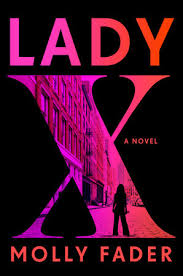
Book: Lady X Author: Molly Fader Publisher: Ballantine Books Year: 2026 Rating: 5 out of 5 stars
Synopsis : “Los Angeles, 2024 Margot Cooper’s life explodes after she discovers that her A-list actor husband sent explicit photos to multiple girls on social media. Desperate to get away from the world – and the paparazzi – Margot flees to her childhood home, with her teenage daughter in tow. But home isn’t the sanctuary Margot was hoping for. In a cardboard box in the corner of the attic, she and her sister find damning evidence about a mysterious vigilante named Lady X, including a blurry newspaper photo from the 1970s of a woman who looks an awful lot like their mother. It turns out that Margot’s husband isn’t the only family member harboring secrets. New York City, 1977 Ginger Daughtry is living her best life with her two beloved roommates, until one of them is assaulted. Astounded by the lack of response from the police, the young women take things into their own hands and find themselves igniting a movement that suddenly takes New York City by storm. Soon what began as a little bit of revenge against terrible men – vandalism here and there, singed collectively as Lady X – starts to take on a life of its own. Their enigmatic reputation spirals beyond their control with copycat criminals running amok under the guise of the enigmatic Lady X. When a body is found fallen – or pushed – from five stories high, the hunt reaches a boiling point. But Lady X has vanished into thin air.”
Review :Lady X is not for everyone. Lady X is a novel full of thick, intoxicating, divine rage that fills your chest cavity, runs down your fingers, and sizzles off your skin as you recount the statistics of women who will be assaulted by men in their lifetimes; as you field yet another “you should smile”; as unwanted fingers run up your arms and legs to touch tattoos without consent; as you recall being asked, by a man, if you’re on your period. It’s the rage of thousands of years of patriarchy; the idea that feminism somehow has nothing to do with global atrocities, and being told that it’s worse somewhere else, so you should be grateful. Lady X is a heralding beacon in a bleak, dark, inky black night sky. It’s timely in a way that this subject will never not be timely without radical, dramatic, civilization altering change – it’s pointed, it’s aggressive, it’s feral, and yet it’s deeply soft, prodding the softness of your humanity and heart with fingers that gently turn your head and say “don’t look away”.
Lady X is a vigilante masterclass on how meekly our culture has shifted over the last fifty years, revealing the dark truth that while women have only had access to bank accounts and credit cards without their husband’s approval since 1974, the culture of men doing so much more than taking advantage of women has hardly changed in all that time. While the culture has certainly shifted, at least in part thanks to #metoo, the truth is that women still make a fraction of what men make in the workforce, are continuously being legislated against, often without exception for medical emergencies or anomalies, and still face the backroom absurdities and assaults that happened in the 70s. Only now, with a president who has openly spoken (and been found guilty of!!) about assaulting women; with younger generations of young men coming into the political field with open misogyny and a bloodlust for the voting rights and the bodily autonomy of women. Molly Fader has perfectly encapsulated the energy that sizzles and dances through every person who has ever been assaulted or harmed at the hands of men who have let their belief in male superiority take complete control. She’s written a novel that hits the button labeled “Rage” that sits in the very center of my chest and flung it right where it hurts. And it’s perfection.
Written between the perspective of Ginger Daughtry in 1977 and her daughter, Margot Cooper in 2024, Lady X jumps between narratives with ease, only ever leaving me frustrated at critical points in the story arc. The unfolding mystery of who Lady X is and what might have happened to her is a thread tying two generations of women together as they simultaneously navigate what it’s like to live in a world where men take and take and take. And before you get upset at how misandrist this sounds, Lady X is the perfect embodiment of the understanding that while not all men are the cause of assault, all women have been or know someone who has been assaulted by a man. Lady X became a folk hero, during a time when New York City was embroiled with the Son of Sam, labor shortages in the police force, and a rolling, city-wide blackout. Created perfectly to fit into our real world, Lady X could have easily come to fruition in real time in 1977, or 2024, or 2025. Lady X became a vigilante figure who gave entire groups of people, not just women, the sense that they could speak up, they could point the finger at their abusers, those who have continuously gotten away with cruelty, and that they could enact real change that might make the world a better, softer place for themselves and other marginalized folks.
Fader has created a world that feels so real, that speaks so pointedly to the time we’re living in and all that’s come before us to get us to where we are, that she goes so far as to write in a Lady X campaign that, fictionally, took place during Trump’s second inauguration. It was so pointed, so necessary, so perfectly, seamlessly correct for the time that I found myself weeping. This is not for everyone. It’s for those who have a belief that a better world could exist, those who dream of a matriarchy, of a third way forward, those who have been hurt and know people who are hurting, and those who wish, desperately, for there to be some small measure of justice in this world. Or, maybe not so small justice. Lady X is a guttural scream in the night, a shattering of that hard exterior shell that keeps you safe and looking the other way, it’s our survival instinct screaming, crying out that yes, this is how it changes.
Advice : I would be remiss not to mention content warnings before sending you to the bookshelves in May 2026. Lady X mentions sexual assault, rape, physical abuse, battery, police brutality, harassment, stalking, catcalling, solicitation of a minor, sexual exploitation, cheating, and vigilante violence. That being said, if you feel you can read the above list in a safe way, this book is an excellent read and perfect for anyone who would like to see the bad guys get what’s coming to them. I flew through this one and found it to be utterly unputdownable. I highly recommend pre-ordering it.
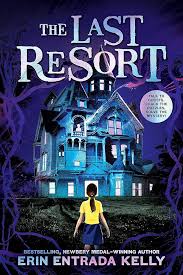
Book: The Last Resort Author: Erin Entrada Kelly Publisher: Scholastic Press Year: 2025 Rating: 4 out of 5 stars
Synopsis : “Just before her Grandpa Clem’s funeral, twelve-year-old Lila makes a shocking discovery. He didn’t die of natural causes – he was murdered. Possibly by someone who wanted to control his inn…and its secret portal to the afterlife. Now, a girl who’s vowed to become “less dramatic” must uncover her grandpa’s killer AND stop the ghosts desperate to make it back to our world.”
Review :The Last Resort is a super fun and enjoyable mid-grade read (grades 3-7) about the power of friendship, family, and finding places where you can be yourself. Lila, a twelve year old whose so-called best friends have described as “too much” and “overly dramatic” and, worst of all, “immature”, is ready for summer vacation so she can work on being as calm as a rock, as cool as ice, and as mature as her two besties think they are as they all head toward seventh grade next year. Her friends have stopped hanging out with her and have begun to hang out without her, she doesn’t have much time to regain their friendships. So when a relative she’s never met, Grandpa Clem, passes away unexpectedly and her family decides to travel out of state for his funeral, Lila is distraught. With the backdrop of frenemies / bullies who find Lila to be too much, we delve into Grandpa Clem’s world of ghosts, crystals, and portals to the world beyond the veil – a less than perfect scenario for a pre-teen who’s trying to be a lot less.
I thoroughly enjoyed this book, it was cute and fun and had some twists and turns that, while I saw coming, didn’t fully take shape until they’d arrived. It doesn’t talk down to the reader or assume the reader’s too young to understand new concepts and it presents unknowns and uncertainties in a way that makes it a true learning experience. I’m always pleased to find a middle grade read that doesn’t feel incredibly dumbed down for a kid to read and The Last Resort really held up. It did include some scary imagery, so I think this might be a proceed with caution book if you or your reader are a bit antsy when it comes to large spiders, the idea of death, or ghostly apparitions – but all in all I found it to be a safe and spooky walk on the paranormal side, perfect for fall! In the finished copy of the book, there will be ghostly illustrations who will come to life on the page via a QR code, which is such a fun addition to an already ghostly book, I think it’ll help bring the book to life in a way that’ll keep the reader thinking about it for a while.
While at Grandpa Clem’s inn, Lila meets a neighbor who’s her age, a boy named Teddy. It’s through Teddy’s friendship that Lila finds her place with someone who doesn’t view her as too much, who lets her be exactly who she is, and who doesn’t dismiss her as being an overly dramatic person. It’s an important lesson without being preachy, that bullies have no place in our lives, and that shrinking ourselves down to fit into the box of other people’s expectations makes us a shell of ourselves. In a world where even adults struggle with this concept, and even the concept of not being bullies to other adults, I found this messaging to be a refreshing change of pace from what we see day-to-day. Ultimately, Lila’s friendships are the cornerstone for this book, not the ghosts!
Finally, I gave this book 4 stars rather than 5 because I felt the ending was too abrupt and lacked the closure I wanted from it. It didn’t need to be drawn out or even significantly longer than it already is, but it would have benefitted from a little more than it received. I think the door was left open for further books down the road, and I’m not ashamed to tell you that this adult will absolutely be reading whatever Kelly comes up with next if she decides to continue this book into a series!
Advice : If you have enjoyed any iterations of Disney’s Haunted Mansion (including the ride), I think you’d enjoy The Last Resort! As advised above, if you or your reader have any squeamishness around spiders, near death experiences, dogs, crows, the threat of death, or ghosts, this might be one you approach cautiously. I think it’s the perfect amount of spooky and calm – a great way to dip the toes into a paranormal subject without diving in head first and scaring the bajeesus out of yourself.
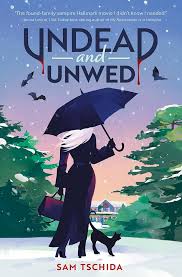
Book: Undead and Unwed Author: Sam Tschida Publisher: Quirk Books Year: 2025 Rating: 1.5 out of 5 stars
Synopsis : “Tiffenie may be three hundred years old, but she’s still a hot mess. The vampire is tragically single, works a dead-end job at a blood bank, and spends her nights marathoning Hallmark Channel moves with her cat. When Tiffenie inherits a fixer-upper home in Valentine, Vermont, thanks to a case of mistaken (okay, stolen!) identity, she seizes the chance to get her life back on track. With her newly undead neighbor (it was an accident!) in tow, Tiffenie is determined to live out her holiday rom-com dreams in this picture-perfect town. But between the mystery of her stolen identity, small-town drama, and the arrival of her insufferable vampire ex-boyfriend Vlad, getting her happily ever after with a smoking-hot Christmas tree farmer won’t be easy. Tiffenie must embark on a journey of self-acceptance – with the help of a few therapy sessions – for the first time in her immortal life.”
Review : Over the last few years of writing ARC reviews, I believe I’ve only given two other books a star rating lower than 2. I give a truly low review only when it feels absolutely necessary – sparingly, you might even say. While my reviews are always honest and truthful and they may be, at times, scathing, I’m always hesitant to give someone a low rating for something they’ve crafted. It feels deeply embarrassing to me that Undead and Unwed has garnered as high a review as 3.5 stars on GoodReads, which is really all I need to say when I tell you that I do not use or read GoodReadsreviews. Having read over 100 advanced reader copies (sorry, only 90 of those have made it here), I can honestly tell you that I have never received an advanced copy as unfinished and unpolished as this book was. It’s not a surprise to find small errors in an advanced copy, some grammatical mistakes, misspellings, an unfinished sentence here or there – it is a surprise to find a book with so many glaring mistakes as Undead and Unwed, and to be completely frank, that’s not even what scored this book 1.5 stars for me. It’s just part of the chaos and nonsense of the entire experience.
This is the first time I’ve wanted to say this : I read Undead and Unwed so you don’t have to. Please. Take my word for it. You don’t have to put yourself through this. The most frustrating aspect of this entire journey through such an incredibly poorly written book and nearly unreadable premise is that I actually liked the initial idea behind the plot. It could have been so much better, it could have been something readable. Execution, however, has failed. We find Tiffenie, a 300 year old vampire, living and working in L.A. at a blood bank – okay, expected, at least to some degree. She’s depressed, doesn’t know how to stand up for herself, and has little will to live beyond caring for her cat, Cat. We learn fairly early on that for a vampire to continue to exist in the world in any kind of feasible manner, they need to take on someone else’s identity in order to rent an apartment or buy a car or work a job – you know, they need a social security number and a real life name. Tiffenie is currently living under the stolen / bought name Tiffany Amanda Blair, an identity she purchased via the “black market” (I’m using quotes here as there’s no real explanation for this and it’s glossed over, so one can really only assume). When she receives a letter in the mail informing her of an inheritance in her namesake’s hometown of Valentine, Vermont, she hops in a hearse (yes, really) and heads out of town. Of course, I’m glossing over a lot of the minutiae here, but this is how things unfold : girl assumes identity, girl receives inheritance meant for the person whose identity she assumed, girl moves to claim the inheritance. Meanwhile, Tiffenie has accidentally drained her neighbor within an inch of her life and is forced to turn her into a vampire and take her on the road to Vermont because…well, just because. There are so many instances where things happen in the book without a good reason, the reader is forced to go along with what’s happening just for funzies because Tschida said so and it makes for poor storytelling.
Evidently, it’s been just ten years since the real Tiffany has moved away from her hometown of Valentine, yet even though Valentine is a tiny, rural town and Tiffany lived there for her entire life as a child and adult, ten years is somehow enough for Tiffenie to show up as a totally different person under the assumed identity of Tiffany and pass for this other person with an entire backstory and history in the town. And no-one blinks an eye. This was the first (of many) glaring issues I took with Undead and Unwed, as an assumed identity does not mean you also look like the person whose identity you stole! We only get a small explanation by way of Tiffenie dying her hair blonde because Tiffany was also a blonde. Yes, you read that correctly. In all other accounts, everyone Tiffenie runs into, be they old flames, friends from high school, or people who knew her family, all really, truly believe that Tiffenie is actually Tiffany. It is as asinine as it sounds. Next, we encounter the trouble with Tiffenie’s bank account – namely, she was dirt poor in L.A., working a job for peanuts, somehow living alone, and yet when she moves to Vermont without a job, she has enough money to start paying thousand dollar fines for living in a condemned building. There’s no explanation for this change in circumstances beyond the inheritance of a condemned property. There hasn’t been some grand windfall, no change in her lifestyle, only that she’s gone from L.A. to Vermont.
If this isn’t enough, Tiffenie is written just as the synopsis describes, as a hot mess. She’s flaky, irresponsible, somehow and for some unknown and never fleshed-out reason, she’s obsessed with not drinking blood, and she has a shopping problem. I don’t love this characterization, but I can get on board with it if it’s how she’s written, unfortunately, Tschida goes back and forth between our modern-day Tiffenie and the Tiffenie of the past who had children, knew how to bake for her family, and lived a real life with big ideas and plans. It’s a stark contrast and the jumping back and forth between these two versions of the self is stilted, as though Tschida threw them in at random without any planning or thought. Further, the conversations are so choppy and robotic, they’re nearly impossible to read. When it comes to story writing, Tschida has landed so far from the mark it’s almost laughable. There are so many instances where someone’s speaking and the only response will be “Yes.” that it became impossible to read with any semblance of seriousness. At one point I actively questioned whether this book was even written or whether it was dictated based on the glaring errors staring back at me from the page. There were multiple instances throughout where the paragraph was re-written but the original was never taken out, so I was presented with multiple directions in which this ARC might go, unsure of which would eventually be chosen for the final copy, and one instance where an entire paragraph was broke up with bullet points. These kinds of errors are not commonplace in an advanced copy, they’re sloppy and lazy and do the author a tremendous disservice – in this instance, Tschida needed all the help she could get and her publishing house did her dirty.
Undead and Unwed is an unreadable mess. I can only hope that by the time it’s actually ready for print it will look dramatically different than it does in it’s advanced copy form, but from my experience this is rarely the case. I suspect this book will be slightly more readable, but I don’t believe it will have improved by much at that point. The concept of a Hallmark Channel-ish story where a vampire moves to Vermont and restores a property, finds a chosen family, and eventually love is actually such a cute idea and I’m actively upset that this book ended up being as poorly written as it was. It needs a significant amount of work, perhaps it would even be worth scrapping the whole thing and starting over, or maybe it would be better to never have started in the first place.
Advice : Don’t. Just, don’t. Don’t fall for the 3.5 GoodReads score. Don’t spend your money. If you really feel drawn to this book, request it at your local library and save your money for something else.
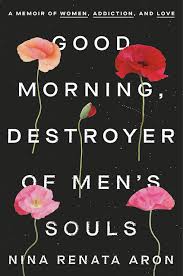
Book: Good Morning, Destroyer of Men’s Souls Author: Nina Renata Aron Publisher: Crown Year: 2020 Rating: 5 out of 5 stars
Synopsis: “‘The disease he has is addiction,’ Nina Renata Aron writes of her boyfriend, K. “The disease I have is loving him.” Their affair is dramatic, urgent, overwhelming – an intoxicating antidote to the long, lonely days of early motherhood. Soon after they get together, K starts using again, and years of relapses and broken promises follow. Even as his addiction deepens, she stays, confined that she is the one who can help him get sober. As a result of an adolescence marred by tragedy, Aron has always felt responsible for those suffering around her. How can she break this pattern? If she leave K, has she failed him? Writing in prose at once unflinching and acrobatic, Aron delivers a piercing memoir that cracks open the long-feminized and overlooked phenomenon of codependency. She shifts between visceral, ferocious accounts of her affair with K – as well as her family’s own struggles with addiction – and defining moments in the history of codependency. Good Morning, Destroy of Men’s Souls is a blazing, bighearted book that illuminates and adds nuance to the messy theaters between felinity, enabling, and love.”
Review: Good Morning, Destroyer of Men’s Souls is more than a small synopsis on the back of a book, it is more than a tiny review on a website or post on social media. It is an all encompassing work, a memoir and an unfaltering look into the heart of the AA, Al-Anon, codependency, trauma, tragedy, love, and growth. Aron is at times a young Joan Didion, basking in the warmth of the California sun, radiating the innocence only a new, young life in San Fransisco can. She wraps the reader in a golden glow, enveloped in the potential of a bright future yet to be seen as she emerges, newly 18, on the west coast – having traveled from the far side of the east coast, from New York, Philly, punk shows and hometown suburbia, to find something of her own, to cast her flag upon new soil; an explorer of new lands and a conqueror of life at once. We spend ever the briefest of stays in Didion-esque Northern California before Aron returns home, called upon by her family and the addiction that grips her sister and in turn the entirety of her familial home. Aron discusses the addiction that codependents find themselves drowning within and the difficulties this level of love, attachment, desire, maybe even lust for the ability to fix it, bring. She waxes poetic on the love she has for the possibility, the person she knows the addicts in her life could be. If only, if only, if only. She struggles; we find her neck deep in an intense and toxic relationship with an old flame, K, yet another addict (heroin, among others). This time she isn’t a budding adult, she has children and a career, a home and a car, both physical and intangible belongings which are easily broken beneath the weight of addiction. Admitting her own codependency, she swings between fury and guilt; quoting Lois Wilson, she acknowledges her own brokenness in needing to fix: “Living with me would be such an inspiration, I thought, that he would not need the balm of alcoholic.” and “Alas, for the codependent, empathy springs eternal.” (220, 218) If she were Joan in a cozy, golden California, in the midst of a lifetime of crisis and trauma she is Melissa Febos – wildly educated, wholly sunk into addiction and love, and deeply, deeply vulnerable. Reaching into the jagged edge of a wound, Aron uses Good Morning, Destroyer of Men’s Souls to tear herself open, slashed and flayed onto the page for the reader to soak in. We are privy to her agony, the newness of motherhood, of “babylove”, of the milky smell of a newborn, and in the same breath we feel her guilt and sorrow as she struggles to hold everything together, to keep the people around her from crumbling to pieces even as she realizes they already have. She uses herself, her own story of codependence, of being a widow to a man who has not died, of her own addictions to both love and substance, to take the reader on a trip through the confoundedness of addiction trauma and enabling. Aron has written a story that rages quietly, burning through the pages as she discusses the history of AA amidst the anguish of her own life. It is heart shattering, honest, and raw.
Advice: This is not an easy book to read, as I said, it’s brutally honest as Aron speaks of addiction and love in blunt terms. However, it is an absolute must-read, a book that will change you, move you, bring you to the page to write a review. It is a deeply personal memoir that I found often challenging in reading it – I absolutely recommend this book, I will be chewing on it for days to come.
 Paige Reviews Books