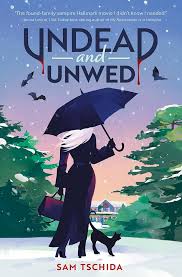
Book: Undead and Unwed
Author: Sam Tschida
Publisher: Quirk Books
Year: 2025
Rating: 1.5 out of 5 stars
Synopsis : “Tiffenie may be three hundred years old, but she’s still a hot mess. The vampire is tragically single, works a dead-end job at a blood bank, and spends her nights marathoning Hallmark Channel moves with her cat.
When Tiffenie inherits a fixer-upper home in Valentine, Vermont, thanks to a case of mistaken (okay, stolen!) identity, she seizes the chance to get her life back on track. With her newly undead neighbor (it was an accident!) in tow, Tiffenie is determined to live out her holiday rom-com dreams in this picture-perfect town.
But between the mystery of her stolen identity, small-town drama, and the arrival of her insufferable vampire ex-boyfriend Vlad, getting her happily ever after with a smoking-hot Christmas tree farmer won’t be easy. Tiffenie must embark on a journey of self-acceptance – with the help of a few therapy sessions – for the first time in her immortal life.”
Review : Over the last few years of writing ARC reviews, I believe I’ve only given two other books a star rating lower than 2. I give a truly low review only when it feels absolutely necessary – sparingly, you might even say. While my reviews are always honest and truthful and they may be, at times, scathing, I’m always hesitant to give someone a low rating for something they’ve crafted. It feels deeply embarrassing to me that Undead and Unwed has garnered as high a review as 3.5 stars on GoodReads, which is really all I need to say when I tell you that I do not use or read GoodReads reviews. Having read over 100 advanced reader copies (sorry, only 90 of those have made it here), I can honestly tell you that I have never received an advanced copy as unfinished and unpolished as this book was. It’s not a surprise to find small errors in an advanced copy, some grammatical mistakes, misspellings, an unfinished sentence here or there – it is a surprise to find a book with so many glaring mistakes as Undead and Unwed, and to be completely frank, that’s not even what scored this book 1.5 stars for me. It’s just part of the chaos and nonsense of the entire experience.
This is the first time I’ve wanted to say this : I read Undead and Unwed so you don’t have to. Please. Take my word for it. You don’t have to put yourself through this. The most frustrating aspect of this entire journey through such an incredibly poorly written book and nearly unreadable premise is that I actually liked the initial idea behind the plot. It could have been so much better, it could have been something readable. Execution, however, has failed. We find Tiffenie, a 300 year old vampire, living and working in L.A. at a blood bank – okay, expected, at least to some degree. She’s depressed, doesn’t know how to stand up for herself, and has little will to live beyond caring for her cat, Cat. We learn fairly early on that for a vampire to continue to exist in the world in any kind of feasible manner, they need to take on someone else’s identity in order to rent an apartment or buy a car or work a job – you know, they need a social security number and a real life name. Tiffenie is currently living under the stolen / bought name Tiffany Amanda Blair, an identity she purchased via the “black market” (I’m using quotes here as there’s no real explanation for this and it’s glossed over, so one can really only assume). When she receives a letter in the mail informing her of an inheritance in her namesake’s hometown of Valentine, Vermont, she hops in a hearse (yes, really) and heads out of town. Of course, I’m glossing over a lot of the minutiae here, but this is how things unfold : girl assumes identity, girl receives inheritance meant for the person whose identity she assumed, girl moves to claim the inheritance. Meanwhile, Tiffenie has accidentally drained her neighbor within an inch of her life and is forced to turn her into a vampire and take her on the road to Vermont because…well, just because. There are so many instances where things happen in the book without a good reason, the reader is forced to go along with what’s happening just for funzies because Tschida said so and it makes for poor storytelling.
Evidently, it’s been just ten years since the real Tiffany has moved away from her hometown of Valentine, yet even though Valentine is a tiny, rural town and Tiffany lived there for her entire life as a child and adult, ten years is somehow enough for Tiffenie to show up as a totally different person under the assumed identity of Tiffany and pass for this other person with an entire backstory and history in the town. And no-one blinks an eye. This was the first (of many) glaring issues I took with Undead and Unwed, as an assumed identity does not mean you also look like the person whose identity you stole! We only get a small explanation by way of Tiffenie dying her hair blonde because Tiffany was also a blonde. Yes, you read that correctly. In all other accounts, everyone Tiffenie runs into, be they old flames, friends from high school, or people who knew her family, all really, truly believe that Tiffenie is actually Tiffany. It is as asinine as it sounds. Next, we encounter the trouble with Tiffenie’s bank account – namely, she was dirt poor in L.A., working a job for peanuts, somehow living alone, and yet when she moves to Vermont without a job, she has enough money to start paying thousand dollar fines for living in a condemned building. There’s no explanation for this change in circumstances beyond the inheritance of a condemned property. There hasn’t been some grand windfall, no change in her lifestyle, only that she’s gone from L.A. to Vermont.
If this isn’t enough, Tiffenie is written just as the synopsis describes, as a hot mess. She’s flaky, irresponsible, somehow and for some unknown and never fleshed-out reason, she’s obsessed with not drinking blood, and she has a shopping problem. I don’t love this characterization, but I can get on board with it if it’s how she’s written, unfortunately, Tschida goes back and forth between our modern-day Tiffenie and the Tiffenie of the past who had children, knew how to bake for her family, and lived a real life with big ideas and plans. It’s a stark contrast and the jumping back and forth between these two versions of the self is stilted, as though Tschida threw them in at random without any planning or thought. Further, the conversations are so choppy and robotic, they’re nearly impossible to read. When it comes to story writing, Tschida has landed so far from the mark it’s almost laughable. There are so many instances where someone’s speaking and the only response will be “Yes.” that it became impossible to read with any semblance of seriousness. At one point I actively questioned whether this book was even written or whether it was dictated based on the glaring errors staring back at me from the page. There were multiple instances throughout where the paragraph was re-written but the original was never taken out, so I was presented with multiple directions in which this ARC might go, unsure of which would eventually be chosen for the final copy, and one instance where an entire paragraph was broke up with bullet points. These kinds of errors are not commonplace in an advanced copy, they’re sloppy and lazy and do the author a tremendous disservice – in this instance, Tschida needed all the help she could get and her publishing house did her dirty.
Undead and Unwed is an unreadable mess. I can only hope that by the time it’s actually ready for print it will look dramatically different than it does in it’s advanced copy form, but from my experience this is rarely the case. I suspect this book will be slightly more readable, but I don’t believe it will have improved by much at that point. The concept of a Hallmark Channel-ish story where a vampire moves to Vermont and restores a property, finds a chosen family, and eventually love is actually such a cute idea and I’m actively upset that this book ended up being as poorly written as it was. It needs a significant amount of work, perhaps it would even be worth scrapping the whole thing and starting over, or maybe it would be better to never have started in the first place.
Advice : Don’t. Just, don’t. Don’t fall for the 3.5 GoodReads score. Don’t spend your money. If you really feel drawn to this book, request it at your local library and save your money for something else.

 Paige Reviews Books