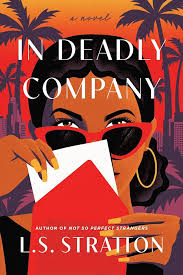
In Deadly Company Review

Book: In Deadly Company
Author: L.S. Stratton
Publisher: Union Square & Co.
Year: 2025
Rating: 4 out of 5 stars

Synopsis : “As the assistant to the CEO of a Fortune 500 company, Nicole Underwood has plenty of tasks on her to-do list – one of which is the blowout celebration for her nightmare, on-percenter boss, Xander Chambers. But when the party ends in chaos and murder and Nicole is one of the survivors, suspicion – from the investigators to the media – lands on her. Was she the reason for all the bloodshed?
A year after those deadly events, Nicole tries to set the public record straight by agreeing to consult on a feature film based on her story. However, while on set in Los Angeles, she’s sidelined by inappropriate casting and persistent, bizarre script changes – and haunted by persistent visions of her now-deceased boss. It seems clearing her name ins’t so simple when the question of guilt or innocence is…complicated.”

Review : In Deadly Company is an enjoyable, inventive, and easy to read thriller with a truly unique plot that doesn’t fall into the trap of the unreliable female protagonist trope so many thrillers seem to adore. It’s well written, quick moving, and leaves you guessing all the way until the end. While I did find the final reveal to be a bit obvious and contrived, it was still fun to get there in the end. I thoroughly enjoyed this read, found myself wanting to slow things down so it wouldn’t end quite so soon, and have been chewing it over since I finished it yesterday – all hallmarks of a good book.

The narration jumps a bit, and doesn’t hold fast to a set-in-stone pattern which I found to be unnecessary, but provided some texture and certainly helped give context to the way events played out. Between Nicole’s present day and her past, we watch the fateful events of her boss’s birthday party unravel, not only the alluded to murders (yes, plural), but the behind the scenes goings on in Nicole’s personal life that we are only granted glimpses of throughout the book. In the present, Nicole is watching and “consulting” on the movie retelling of the events of her boss, Xander Chambers’ birthday – she wields almost no say in how the story gets told, but she’s been hired by the production team and so she’s there, on set, watching the events play out once more despite very clearly having PTSD. In the past, we simultaneously watch the events play out in real time, catching little bits here and there that might reveal who ends up murdered and why, but never enough to fully catch on to the carnage that would eventually play out by the time the birthday weekend was over.

This review will be short and sweet, nearly anything else I have to say would include spoilers that might truly wreck the ending for you, so I’ll leave things where they are. I will say, however, that I wish the ending had taken a slightly different turn – without giving you the details, you’ll have to read those for yourself, the final twist at the end felt contrived and forced, giving the power of the novel a bit of a lackluster finish. It didn’t feel well thought out, but it did feel a bit messy. Things could have tied up in a nicer way, been a bit less all over the place, and not included one of the most obvious plot twists in history. Okay, that’s all. If I say more, I’ll spoil it for you!

Advice : This was such a fun read! If you’ve been disillusioned by thrillers written from a female perspective, I think you should really give this one a shot! Be warned, there are graphic descriptions of blood, gore, and death; the author describes PTSD flash backs; and there’s mention of the date rape drug as well as what happens when it’s used.
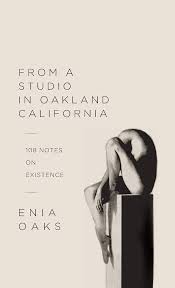
From a Studio in Oakland California Review

Book: From a Studio in Oakland California : 180 Notes on Existence
Author: Enia Oaks
Publisher: Self Published
Year: 2025
Rating: 3.5 out of 5 stars

Synopsis : “This collection of poems and essays is for those who sit at the crossroads of past and future, wondering which way to turn. Those who have bravely restarted and are building new homes from within themselves. Those who believe in the grand experience of life and living it fully, even when it asks everything of them. Those hurting, healing, or transforming. For the ones who are seeking meaning or a deep exploration of the layers of existence.”

Review : Enia Oak’s debut book, From a Studio in Oakland California : 108 Notes on Existence is not to be read quickly, blown through, or breezed by; it’s made to be savored, slowly devoured, and meditated upon. It does not surprise me one bit to find this book of 108 missives to be a meditation – it’s spiritual in nature. Written in short blurbs, poems, and ideas, FASIOC is filled with logical life advice, imparted wisdom, and personal exploration. It is quite literally packed to the cover with information on how and why and when to grow, on the choices we make as humans, the way we stretch out for someone else to witness our lives, and how we might best look inward to see and gently tend our inner child as fully formed adults.

While Oaks’ synopsis / letter to the reader calls this book a “collection of poems and essays”, I would more likely call this an open letter to someone who’s going through therapy and doing the work to heal. Based on Oaks’ description, I was initially confused by the layout and conversive tone her poems and essays take. They don’t necessarily read as poems, certainly not so when you take the totality of the book under review, but they do read as essays directed toward the reader. Like I said, it reads like an open letter, not like a collection of poems. It really comes down to the naming of the thing, for me – if they weren’t named as poems, I wouldn’t take issue or feel surprised as a reader, but because I was expecting poetry, I found myself a bit taken aback and disconnected as I got into the meat of the book. I do feel that Oaks might have benefitted from a more formal editor / publisher rather than going the self-published route, it’s truly worth mentioning that I have dog eared this book from start to finish. While there are aspects that I feel read in a discordant way, small mistakes, and grammatical errors I wish weren’t included, Oaks has a distinctive point of view that has a place in this world. This book feels important for so many people.

I found Oaks’ work to be most successful in her most experimental forms, where we might call the style a poem (but again, I struggle to view most of these works as poetry), or where the style seems completely unique to the inner workings of Oaks’ mind. Most of the book is written in a direct way to “you”, perhaps at times the reader, perhaps at times the writer, perhaps at times our collective inner child. It’s less a work of interpretation for the reader, and more directions on how to live your life as told by a therapist – of whom Oaks is not, which is worth saying. I found so many pieces of this book aligning with my own lived experience, and while this did not feel profound, it did feel familiar. There were many reasons Oaks’ collection garnered 3.5 stars, but I want to remind you, reader, that that’s more than 50% and I did genuinely enjoy reading this one.

Advice : This book is already available to buy! If you’ve spent time in therapy I suspect you will enjoy this book. If you like a collection of small works that are quick and easy to read at your own pace with no deadline or need to speed your way through, I think you’ll enjoy this.

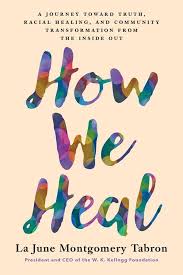
How We Heal Review

Book: How We Heal
Author: La June Montgomery Tabron
Publisher: Disruption Books
Year: 2025
Rating: 5 out of 5 stars

Synopsis : “From a vivid portrait of her childhood in 1960s Detroit to her leadership of one of the world’s largest philanthropic institutions, La June shares her full-circle, American story – a coming-of-age journey where she gains a firsthand understanding of how systemic racism prevents our children and communities from thriving and learns about the transformative role healing can play in helping all of us transcend the legacy of racial inequity.
As she rises to her position as the first female and first African American leader of the W.K. Kellogg Foundation, La June experiences the power of sharing and listening with empathy. And with the help of mentors and colleagues, she refines the message that will guide the foundation’s mission for years to come : Healing can begin only with truth telling.
Empowered by the mission set forth by its founder to support children and families, the foundation explores a racial healing framework that transforms communities and individuals around the world – from small rural towns and big cities across the United States, including La June’s own beloved Detroit, to Mexico, Haiti, and beyond.
How We Heal serves as a testament to the power of transformation and a blueprint for how each of us, no matter who we are or how we lead, can use racial healing to move from trust to empathy, from understanding to repair – one conversations and one connection at a time.”

Review : Whew. That’s a heck of a synopsis, isn’t it? And though How We Heal is a mere 212 pages long (in ARC form), much like the back-cover synopsis, it packs a lot into those 200-odd pages. While La June spends time detailing what her childhood was like growing up in Eastside Detroit both prior to and after the Detroit Rebellion in 1966, it’s worth noting that the majority of the book describes in detail the work she has and continues to do at the W.K. Kellogg foundation, first as COO and currently as CEO, among other titles. How We Heal is less about La June herself and more about the work that’s been facilitated through the Foundation and through the people who have been impacted by the Foundation’s charitable worn. While the start of the book engages the reader as, perhaps not strictly memoir, but more so memoir adjacent, it’s worth knowing before you dive in that it is decidedly not a memoir.

La June, a direct descendant of Isaiah Thornton Montgomery, the founder of the Reconstruction era town of Mound Bayou, Mississippi, describes the pitfalls and structures of power imbalance that have served to create racial imbalances and divides throughout the United States. And while she would have every right to broach this topic with hate-laced accusations and pointed fingers, La June instead describes what she calls the empathy deficit to explain much of what has stunted racial equity and growth, if not rolled back progress entirely. Rather than assuming that the growth of opportunities and formulation of protections around basic human rights might take all of the above away from those who are not Black or Hispanic or Asian or Indigenous, empathy reminds us that we are all worthy and capable of having access to spaces of growth, stable and safe housing, and quality job opportunities with good wages. When racial equity exists, when we find ourselves within diverse communities, studies show time and time again that we all thrive. It isn’t an us vs them narrative presented within How We Heal, it is very much so the opposite, with La June asking us to imagine a world in which our country outgrows its flawed beginnings and continuous, subsequent failings. As La June says “…through inclusivity, we could make the table bigger.” (How We Heal)

Detailing her decades of work at the Kellogg Foundation, La June describes how the Foundation transformed from a world in which race was an unmentionable topic to a world in which the Kellogg foundation runs multiple racial healing circles throughout the world in order to bridge divides between any number of groups of people. Describing the necessary work at play within the Foundation’s days in the early 2000s as it began to transition into a space that directly addressed racial divides and inequity, a member of the board of trustees, Joe Stewart said (paraphrased by Montgomery Tabron) “Either work to fulfill the dreams of everyone in this nation or tear down the Statue of Liberty.” Because we come from a country whose very foundation was built on the backs of enslaved people and Indigenous massacre, we cannot simply step into the realm of reconciliation without actively addressing the root problems, working toward transformation, and find ways to unite. Enter : TRHT, or Truth, Racial Healing, and Transformation – a project created by those working within the Kellogg Foundation to bring spaces of true healing into diverse communities impacted by racism, a history of redlining, systemic poverty, gun violence, even apartheid. Racial healing circles are designed based on Indigenous practices worldwide and TRHT has been facilitating circles of healing, understanding, and equity for decades, attempting to reach as many people as possible. When it comes to a blueprint for healing, this is it. La June shares so many stories of positive impact within these racial healing circles, it feels almost hard to believe at times. Rather than creating spaces where fingers are pointed and injustices are gripped tightly to, racial healing circles exist to create spaces of radical transformation through understanding and forgiveness. When we are able to fully hear and see where those who have different lived experiences than us are coming from, we can begin to repair something that began as fundamentally broken.

While How We Heal read at times like a proposal for a board meeting, it was deeply informative, well researched, and concise. It laid out a foundation for our path forward, it did more than present the scary facts and figures, it laid out the work the Kellogg Foundation has been doing for a century to combat those figures – going even further to explain how individuals and groups around the globe could be (and have been) taking steps of their own using the very blueprint the Kellogg Foundation uses to create radical healing where it’s so desperately needed. It’s encouraging to me to read a book like this, particularly as we see racial divides deepening, knowing that healing has a way forward. It can and does exist. There’s hope here. And that’s something you can’t buy – or maybe you can, in the form of this book. I found myself crying multiple times during my reading of this book – the stories of hope, forgiveness, healing, and transformation are incredibly moving. It’s well worth the read.

Advice : I think this is a worthwhile read for anyone who is genuinely interested in seeing healing take place on a global scale, anyone who lives in cities with racial disparities (that’s most of us!), or anyone who’s interested in a new take on an old problem. You’re going to want to read this one.

Devil is Fine Review

Book: Devil is Fine
Author: John Vercher
Publisher: Celadon Books
Year: 2024
Rating: 5 out of 5 stars

Synopsis : “From acclaimed novelist John Vercher, a poignant story of what it means to be a father, a son, a writer, and a biracial American fighting to reconcile the past.
Reeling from the sudden death of his teenage son, our narrator receives a letter from an attorney : he has just inherited a plot of land from his estranged grandfather. He travels to a beach town several hours south of his home with the intention of immediately selling the land. But upon inspection, what lies beneath the dirt is much more than he can process in the throes of grief. As a biracial Black man struggling with the many facets of his identity, he’s now the owner of a former plantation passed down by the men on his white mother’s side of the family.
Vercher deftly blurs the lines between real and imagined, past and present, tragedy and humor, and fathers and sons in this story of discovery – and a fight for reclamation – of a painful past. With the wit of Paul Beatty’s The Sellout and the nuance of Zadie Smith’s On Beauty, Devil is Fine is a darkly funny and brilliantly crafted dissection of the legacies we leave behind and those we inherit.”

Review : I had absolutely no idea what kind of wild ride I was getting myself into when I opened this book – full disclosure, the synopsis gives approximately 10% of the book away (okay, maybe I exaggerate…45%?). I started it a couple evenings ago and (spoilers), much like our protagonist, found myself losing time. I looked up two hours later, half the book read, and breathed out for the first time in who knows how long. Woah.

*Due to the little information provided by the synopsis, the majority of this review will contain spoilers, you have been warned.*

I absolutely demolished this book. I can’t even explain to you how quickly I devoured it. So much so that it wasn’t until this very moment I sat down to write this review that I realized we never get the narrator’s name. The novel begins with the narrator sitting in traffic on his way to his teenage son’s funeral, stopped somehow by construction, watching a construction worker do a dance while our narrator has a panic attack. A writer and tenure-track professor, our narrator is a biracial Black man working through what it means to exist in a post-2020 world where his audience and colleagues have largely appeared to have moved on from the protests and interests that were front and center just a few years ago. Finding the book he’s been working on tossed aside by one publishing house after the next, he finds his tenure tracked job suddenly on the rails. Unless he can get his new book picked up immediately, he risks losing his secure job. In the midst of the turmoil and trauma of not only losing his son but the prospect of losing his job, he receives a letter from his attorney : a large piece of property on the coast of Pennsylvania that was willed to his son has now passed to him. Our narrator decides to take a few extra days of bereavement leave to have a look, put the property on the market, and take a trip to a place he has hated since childhood – the beach.

It’s hard to fully explain the depth of surrealism that Vercher’s able to achieve in this work. Devil is Fine presents itself as a pretty realistic book grounded in a pretty realistic character, someone we might see teaching classes and publishing books, someone we might see on social media, someone we can relate to immediately as grounded in reality. It’s when our narrator makes his way to the sea, though, that the thread holding reality and dreams begin to unravel. On a cocktail of anti-anxiety medications, our narrator (who has been sober for 17 years) finds himself saying yes to a drink at the bar attached to his small rental at the beach. As it turns out, the property he’s inherited has not come with any kind of structure so he rents from a bartender / realtor / bike shop owner who serves as his off-the-wagon enabler, serving drink after drink after damned drink to a man who very clearly should not be served in the first place. There are so many moments of frustration and grief that swirl throughout this story, and this relationship between alcohol, medications, and those who egg him on while simultaneously providing a form of magical-comedic-grounding relief is one of them.

As our narrator dives deeper into the all too familiar taste of alcoholism, he begins to find himself plagued by sleep paralysis – or so it seems. Waking to find emails sent, book proposals drafted, and responses given in the middle of the night, what should ultimately be a fairly benign experience begins to take on supernatural undertones. When our narrator, in a fairly drunken haze, steps barefoot onto his beachfront property one night, he unexpectedly, and painfully steps on a dead jellyfish, stung even in it’s death. Now he’s not only battling alcohol and medication induced sleep demons, he’s also battling physical pain. The boundaries around the natural world begin to swim and blur and fracture, creating ghostly appearances, pulling mementos from his past into his present, and allowing him to have, what had until now been a one-sided conversation with his son, a two-sided conversation with the dead.

It is during this unraveling of reality that our narrator comes to find that the sprawling beachfront property he’s inherited is actually a former plantation, owned and passed down by the members of the white side of his family. Through this dream-like experiences, our narrator begins to confront the very real demons of his past, the generational curses that follow family members, and perhaps even emerge from beyond the grave, and the father-son relationships that not only created his relationship with his son but mirror his relationship with his own father. It’s through this reality bending that our narrator begins to find the space to heal the wounds that have lead to the at times fractured relationship he and his son shared. We begin to see reality for what it is, not something that exists in one time and place, but something that bends and moves, shaping and folding itself over generations, creating and dissolving into each family member until they’re ready and capable of finding the healing necessary to move forward.

Advice : I cannot recommend this book highly enough. This is hands down one of my top books of the year. It’s expertly crafted, full of intricate detail, and that ending! My god! The ending! I won’t spoil it for you, but trust me when I say this is a must read.

Rise of a Killah Review

Book: Rise of a Killah : My Life in the Wu-Tang
Author: Ghostface Killah
Publisher: St. Martin’s Press
Year: 2024
Rating: 3 out of 5 stars

Synopsis : “Dennis Coles – aka Ghostface Killah – is a co-founder of the Wu-Tang Clan, a legendary hip hop group who established themselves by breaking all the rules, taking their music to the streets during hip hop’s golden era on a decade-long wave of releasing anthem after classic anthem, and serving as the foundation of modern hip hop. An all-star cast who formed like Voltron to establish the pillars that serve as the foundation of modern hip hop and released seminal albums that have stood the test of time
Rise of a Killah is Ghost’s autobiography, focusing on the people, places, and events that mean the most to him as he enters his fourth decade writing and performing. It’s a beautiful and intense book, going back the the creative ferment that led to Ghost’s first handwritten rhymes. Dive into Ghost’s defining personal moments, his battles with his personal demons, his journey to Africa, his religious viewpoints, his childhood in Staten Island, and his commitment to his family (including his two brothers with muscular dystrophy), from the Clan’s early successes to the pinnacle of Ghost’s career touring and spreading his wings as a solo artist, fashion icon, and trendsetter.
Exclusive photos and memorabilia, as well as graphic art commissioned for this book, make Rise of a Killah both a memoir and a unique visual record, a “real feel” narrative of Ghost’s life as he sees it, a one of a kind holy grail for Wu-Tang and Ghost fans alike.”

Review : Chronicling his life, from formative childhood years growing up in the West Brighton projects, to being introduced to kung-fu movies in his early teens, to forming the Wu-Tang Clan, crafting his Toney Stark persona, and everything in between, Ghostface Killah takes the reader on journey into stardom and the drive to simply make it in Rise of a Killah. It would be difficult to listen to music or engage with pop culture without encountering Wu-Tang clan, either having listened to their music or running into one of their cult-like followers. However, for someone like me, who has listened to their music over the years and enjoyed their work, though isn’t a die-hard fan, this book felt a little lacking. This book is very clearly geared toward the ride or die fans, the fans who’ve followed Ghostface and Wu-Tang Clan, who know the ins and outs, the ups and downs of the Clan and are familiar with the intricacies already – prior to reading the book – but I’ll get into that.

Rise of a Killah reads like a conversation, and that’s because it is a conversation. This book has been transcribed, and while I’ve enjoyed that style of reading in the past, there were very few moments during the course of this book that I didn’t feel this would be better suited as a docu-series. I enjoyed reading Ghostface’s story, he is, and has been, open and vulnerable about things that were, and continue to be, hard topics for people to talk about. I found it invaluable to read about his experiences with his mental health struggles, with how he wishes friends would reach out when they see those they’re close to having a hard time, and the way he found peace through speaking openly with RZA about what he was experiencing. During a time when it wasn’t nearly as acceptable to speak about your mental health or wellness, Ghostface leaned into being open with those around him – much the same way his lyrics spoke to things people weren’t rapping about at the time, like growing up in the projects and buying welfare cheese. He talks about the pressure he felt from a young age, living with a single parent and two wheelchair bound brothers, both of whom had muscular dystrophy, and how that helped shape his experience and push him into spaces with people he might otherwise not have come into contact with.

However, there were so many instances in the book that felt like partial stories, partial retellings, so many aspects left out, that the book felt lacking, at times even incomplete. And don’t get me wrong, I understand not everything can or should be included in an autobiography, I’m not naive – I just wish there had been more meat on the bone here. For example, toward the end of the book, Ghostface’s manager, Mike Caruso, speaks with the transcriber, going back in time and sharing his side of how things were happening mostly with the Def Jam label. Ghostface had already covered the years that Caruso was covering, yet we got infinitely more detail and more interesting stories from him than we did from Ghostface. I don’t think this is a poorly told story, but I do think the format choice is wrong for the impact the stories could be making. I found myself thinking over and over again that this would be the perfect documentary or docu-series, I would thoroughly enjoy watching this, having moments where the narrative could cut away and more details could be provided; at the end of the day, if I wanted to full understand this book, I’d have to spend as much time googling things as I did reading it. Had this been less of a transcribed conversation and more of a video interview, I think the impact would have been monumental. Instead, it falls a bit flat and leaves me with more gaping holes than I had before I read it.

I think the final release of the book will be a huge deal for fans of Ghostface and Wu-Tang Clan, it’s filled with photos, illustrations, and lyrics that will have fans drooling. The book talks a lot about Ghostface’s iconic wardrobe choices, from the diamond studded robes to his gold armbands, and details how colors impact his mental state in a way that profoundly influences his work. This is a great book for those fans who have been with Wu-Tang Clan since the inception, who collect every piece of merch, attend every show they can, and know all the infinite details.

Advice : If you’re a die-hard Wu-Tang Clan or Ghostface Killah fan, this is it. You’re going to want to mark your calendar for May 14th 2024 and be sure to grab a copy. If, however, you aren’t a day one fan, this might end up feeling confusing and hard to read. It definitely has its audience, but I think the broader appeal might be lost.

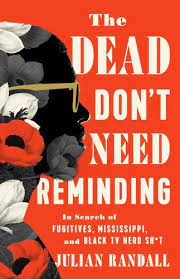
The Dead Don’t Need Reminding Review

Book: The Dead Don’t Need Reminding
Author: Julian Randall
Publisher: Bold Type Books
Year: 2024
Rating: 5 out of 5 stars

Synopsis :The Dead Don’t Need Reminding is a braided story of Julian Randall’s return from the cliff edge of a harrowing depression and his determination to retrace the hustle of a white-passing grandfather to the Mississippi town from which he was driven amid threats of tar and feather.
Alternatively wry, lyrical, and heartfelt, Randall’s voice bursts off the page with verve, humor, and poet’s eye for detail. In this book, Randall transforms pop culture moments into deeply personal explorations of grief, family, and the American way. He envisions his fight to stay alive through a striking medley of media ranging from Spiderman and Jordan Peele movies to BoJack Horseman and the music of Odd Future. Pulsing with life, sharp, and wickedly funny, The Dead Don’t Need Reminding is Randall’s journey to get his ghost story back.”

Review : The Dead Don’t Need Reminding is one of those books you read the way you eat a great meal, slowly, purposefully, savoring every single bite. Comprised of essays, TDDNR is a lyrical work of pop culture references, self inquiry, depression, chronic pain, and what it means to exist within a queer, Black body in America. Randall weaves a narrative that’s steeped with grief, tugging on a thread that unravels to reveal ancestral history, the kind that dips through an entire body, tethering each generation to the last, reminding us what it is to search for yourself amongst the dead. I devoured this book quickly, at first, then slowly, so slowly, asking the narrative to slow down, to keep from ending. You know how it is.

My copy of The Dead Don’t Need Reminding is now filled with dogeared pages, underlined, read again and again. It is one of those books you never stop reading. Filled with longing, Randall takes the reader on his journey through life-long destabilizing depression, suicidal ideations (and intentions), chronic pain that interjects throughout the narrative in the way only chronic pain can do, racism, and an endless running list of cultural references he uses to bind us to a better understanding of his own inner (and outer) world. Randall explains that he thinks in quotes, in lyrics, in movies and tv shows, using examples from BoJack Horseman, Spiderman, Kanye West (Ye), Drake, Odd Future, and more to open his heart and mind to the page, to the reader. Even without a complete knowledge of the totality of his references, the impact is striking. I enjoy reading about the things other people enjoy, particularly if it’s done in a way that doesn’t require me to have the references handy at all times, and this is that book. Randall takes quotes and clips and concerts and makes them sing on the page, brings them to life for a reader who maybe doesn’t have every single quote or clip or concert in their own mind. They do now. It works.

Speaking with so much ache, Randall winds us through a collection of essays into the heart of his grief, into the empty crater of depression, and into the humid search for an ancestral burial ground – a gravesite in Mississippi, proof of life.

I’ve struggled with how to write this review. How do you review a book you can’t quote, not yet? How can I review this book without showing it to you, without flipping to a dogeared page and reading an underlined verse? How do I explain the depth this book sunk me into? It is a stunning masterpiece, exploring boyhood tenderness that transmits itself into adulthood tenderness, fear, longing, and the desire to live – the choice to live – while haunting a family line in search of ghosts.

Advice : Run. Don’t walk. You’re going to want to read this one.

The Other Black Girl Review

Book : The Other Black Girl
Author : Zakiya Dalila Harris
Publisher : Atria Books
Year : 2021
Rating : 4.5 out of 5 stars

Synopsis : “Nella Rogers is an ambitious young Black woman trying to make her mark at the legendary Wagner Books. Needless to say, she is thrilled when Hazel joins the team and is eager for the friendship she assumes will be just around the corner, easy, and immediate. but when a moment of support goes horribly wrong (in a very public way), Nella retreats and finds herself watching and questioning Hazel’s every move. Urgent, propulsive, brilliant, and hilarious, The Other Black Girl is a psychological masterpiece, where micro aggressions and gaslighting turn a company’s “civilized” atmosphere into a slowly unraveling horror.”

Review : The Other Black Girl was a slow burning, psychologically thrilling, completely haunting novel. I’m torn, generally, between love and hate for a book who jumps between characters; it’s either done well or it’s not, there’s very little middle ground. Harris nearly-perfectly executes this technique (nearly, hence the .5 rating) throughout the entirety of the novel but lost me briefly at the end with a chapter that was not entitled and left me trying to guess who the character was supposed to be – probably the point of the chapter, but ultimately it felt disjointed. Aside from the minor disjointedness from the final chapter, the rest of the book read easily and enjoyably. Finally, a thriller that doesn’t follow the same, old, stale routine. It’s a miracle.
I loved the pacing of this book. It’s not clear it’s even entering into the world of thrillers and horror until you’re well into it, setting the stage for a deeply personal encounter. All of the build up had a point, it all lead to a conclusion that was surprisingly twisty, and I never once felt like there was story just for the sake of filling pages. I’m grateful when I find a book that engages details that further the plot rather than a book I come away from wondering why I read half of what I read.
Harris leaves us wanting more as she wraps the book up and for that I’m both frustrated and glad. I wish there was more! I still have questions and there are characters I was hoping to hear more from, but it doesn’t feel empty or come across as incomplete. It reads like a good book should: realistically (as much as can be expected from a thriller / horror novel). Contrary to popular opinion, I don’t always want a book to tie up a story into a neat little bow, they read as stilted and unlikely. Harris proves that you can have an unlikely story without creating a book that feels unlikely.

Advice : If you like thrillers, psychological movies, or an unexpected ending, you’ll love The Other Black Girl. It is a truly well written novel that will suck you in and keep you coming back for more. I highly recommend this book!