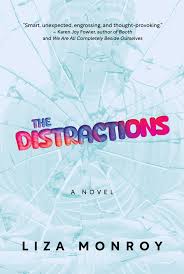
Book: The Distractions
Author: Liza Monroy
Publisher: Regalo Press
Year: 2025
Rating: 3 out of 5 stars
Synopsis : “Mischa Osborn spends her days as a ProWatcher – keeping distracted people on task and lonely ones accompanies – from her Brooklyn Mega-building, while eating Petri-Meat Steax and working out with her favorite personal trainer, a straight-talking algorithm named Tory.
Her carefully constructed, isolated existence is suddenly upended by a chance realspace encounter with a HighlightReel celebrity, Nicolas Adan Luchano. On their first date, hiking in Kuulsuits and watching DroneBeez pollinate flowers, Mischa experiences a brief but intense realspace connection.
Mischa takes to relentlessly watching Nic onReel. As Mischa’s ReelWatching spirals into an all-consuming obsession, and even realspace stalking, Mischa takes increasingly desperate measures to be seen and valued, sucking others into her vortex of obsession until she completely loses control.
Meanwhile, someone is equally obsessed with Mischa, tracking her every move and perhaps even influencing her choices.
A tale of how technology enables obsession, envy, and unrelenting comparison, told through an eccentric cast of interconnected characters, The Distractions invites us to reflect on who we are watching, and why.”
Review : Liza Monroy’s The Distractions asks what might happen if our lives became nothing more than content for others to watch, taking our current reality several steps beyond where we find ourselves in 2025. Set in some kind of ambiguous future – is it one hundred years, two hundred, a thousand? – The Distractions is an imagining of where our lives might take us if things were simply not to deviate from where they are in the present. In a world where we are constantly attached to our phones, where smart homes, smart watches, smart glasses, and self-driving cars are becoming more and more the norm, it’s not hard to see where Monroy’s concept was born. Mischa, our protagonist, spends years consumed with obsession, literally (no, really) losing herself to the endless succession of constantly streamed video feeds of the objects of her ever-worsening obsession. I think it’s worth noting that The Distractions reads like an addiction spiral and if you’ve found yourself in that space, this may not be the right book for you.
I’ll be the first to admit that dystopian fiction is not my favorite, to put it lightly. I wasn’t completely clear on just how dystopian this book would be until I really got into the meat of it – I knew it would be futuristic as it begins with five pages filled with verbiage necessary to understanding the world Monroy has crafted. Five. It’s a task for any author to fully create a functioning and understandable world, and while this is something I encounter more regularly in the realm of fantasy, Monroy gave herself quite the task with this book. I do think she succeeded in creating a reality that I was able to easily understand after I spent the first chapter flipping back and forth between her compendium of terms and the page I was reading. Once I got into the novel, I was able to seamlessly grasp the terms and concepts as they’re just not that far off from where we are these days and the terms we have in our common vocabulary. I will say, I found this to be less speculative and more progressive, if that makes sense! There was so little imagining of the future and truly so much speeding up from where we are – the understanding is that as a society we only evolve through technology and rampant consumerism and all the rest we just learn to live with. Like most dystopian novels, it was flat out sad.
The Distractions amplifies a world we already find ourselves living within and with an uptick in people considering leaving social media or seeking out other sources of connection, I think Monroy did herself a disservice by choosing not to be speculative. Speaking of the landscape in California, Monroy tells us that everything is on fire these days – the timing of this book feels potent; of the air quality and heat index, one can only step outside while wearing a protective suit and most choose to stay inside instead; of food, we see Mischa et al consuming lab grown “meat” and cricket powders; of bird populations, well, there aren’t any. It’s all so reminiscent of our current reality that as things do change and progress and we, ideally, evolve beyond our need to consume at all costs, I think The Distractions will, at least in small part, become irrelevant and that’s a tough thing for a dystopian futuristic novel. And I don’t think I’m being overly optimistic here, but maybe I am. I just tend to expect that the current and immediate future generations will find ways to connect with each other outside of online spaces, particularly as our online spaces take a turn for the worse.
Where this book fell flat for me, is in the functional flow of the narration and the content within. While written well and given appropriate pacing, particularly as we witness Mischa losing literal years of her life, it felt as though it wasn’t a fully thought out concept outside the actual obsession that comprised 85% of the book. Monroy initially describes Mischa as preferring to keep to herself, to not engage with other humans, and to appropriately divvy up her time. However, the downward spiral into obsession came on quickly, as though this wasn’t the first time it happened, and the inability to even see glimpses of Mischa’s past life felt off. I realize the nature of addiction looks different to everyone, but it felt incomplete, as if we were missing crucial details about Mischa’s life prior to beginning the book. Likewise, the ending of the book was a convoluted, confusing mess that left me wondering why it was written the way it was. I was left with questions that might have served as intriguing methods of concluding the book but instead grew tangled the more Monroy attempted to explain them. It didn’t feel neat, it felt needlessly messy; I can be completely content with messy if it’s purposeful and intentional and meets the standard of the entirety of the book, but this was not that. Finally, yes, Mischa was being watched the entire time, we know this because there’s a second narrator, but the finale (and the back of the book) make this narrator out to be much more sinister than they came across in our time spent with them – and I found the details of just how this being watched Mischa to be convoluted and confusing at best. There’s so little explanation for the voyeur that it almost felt like I wasn’t meant to question it, but of course I did because there was no explanation…you see my problem?
Ultimately, this was an interesting concept that reminded me at times of the movie Wall-E and at times of Philip K. Dick’s Do Androids Dream of Electric Sheep?. I could go on for many more paragraphs about the implications of AL (advanced algorithms in The Distractions), the ethics presented in this book, of autonomous artificial intelligence, and our perceived humanity within the complex matrix of technology, but I’ll leave it here. The Distractions was interesting and clearly fleshed out in ways I will never be able to grasp, but it felt incomplete and perhaps even unnecessary, or at least I can hope. And maybe that’s all that can really be said about a dystopian novel, at the end of the day. It makes you hope and wish for a better future, and this book certainly did that for me.
Advice : If you, like me, aren’t the biggest fan of dystopian fiction, if you prefer speculative fiction, or you’re horrified by the idea of AI or social media taking over our lives, this may not be for you. If you enjoy the ethics and philosophy behind all of the above, you may just well love this one.
 Paige Reviews Books