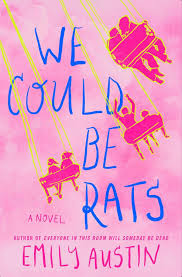
Book: We Could Be Rats
Author: Emily Austin
Publisher: Atria Books
Year: 2025
Rating: 5 out of 5 stars
Synopsis : “Sigrid hates working at the Dollar Pal. Having always resisted the idea of “growing up” and the trappings of adulthood, she did not graduate high school, preferring to roam the streets of her small town with her best friend, Greta, the only person in the world who ever understood her. Sigrid was never close with her older sister, Margit, who is baffled and frustrated by Sigrid’s inability to conform to the expectations of polite society.
Sigrid’s detachment veils a deeper turmoil and sensitivity. She’s haunted by the pains of her past, from pretending her parents were swamp monsters when they shook the floorboards with their violent arguments to losing Greta’s friendship amid the opioid epidemic ravaging their town. As Margit sets out to understand Sigrid and the secrets she has hidden, both sisters, in their own time and way, discover that reigniting their shared childhood imagination is the only way forward.
What unfolds is an unforgettable story of two sisters fingering their way back to each other, and a celebration of that transcendent, unshakeable bond.”
Review : Before I dive into We Could Be Rats (WCBR), I would be remiss not to discuss some content warnings. Something I appreciated a great deal about Austin is that she included a singular content warning at the start of the book, a small blurb letting the reader know that suicide would be discussed. But, we can’t simply leave it at that. WCBR does not merely bring up the mention of suicide, it is an entire book about suicide; likewise, it more than mentions domestic violence – within varying familial structures. There are both discussions of and visceral scenes depicting traumatic triggers, discussions of opioid addiction, mental health struggles beyond the aforementioned suicide, sexual assault, and threats of public violence.
WCBR is not merely a stunning work of fiction by Austin, it is at times a funhouse of mirrors, frequently nostalgic, and wildly relatable all in one turn. Not content to simply give us a story, Austin has crafted a well-timed mind fuck of a novel (I think you’ll pardon my language after you read this instant hit). Told in thirds, Austin challenges the reader to steep themselves deeply within a broth of empathy through many, so, so many suicide note attempts through Sigrid’s lens, read as though through the eyes of her older sister, Margit. We spend the majority of WCBR weaving through thinly veiled confessions, dodging twists and turns thrown into the mix with the deft hand of a creative writing genius – I don’t use that term lightly. There were moments, moments I won’t even begin to describe for fear of giving too much away (perhaps to tempt you further to adding this one to your list of books this year), where I found myself skeptical of Austin’s writing, unsure of how her writing fit with the narrative I was being told to believe – enough so that I considered giving this book a 4 out of 5 stars. But then…well. Things changed.
The remaining two thirds of the book are told from the perspective of Margit and Sigrid, respectively. As the story unfolds in the most miraculously unpredictable and loping manner, we bare the honor of witnessing just how alike the two sisters are, despite a lifetime of misunderstanding, growth in opposite directions, and their shared trauma. Without realizing how intertwined their lives have been, Margit and Sigrid find their feet falling into step before they can even recognize what’s happening. Margit, the classic older sister, the protectress and truly the only adult-like figure in Sigrid’s life, finds comfort in caring for others in her own way – perhaps to the detriment of those she aims to care for. Sigrid, on the other hand, finds herself adrift, floating through life like a bird in a sea of monkeys, despite dreams and desires, taking a backseat to the hopelessness and despair of life in a deeply conservative small town struggling with an opioid crisis.
Austin weaves a palpable sensation of otherness into WCBR, I found myself slipping off the human realm of Paige the reader, sidling into Sigrid’s imaginative mindscape with ease. Sigrid feels deeply relatable to me, though I’m not sure this will be universally felt, as a twenty-year-old with no plan or idea for the future. Sigrid writes at times about not knowing yet who she is, of sliding into versions of the self that others wear, trying each on to see what fits best, slipping into the skin of those who know themselves and in doing so attempting to discover who she might be as well. At its core, WCBR is a story about the threads of family trauma that burrow into the lives of those whose lives are intimately touched by it, the threads that tie us to each other, and the ways in which we exist in the world as part of a whole because of, or in spite of them.
Austin asks us to move through the tangible grief within WCBR to see the beacons of light she’s offered in the sacred space of shared humanity. She doesn’t tug at us to touch these spaces, rather, as she gently guides us through we find that we cannot help but brush against them. The light seeps through no matter how hard we try to ignore it. And in doing so, we may just find our own shared connections with Sigrid and Margit – a tiny parcel of humanity of our own.
Advice : I wish you well on your journey into We Could Be Rats. I say so confidently because I feel so strongly that you should read this book. It’s beautiful, it flows well and reads quickly, and it’s an important story whose aspects will likely reach each reader in completely different ways. Add this one to your list.
 Paige Reviews Books