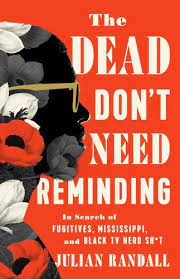
Book: The Dead Don’t Need Reminding
Author: Julian Randall
Publisher: Bold Type Books
Year: 2024
Rating: 5 out of 5 stars
Synopsis : “The Dead Don’t Need Reminding is a braided story of Julian Randall’s return from the cliff edge of a harrowing depression and his determination to retrace the hustle of a white-passing grandfather to the Mississippi town from which he was driven amid threats of tar and feather.
Alternatively wry, lyrical, and heartfelt, Randall’s voice bursts off the page with verve, humor, and poet’s eye for detail. In this book, Randall transforms pop culture moments into deeply personal explorations of grief, family, and the American way. He envisions his fight to stay alive through a striking medley of media ranging from Spiderman and Jordan Peele movies to BoJack Horseman and the music of Odd Future. Pulsing with life, sharp, and wickedly funny, The Dead Don’t Need Reminding is Randall’s journey to get his ghost story back.”
Review : The Dead Don’t Need Reminding is one of those books you read the way you eat a great meal, slowly, purposefully, savoring every single bite. Comprised of essays, TDDNR is a lyrical work of pop culture references, self inquiry, depression, chronic pain, and what it means to exist within a queer, Black body in America. Randall weaves a narrative that’s steeped with grief, tugging on a thread that unravels to reveal ancestral history, the kind that dips through an entire body, tethering each generation to the last, reminding us what it is to search for yourself amongst the dead. I devoured this book quickly, at first, then slowly, so slowly, asking the narrative to slow down, to keep from ending. You know how it is.
My copy of The Dead Don’t Need Reminding is now filled with dogeared pages, underlined, read again and again. It is one of those books you never stop reading. Filled with longing, Randall takes the reader on his journey through life-long destabilizing depression, suicidal ideations (and intentions), chronic pain that interjects throughout the narrative in the way only chronic pain can do, racism, and an endless running list of cultural references he uses to bind us to a better understanding of his own inner (and outer) world. Randall explains that he thinks in quotes, in lyrics, in movies and tv shows, using examples from BoJack Horseman, Spiderman, Kanye West (Ye), Drake, Odd Future, and more to open his heart and mind to the page, to the reader. Even without a complete knowledge of the totality of his references, the impact is striking. I enjoy reading about the things other people enjoy, particularly if it’s done in a way that doesn’t require me to have the references handy at all times, and this is that book. Randall takes quotes and clips and concerts and makes them sing on the page, brings them to life for a reader who maybe doesn’t have every single quote or clip or concert in their own mind. They do now. It works.
Speaking with so much ache, Randall winds us through a collection of essays into the heart of his grief, into the empty crater of depression, and into the humid search for an ancestral burial ground – a gravesite in Mississippi, proof of life.
I’ve struggled with how to write this review. How do you review a book you can’t quote, not yet? How can I review this book without showing it to you, without flipping to a dogeared page and reading an underlined verse? How do I explain the depth this book sunk me into? It is a stunning masterpiece, exploring boyhood tenderness that transmits itself into adulthood tenderness, fear, longing, and the desire to live – the choice to live – while haunting a family line in search of ghosts.
Advice : Run. Don’t walk. You’re going to want to read this one.
 Paige Reviews Books