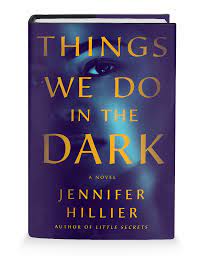
Things We Do in the Dark Review

Book: Things We Do in the Dark
Author: Jennifer Hillier
Publisher: Minotaur Books
Year: 2022
Rating: 2 out of 5 stars

Synopsis: “In the dark, monsters are real. When Paris Peralta is arrested in her own bathroom – covered in blood, holding a straight razor, her celebrity husband dead in the bathtub – she knows she’s in serious trouble.
In the dark, it never happened. But as bad as it looks, the arrest is not what worries her the most. With the unwanted media attention now surrounding her, it’s only a matter of time before someone from her old life recognizes her and destroys everything she’s worked so hard to build.
In the dark, she could be anyone. Because Paris has a dark past. And she’ll do anything to keep it hidden.”

Review: Things We Do in the Dark has a promising synopsis, it sounds intriguing and dark, mysterious and interesting. To say it falls flat is an understatement. To be completely honest, I found myself bored reading this book. There was a tiny section where I grew more interested somewhere around 3/4 of the way through, but it was short lived and the book returned to it’s dull story-telling for it’s finale. Hillier skirts the more graphic details of Paris’ previous life, stopping short of telling you what’s really going on, leaving it up to the reader’s imagination. I personally think if you’re going to tell a story that requires some content warnings, and this does, you might as well go all in and embrace what you’re telling rather than apologize for it by simply not describing or naming the thing. So let’s talk about the content warnings: Things We Do in the Dark contains implications of pedopohelia, assault, domestic violence, and PTSD. It references harm to a minor, incest, and contains racist language. While all of the above sounds fairly graphic, this book would likely receive a PG-13 rating as a movie, do with that what you will.

Though this book has little to nothing to do with music, each chapter begins with a quote from a popular song. The song lyrics rarely, if ever, tie into the chapter, and the effect is meaningless. It adds to my distaste for how this book was put together, giving the impression that perhaps there are places in the book that should have been highlighted in order to tie in with the chapter lyrics. Why go through the trouble of choosing lyrics for each chapter of a book that has nothing to do with music? I believe it’s referenced one, maybe two times through the entire 397 page book. This is the least of my issues, however. While the writing was fine and I found almost no grammatical errors that seem to be common in ARCs, it lacked that thing that makes you want to keep turning pages. It took me much longer to read this book than the past few ARCs simply because I didn’t care what happened. Not only did I figure out what was going on long before it was revealed because it was glaringly obvious, the “twists” were revealed much too early to give the reader any incentive to keep going. I’ve said it many times before, you don’t have to be a good writer to write a compelling story. I’ve read many books that were poorly executed but I kept turning the pages because I needed to know what was going to happen. What We Do in the Dark is simply not that book.

Hillier doesn’t stay true to her character, Paris, toward the end stating “[she] had been trained not to cry.” But by this point, we’ve seen the main character cry several times. This might seem small, but this sentence was 301 pages into the book and by this time the main character has cried no less than five times that we know of. Hillier tells Paris’ story by jumping back and forth between Paris’ point of view in the present, her point of view in the past, and the point of view of her former best friend / roommate, Drew. Paris has lived a hard life full of oppression, abuse, and trauma, yet when she reconnects with Drew, supposedly the best person in her life, potentially the love of her life, he is condescending, offensive, and patronizing. While she stands up for herself, she doesn’t demand apology or change from Drew, she simply allows him to continue to be the bully he has always been. I’m not sure why he’s painted to be a savior figure here, but he becomes someone she relies upon once again as her perspective jumps back to the future (she relied on him a great deal in her younger years, before she had the wherewithal to stand up for herself), and I found myself feeling completely disgusted as I read.

Things We Do in the Dark, lastly, is entitled far too closely to the hit TV show What We Do in the Shadows and contains names of characters that share names of characters in other TV shows. While none are related, and I suspect are just coincidence, I couldn’t read through the book without making the connections and I have to wonder why an editor wouldn’t suggest some name changes. Least of all, the title of the book should be at least slightly more different, as What We Do in the Shadows is a current, and wildly popular show that has absolutely nothing in common with this book. These are semantics, I suppose, but added to my pile of issues with reading through this book, end up being more than small irritants I could look past.

Advice: Skip this book. There are no surprises, there are no twists that you won’t see coming a mile away, there’s nothing interesting here. While it may be sort of unique in plot, it’s not wholly unique and could be supplemented with several other suspense novels, including any of the past suspense novels I’ve read and criticized for being cookie cutter versions of each other. This one is not worth the read.
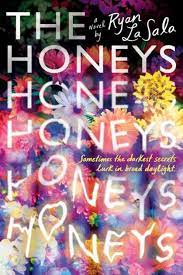
The Honeys Review

Book: The Honeys
Author: Ryan La Sala
Publisher: Push
Year: 2022
Rating: 5 out of 5 stars

Synopsis: “Mars has always been the lesser twin, the shadow to his sister Caroline’s radiance. But when Caroline dies under horrific circumstances, Mars is propelled to learn all he can about his once-inseparable sister, who’d grown tragically distant.
Mars’ gender fluidity means he’s often excluded from the traditions – and expectations – of his politically connected family, including attendance at the prestigious Aspen Conservancy Summer Academy, where his sister poured so much of her time. But with his grief still fresh, he insists on attending in her place.
What Mars finds is a bucolic fairytale. Folksy charm and rigid gender roles combine with toxic preparatory rigor into a pristine, sun-drenched package. Mars seeks out his sister’s old friends: a group of girls dubbed the Honeys, named for the beehives they maintain behind their cabin. They are beautiful and terrifying – and Mars is certain they’re connected to Caroline’s death.
But the longer he stays in Aspen, the more the sweet mountain breezes give way to hints of decay. Mars’ memories begin to falter, bleached beneath the relentless summer sun. Something is hunting him in broad daylight, tying with his mind. If Mars can’t find it soon, it will eat him alive.”

Review: In the front of my review copy of The Honeys, La Sala has left a note for the reader. In it he writes: “As I write you this letter, another fear has found me. My first two books have shown up on a list concocted by a Texas lawmaker, to be investigated for their potentially discomforting themes around queerness, equity, and justice…This man fears me and my art. And I wish – like Mars – his reaction to fear was to learn. As an author, I do think of my works as edifying. I want The Honeys to shock and scare you, but after the buzzing fades, there is much to learn in these pages.”

As you may know from past reviews, I have read several YA books over the last few years and come away feeling frustrated and disappointed. I kept saying “YA can be better!” La Sala has proved me right with The Honeys. A quick-witted and sharp story, The Honeys is also a successful horror / suspense novel, and for that I find myself eternally grateful. I have spent so many hours reading essentially the same book over and over and over within the horror / suspense genre that I’ve grown bored and annoyed, at best. Finally. Finally! A YA novel, a horror / suspense novel at that, that breaks all the norms and blazes its own path forward. The Honeys unfolds slowly and you spend a majority of the book getting to know Mars and Aspen, learning what the camp looks like, discovering all the ways Mars has to fight for their very existence, and learning hints here and there about what may or may not have happened to his sister Caroline while attending the camp. I can appreciate a slow-to-unfold horror story, particularly when it begins it’s descent before there are 10 pages left. La Sala does not disappoint in this regard, as the book begins to gain momentum and work toward a conclusion with a good several chapters to go. In this way, the construction of the book is excellent, something I don’t find very often in both YA and horror novels.

I was a bit torn over whether to give The Honeys 4 or 5 stars when I got to the end – in full transparency, as I read I was convinced it was 5 out of 5 for the majority of the book. It was only when I got to the end that I started to question that rating. I came up against my own mind, thinking “but this is a queer novel” and wondering why there wasn’t some poignant sociologial meaning to draw everything together at the end. What I finally came to realize is that this is a young adult horror novel told from a queer narrator, not a queer novel with horror themes thrown in. While it does answer the brief and delve into Mars’ point of view and the way in which they interact with and are confronted by the world, it doesn’t to come to the end and force the reader to learn something profound – that happens slowly, as you get to know Mars through the bulk of the book. At the end of the day, this is a horror novel told from the point of view of a narrator with a different perspective than the majority of horror or suspense novels I’ve seen out there.

The writing is excellent, especially for a review copy. You have probably read by now, if you’ve been following my reviews for any length of time, that I often get review copies merely weeks before they’re published and still manage to find a plethora of grammatical errors and general mistakes throughout. In The Honeys I found two: one was a repeated word and one was a word left out. The Honeys doesn’t come out for mass reading until August of 2022, so La Sala is way ahead of the game as far as review copies go. I was so overwhelmingly surprised and pleased with the way this book was put together, the quality of the writing, and the overall storytelling, I finished the book and immediately looked up his other two books. YA isn’t a genre I tend to read on my own for fun, but I would gladly read another book from La Sala if his other two are anything like this one.

I can’t speak highly enough about The Honeys. It confronts themes I feel are important, and I think are becoming more important to young readers: the gender binary, traditional gender roles, and the danger that women and trans people feel in the presence of the “boys will be boys” mentality. I’ve read other queer review copies, and particularly within the YA genre it often feels as though the authors are trying too hard to fit these characters into their narrative. The Honeys didn’t feel forced, it didn’t feel over the top, or utterly absurd; it felt natural, it flowed in a way that felt organic, and it left me feeling as though the topic of gender fluidity wasn’t merely thrown in as a token to the audience. Perhaps it’s because La Sala is gender fluid whereas other YA books with queer characters that I’ve read to review have been written by authors who aren’t, or perhaps it speaks to La Sala’s talent as a writer, or maybe (most likely) it’s both. Either way, I came away both absolutely thrilled and disappointed that I’d read through it so quickly.

Advice: I don’t think you have to be a fan of YA books to read and enjoy The Honeys. I think if you enjoy suspenseful novels, beautiful imagery, and a good mystery then The Honeys is going to tick all the boxes for you. If you enjoy quality writing and a mystery that you can’t really solve on your own way ahead of the ending, you’ll love this book. If you’re interested in reading more gender fluid or queer character points of view, this book hits the mark. If you’re a fan of summer camp suspense, again, it checks all the boxes. I think this is a book for a wide and diverse range of audiences and I can’t recommend it enough.

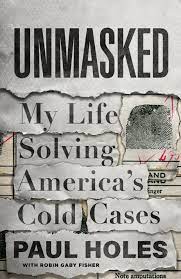
Unmasked Review

Book: Unmasked: My Life Solving America’s Cold Cases
Author: Paul Holes with Robin Gaby Fisher
Publisher: Celadon Books
Year: 2022
Rating: 4 out of 5 stars

Synopsis: “Most people know Paul Holes as the gifted cold-case detective with a big hear and charming smile, who finally caught the Golden State Killer. But until now, no one has known the man behind it all, the person beneath the flashy cases and brilliant investigations.
In Unmasked, Holes takes us through his memories of a storied career and provides an insider account of some of the most notorious cases in contemporary American history, including the hunt for the Golden State Killer, Laci Peterson’s murder, and Jaycee Dugald’s kidnapping. This is also a revelatory profile of a complex man and what makes him tick: the drive to find closure for victims and their loved ones, the inability to walk away from a challenge – even at the expense of his own happiness.”

Review: Unmasked does not come with any content warnings (and it should), so let me begin this review by providing a few. Unmasked contains graphic depictions of violent crimes including murder, kidnapping, criminal confinement, sexual assault, battery, domestic violence, robberies, and more. It describes PTSD, anxiety attacks, panic attacks, and both alcohol and drug abuse as coping mechanisms. That aside, if you are a true crime junky or have followed any of the above mentioned cases as they unfolded, Unmasked offers a rare insight into the forensic processes that led to the demise of many North American serial killers. If you’re taken with the true crime craze as much of the world seems to be, you have likely read some of the books written by former detectives who have solved high-profile crimes. They’re often interesting, though generally a bit dry, and may not offer the kind of skilled writing you’d get from a professional author – and I think that’s to be expected. There’s something familiar about the way a former detective writes a book, it’s often just the facts, ma’am, straightforward and to the point; outlining the details, the clues, and the methods they followed to get to a place where their subject was found and arrested (for the most part). But just because it’s familiar doesn’t mean it’s compelling. I find these books tend toward a historical retelling that can be boring and lacking narrative that I crave from a compelling work of non-fiction.
Perhaps it’s because Holes had Robin Gaby Fisher, a NYT best selling author and two time finalist for the Pulitzer Prize, or perhaps it’s the particularly unique perspective Holes offers, but Unmasked reads like it’s written by an author, not a former crime scene investigator. And that’s not to say that I don’t appreciate the work of former detectives, but it can’t easily be said that they’re natural born writers (of course, this is a generalization). Holes weaves his own narrative throughout the book, taking us through the steps that led him to become a forensic investigator, that brought him down the path of working and, in many cases, solving cold cases largely on his own time. He speaks at length about his own psyche, discussing the obsession that drives him to solve murders, similar to his mother’s obsession that led her to have an eating disorder, and his brother’s obsession that was later diagnosed as OCD. He has woven himself into this book in such a delicate manner that the book has no choice but to reflect a strong narrative. I suspect that Gaby Fisher played a large part in the finessing of Unmasked and I can appreciate that effort – though, in the end it’s Gaby Fisher’s involvement that led me to give this book 4 rather than 5 stars. Despite their best efforts, Unmasked still retains some bit of dry, too-complex-for-layman details about forensics that, I assume, have likely been dumbed down a bit for the average reader to understand. I found myself skipping over these parts, though I’m sure Holes felt they were crucial to explaining his process as he used forensic technology to solve these crimes, they read as complicated and long-winded and if I skipped over them, surely they could have been pared down even further. I’m a bit torn over his long-winded descriptions of forensics and DNA technology, though, because he doesn’t treat the reader as if we’re too uneducated to understand, but at the same time, in fact I am too uneducated in the realm of forensic science to understand.
With the help of Gaby Fisher, there are aspects of the book that I wish had been stronger or more well put together. Holes jumps from one crime to another before returning to the original crime, and in the case of the Golden State Killer, or EAR as he’s initial referred to, so many of his crimes and victims resemble one another that it becomes a bit convoluted and hard to follow at times. I do like a narrative that can bounce around from one thing to the next in a seamless way, but I found myself wondering if I hadn’t just read the account a chapter earlier multiple times, so I think there’s still some clarity missing from this narrative. With the help of Gaby Fisher, I would hope there wouldn’t be so many of these instances, but it’s impossible to know where the book began in order to get to where it is now. Either way, there was still some work left to be done, but given that I received this review copy a mere month before it was published, I suspect that the book was altogether finished at that point.
I found this to be an excellent counterpart to Michelle McNamara’s I’ll Be Gone in the Dark. Having read McNamara’s book when it came out a few years ago, right as the Golden State Killer was caught, I had already heard of Paul Holes and was familiar at least on a small level with what his work entailed. Having read about the detailed search for the GSK that spanned decades from McNamara’s side of things as a journalist and amateur internet sleuth, getting the bulk of Hole’s work from his perspective was genuinely an excellent counterpart. I appreciated, as well, that Holes addressed his working relationship with McNamara and also spoke about her death, something I was hoping for as I read through, and glad to see put into words. McNamara devoted much of her life leading up to her death by accidental overdose to the GSK search – in fact it was McNamara herself who gave him the formal name ‘Golden State Killer’.
Overall, I found Unmasked to be thorough, decently well written, and full of details that drove a complete and satisfying narrative.

Advice: If you struggle with true crime stories, this is absolutely not going to be the book for you. If, on the other hand, you live for true crime podcasts, books, and tv shows, you will probably love Unmasked. It ticks all the true crime boxes and leaves you feeling satisfied with the retelling. If you read and enjoyed I’ll Be Gone in the Dark by Michelle McNamara, I think Unmasked is a logical next read for you.

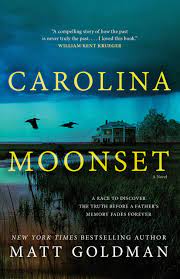
Carolina Moonset Review

Book: Carolina Moonset
Author: Matt Goldman
Publisher: Forge Books
Year: 2022
Rating: 2 out of 5 stars

Synopsis: “A family must race to discover the truth before one man’s memory fades forever. Joey Gren has returned to Beaufort, South Carolina, to look after his ailing father, who is succumbing to dementia. Marshall Green’s sort-term memory has all but evaporated, but, as if in compensation, his oldest memories are more vivid than ever.
At first this seems like a blessing of sorts, with the past providing a refuge from a shrinking future, but Joey grows increasingly anxious as his father’s memories begin to hint at deadly secrets, scandals, and suspicions long buried and forgotten that still have the power to shatter lives – and change everything Joey thought he knew.
Especially when a new murder brings the police to his door…”

Review: I was thrilled to receive a book set in my home state of South Carolina. I love to read books based in the Carolinas, no matter the author, they tend to wax poetic about all the aspects I love: palmetto trees, marshlands, water birds, thick summer nights, and sweet tea. I couldn’t seem to find if Goldman has actually spent any time in South Carolina, but I can tell you the book read as if he hadn’t. Anyone who’s from the palmetto state knows that the “palm trees” you find in South Carolina are in fact palmetto trees – they aren’t the palm trees you find in California or Florida. They’re short, stumpy, and don’t have coconuts. Goldman mentions the trees, but refers to them as palm trees and for this I was immediately baffled. There were small discrepancies like that through the book, aspects of the south that could have easily been googled or even found on a research trip, but didn’t ring quite true as a native. Maybe I’m being nitpicky here. Anyone who isn’t from South Carolina would likely not have cared a lick.
Carolina Moonset was an interesting murder mystery, I’ll give it that. The plot felt unique and not over-done in the way that a lot of suspense / mysteries can be, though it was told from a male perspective and most of my issue with the suspense / mystery genre these days comes from female based narratives. The biggest problems I found were glaring, though. While I had small bits to nitpick, the bulk of my problem with the book lay with the bulk of the book. Goldman’s bio proudly talks about his work as a television screenwriter for shows such as Seinfeld and Ellen among others. Carolina Moonset read like a television show – a fairly unrealistic television show, at that. The dialogue felt unrealistic in a flourishing kind of way, characters speaking and thinking in ways that felt like narrative rather than conversation. The interactions between characters felt forced and fake, perhaps best suited for a TV show I don’t have to put much thought into, and shouldn’t put much thought into because if I did I would probably have to turn the show off.
The plot was okay, it really was. The idea for the book is promising: a father, recently diagnosed with Lewey Body Dementia, begins to recall experiences from his past with great clarity. He begins telling stories he’s never told before, stories his family are shocked to hear, he even begins having hallucinations, seeing old friends and having upsetting conversations with people who aren’t there. His family, rightfully so, becomes worried. When a member of a prominent, wealthy local family is murdered, a family the father has recently spoken of vehemently, his son Joey fears the worst. After all, there’s a family gun that his mother somehow has no idea exists, though it’s been in the family since Joey was a child and has lived in his father’s tackle box, out in the open, happily aging in their shed. Though we’re told in detail how frail and ill Joey’s father is, somehow he becomes the prime suspect in the police’s murder investigation. Joey’s father, Marshall, not only grew up in Beaufort, but ran a no/low cost medical clinic for decades often putting in seventy hours of work a week for the community. He is not only an upstanding member of society, but his (somehow) 90-something year old brother who is (again, somehow) still practicing law is a pillar in the community with direct ties to the wealthiest families in Beaufort. That the police would zero in on a 75 year old man with dementia and virtually no body strength as the murderer feels…absurd. At best.
So much of the book is spent the the police hounding this family, hounding Marshall who cannot even remember that he’s spoken to the police twenty minutes ago, and hounding Joey that it feels almost not worth reading at points. In fact, when the book is all said and done and everything has been wrapped up, once the police find the murder weapon and arrest the murderer, they still find the time and the audacity to interrogate Joey and his brand new, as of 6 days ago, girlfriend over something completely unrelated to the crime just because they “don’t like loose ends”. It’s implausible. It’s outrageous. It’s unrealistic. Joey and his new girlfriend, suspecting this would happen, get married so they won’t have to testify against each other if a grand jury is, for some unspecified reason, called. Even though they had nothing to do with the case, even though the murderer confessed, even though everything is tied up in a nice little bow. And not only do Joey and his girlfriend suspect a grand jury, they’re threatened with it by the police in the last few pages of the book. Frankly, I don’t even know how to address the ridiculousness of this plot point, so I won’t.
The murder confession is equally ridiculous, bringing up aspects of a character we’ve seen and heard nothing about until they start spewing their confession at the end of the book. There are ties they make to Joey that make no sense given the interactions they’ve had and the entire confession feels incredibly forced, as if written by someone who knew they had to present a murderer but just couldn’t quite get their plot into a space where it would happen in a believable way. The entirety of the book is unrealistic, but the confession truly takes the cake. I was able to guess who committed the murder before I was halfway through the book, though the motive was complicated and again, you guessed it, unrealistic.
There are tidbits of information strewn throughout the book as if Goldman got to the end and realized he needed to tie things together, so rather than rewrite he simply added a few details here and there in a haphazard way, thinking that would placate his readers. And honestly, maybe it did – I haven’t read any other reviews of Carolina Moonset to say one way or the other, but for this reader they did not.

Advice: If you’re looking for a book about the Carolinas that leaves you feeling mesmerized, you’d be better off reading Where the Crawdads Sing and you know how I feel about that book (and if you don’t, the rating I gave it was equal to this book). If you’re looking for a murder mystery where you can zone out and not give it much thought, again, I don’t think this is the book for you. Though the book itself requires you to not participate with your analytical thought processes, it’s a genuinely sad story of a man losing his ability to interact with the world in any kind of meaningful way and in that regard I wouldn’t even recommend it as light reading. You’re better off trying a different book.